The Official Blog of the

Archive for the ‘Cultural Bridges’ Category

The Cultural Heritage of Iraq and Syria: “Destroyed by Human Ignorance – Rebuilt by Human Hope”

In Being a World Citizen, Cultural Bridges, Current Events, Human Rights, International Justice, Middle East & North Africa, Religious Freedom, The Search for Peace on March 3, 2015 at 9:25 PM

THE CULTURAL HERITAGE OF IRAQ AND SYRIA: DESTROYED BY HUMAN IGNORANCE – REBUILT BY HUMAN HOPE”

By René Wadlow

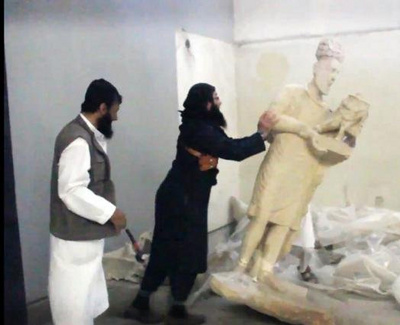
On Friday, February 27, 2015, the United Nations (UN) Security Council condemned “the deliberate destruction of irreplaceable religious and cultural artifacts housed in the Mosul Museum and burning of thousands of books and rare manuscripts from the Mosul Library” and having burned a few days earlier thousands of books from the Mosul, Iraq, University Library. The Mosul Museum which was not yet open to the public had a large number of statues from the pre-Islamic Mesopotamian civilizations as well as statues from the Greek Hellenistic period. The spokesman for the Islamic State (ISIS) faction which carried out the destruction − filmed and posted on the internet by them − maintained that the statues represented gods which had been worshipped while only the true god should receive worship.

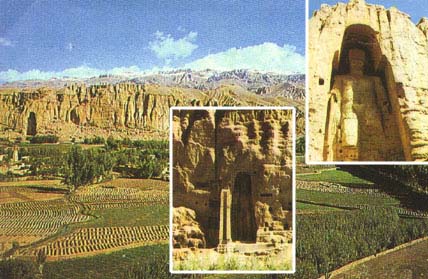
This approach to pre-Islamic faiths and their material culture is the same as had led to the destruction of the large Buddha statues in Afghanistan − monuments that attested to the rich culture along the Silk Road.

There have been iconoclastic movements in the past, especially among Muslims and early Protestants holding that the spiritual world cannot (and thus should not) be represented in forms. All forms lead to confusing the specific form with the spiritual formless energy behind it. The iconoclastic reasoning can be defended, but not the destruction of objects which represented other philosophies, cultures and levels of understanding. (1)

As if to drive home to the least philosophical in the area, the ISIS also attacked Assyrian Christian villages in the area; villages were emptied, persons taken as hostages and younger women forced into slavery. The Assyrian Christians are among the oldest of the Christian communities; some speak Aramaic, the language spoken at the time of Jesus.

The shameless destruction by ISIS members of historical treasures Iraq will never be able to get back.

The shameless destruction by ISIS members of historical treasures Iraq will never be able to get back.

There are world laws against slavery going back to the abolitionist movements of the 1800s and made universal by conventions of the League of Nations and the UN. These conventions are rarely cited except in discussions of the current trafficking of persons as a “modern form of slavery”. Now ISIS has given us examples of slavery in its old forms, nearly to the point of caricature. We need to dust off these conventions and see that they are applied.

Syria and Iraq are home to some of the world’s first cities, a complex and unique meeting of states, empires and faiths. The protection of works of art and cultural heritage is a newer aspect of world law in which UNESCO is playing a leading role. Until the filming and posting of the destruction in Mosul, the looting of museums in Apamea, Aleppo and Raqqa as well as numerous archaeological sites had been known to specialists but had not gained wide public attention. Most of the looted objects were not destroyed but sold on a parallel international art market to fill the ISIS coffers. There is a need to develop global awareness and to campaign against this illicit trade in looted Syrian and Iraqi artifacts which first pass through the neighboring countries of Lebanon, Turkey and Jordan before ending in the hands of dealers and small auction houses who also profit from the theft.

The protection of cultural heritage owes much to the vision and energy of the Russian artist Nicholas Roerich (1874-1947). Roerich’s desire to make known the artistic achievements of the past through archaeology, coupled with the need to preserve the landmarks of the past from destruction, led to his work for the Banner of Peace to preserve art and architecture in time of war. Roerich had seen the destruction brought by the First World War and the civil war which followed the 1917 Russian Revolution. He worked with French international lawyers to draft a treaty by which museums, churches and buildings of value would be preserved in time of war through the use of a symbol − three red circles representing past, present and future − a practice inspired by the red cross to protect medical personnel in times of conflict.

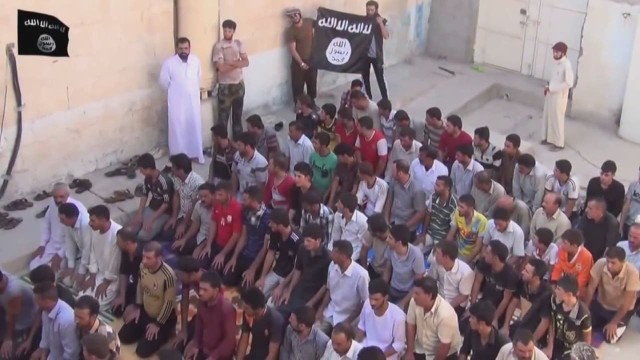
In the areas it has conquered, ISIS has established formal slavery, including for girls as sex slaves.

In the areas it has conquered, ISIS has established formal slavery, including for girls as sex slaves. (C) CNN

Roerich mobilized artists and intellectuals in the 1920s for the establishment of this Banner of Peace. Henry A. Wallace, the United States Secretary of Agriculture and later Vice-President, was an admirer of Roerich and helped to have an official treaty introducing the Banner of Peace − the Roerich Peace Pact − signed at the White House on April 15, 1935 by 21 States in a Pan-American Union ceremony. At the signing, Henry Wallace on behalf of the USA said “At no time has such an ideal been more needed. It is high time for the idealists who make the reality of tomorrow, to rally around such a symbol of international cultural unity. It is time that we appeal to that appreciation of beauty, science, education which runs across all national boundaries to strengthen all that we hold dear in our particular governments and customs. Its acceptance signifies the approach of a time when those who truly love their own nation will appreciate in addition the unique contribution of other nations and also do reverence to that common spiritual enterprise which draws together in one fellowship all artists, scientists, educators and truly religious of whatever faith.”

As Nicholas Roerich said in a presentation of his Pact “The world is striving toward peace in many ways and everyone realizes in his heart that this constructive work is a true prophesy of the New Era. We deplore the loss of the libraries of Louvain and Oviedo and the irreplaceable beauty of the Cathedral of Reims. We remember the beautiful treasures of private collections which were lost during world calamities. But we do not want to inscribe on these deeds any words of hatred. Let us simply say: Destroyed by human ignorance − rebuilt by human hope.”

After the Second World War, UNESCO has continued these efforts, and there have been additional conventions on the protection of cultural and educational bodies in times of conflict, in particular the Hague Convention of May 1954, though no universal symbol as proposed by Nicholas Roerich has been developed.

In 2001 Afghanistan's Taleban militia, an "early version" of ISIS, blew up the magnificent Buddha statues of Bamiyan, thinking this would help them strengthen their implacable grip on the country. This most unwise move only hastened their downfall.

In 2001 Afghanistan’s Taleban militia, an “early version” of ISIS, blew up the magnificent Buddha statues of Bamiyan, thinking this would help them strengthen their implacable grip on the country. This most unwise move only hastened their downfall. (C) RAWA

As too often, governments and people react after events rather than affirm from a deeper level of consciousness. Now, we have seen mindless but deliberate destruction of both art and people. Let us not inscribe on these deeds any words of hatred, but let us work unitedly and creatively to establish a just peace.

Prof. René Wadlow is President and Chief Representative to the United Nations Office at Geneva of the Association of World Citizens.

(1) A good overview of iconoclastic movements in the non-Muslim world see: Alain Besancon, L’Image interdite. Une histoire intellectuelle de l’iconoclasme (Paris: Gallimard, 1994, 722pp.)

Religious Liberty: Challenges and Tasks Ahead for Nongovernmental Organization Action

In Being a World Citizen, Conflict Resolution, Cultural Bridges, Current Events, Human Rights, International Justice, Religious Freedom, Solidarity, The Search for Peace, United Nations on February 2, 2015 at 4:21 PM

RELIGIOUS LIBERTY:

CHALLENGES AND TASKS AHEAD FOR NONGOVERNMENTAL ORGANIZATION ACTION

By René Wadlow

Every year, January 30 is a most appropriate day on which to reflect on issues of religious liberty and to the challenges facing us as members of nongovernmental organizations (NGOs) such as the Association of World Citizens (AWC). January 30 is the anniversary of the assassination of Mahatma Gandhi by Nathuram Godse, an agent of the semi-military militant Hindu organization RSS (Rashtriya Swayam-sevah Sangh). In the eyes of Godse, Gandhi was too tolerant of Muslims in the riots then going on at the time of independence and partition between India and Pakistan. Currently, the RSS is still very active trying to force with its militias Indian Christians to become Hindus. The RSS is backed by some factions within the Indian government. The RSS is a good example of the fact that efforts to destroy or limit strongly freedom of thought and religious liberty come from both governments and from religious organizations.

As the AWC has been very active on religious liberty issues within the United Nations (UN) human rights committees in Geneva, I will list briefly the types of challenges which we face and then mention UN standards which we can use in our efforts to promote religious liberty.

  • The first situation is when a State has a State Religion and persecutes minority religions within the country. An example is the Islamic Republic of Iran which has banned the Baha’i religion (which began in Iran) and persecutes its members.
  • The second situation is when a State has a State Religion and persecutes branches of that religion with which it disagrees: the Pakistan government persecution of the Ahmadi branch of Islam (which began in what is now Pakistan) is an example.
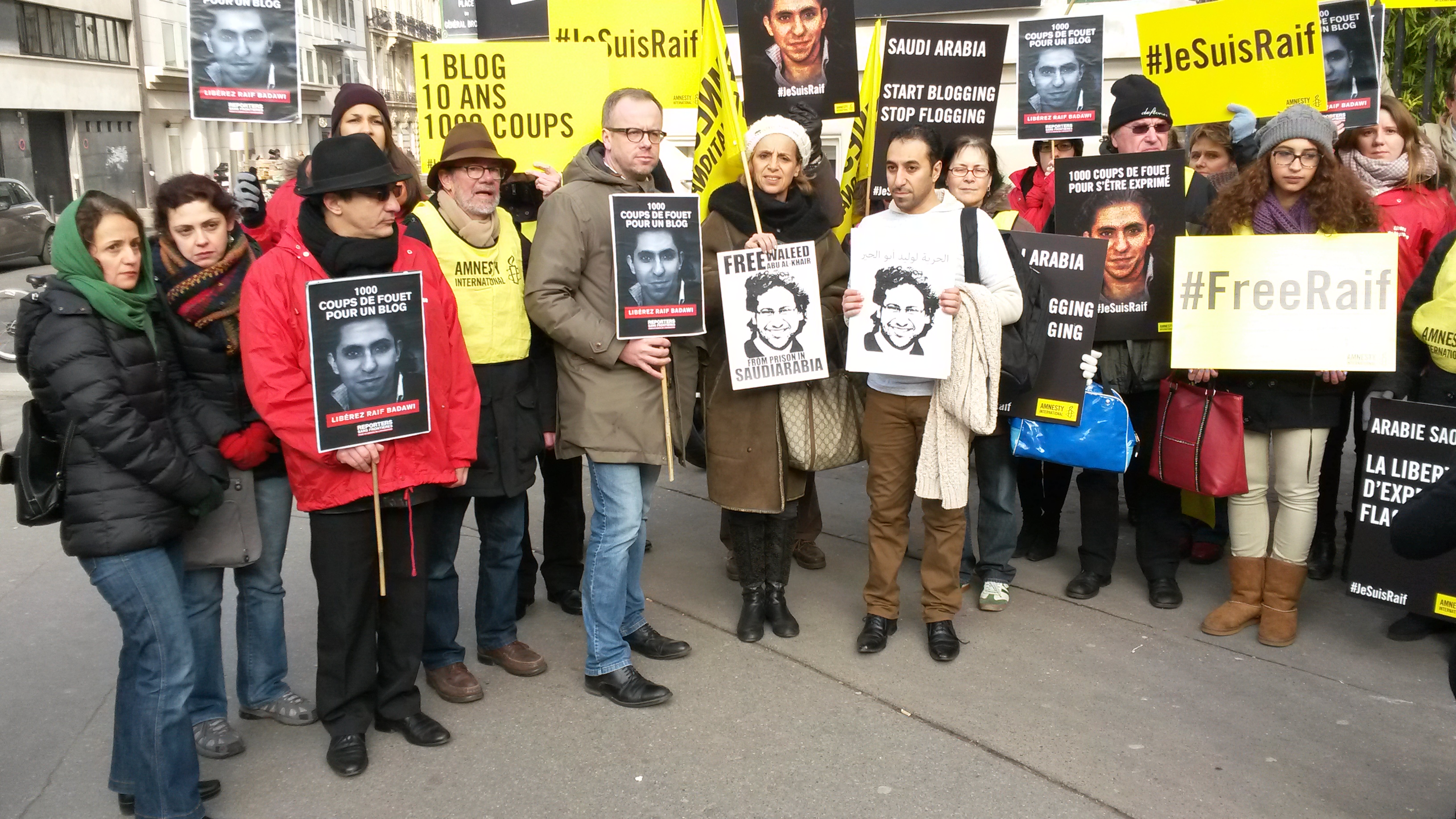
  • The third situation is when a State has a State Religion and persecutes those who wish to bring about reforms within that religion. A recent example is in Saudi Arabia where a young man posted on his Internet blog a plea to limit the powers of the “moral police” who try to enforce what the government considers “moral behavior” such as women not driving an auto. For his blog statement, Ralf Badawi was sentenced to 10 years in prison and 1,000 lashes of a whip (50 lashes in public each week during 20 weeks). The AWC’s External Relations Officer, Bernard Henry, was among those protesting this decision in front of the Saudi Embassy in Paris a few days ago in a demonstration led by Amnesty International.
  • The fourth situation is when a State has not State Religion and is against all religious movements and institutions in general. The Soviet Union from 1922 to 1942. In 1942, Stalin changed his policy to encourage religious people to fight the German invaders. Mainland China during the Cultural Revolution years and the Pol Pot government of Cambodia are examples of governments hostile to all religious movements.
  • The fifth situation: Armed movements which control some territory and who wish to create a State with a State Religion and who are hostile to religious minorities. The Islamic State in Iraq and Syria (ISIS) is a dramatic example of an armed movement which controls an area as large as France, partly in Iraq, partly in Syria. There are forced conversions to Islam and girls and women from minority religions are sold as slaves. The Boko Haram movement, active in nearly as large an area as France in northeast Nigeria, northern Cameroon, and part of Niger acts in the same way. Boko Haram and ISIS follow the same policy and ideology and cooperate when possible. We have very similar patterns, but on a smaller scale, in the Central African Republic where Christian militias have attacked Muslim communities so that the majority of Muslims have fled to neighboring countries. However, the Christian militias have not said that they wish to set up a State with Christianity as a State religion.
  • The sixth situation are States which have no State Religion but where there are popular, nongovernmental currents or movements against specific religions. France, Germany and Myanmar can be good examples. France, most recently after attacks against journalists of a satiric journal by two brothers of Muslim religion, has seen a relatively large number of people attacking Islamic institutions largely at night. In Germany, there is a movement which is holding large demonstrations against Muslims. The German government has been against these demonstrations but is limited in what sort of police actions it can take to prevent them. In Myanmar (Burma) although Buddhism was never officially proclaimed a State Religion, the military-led government favored Buddhist groups to such an extent that Buddhism could nearly be considered a State Religion. Currently there are Buddhist monk-led attacks against the Rohingyas − a Muslim minority − and the government has done nothing to prevent such attacks.
On January 23 Amnesty International France and Reporters Without Borders held a protest before the Saudi Arabian Embassy in Paris in support of blogger Raif Badawi. (C) Bernard J. Henry/AWC

On January 23 Amnesty International France and Reporters Without Borders held a protest before the Saudi Arabian Embassy in Paris in support of blogger Raif Badawi. (C) Bernard J. Henry/AWC

These six situations highlight violent situations in which religions are banned, followers killed, imprisoned, sold into slavery and living in fear of being attacked.

There are, of course, many examples of more subtle forms of discrimination, the use of tax policies, the non-recognition of a group as a religion, the banning of healing practices, images making fun of a religion etc. It is important to be aware of these more subtle forms. They need to be prevented, but they are less visible than the imprisonment of a person so they lead to fewer protests.

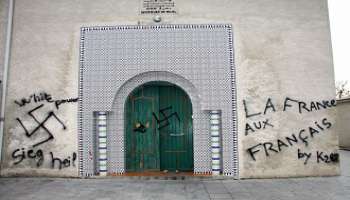
The front door of a mosque in France in 2009, covered by racist and neo-Nazi graffiti. Over the last five years anti-Islam acts have soared in the country, hitting an all-time high in the wake of the terror attack against the weekly satirical newspaper Charlie Hebdo of January 7, 2015. (C) Thierry Antoine/AFP

The front door of a mosque in France in 2009, covered by racist and neo-Nazi graffiti. Over the last five years anti-Islam acts have soared in the country, hitting an all-time high in the wake of the terror attack against the weekly satirical newspaper Charlie Hebdo of January 7, 2015. (C) Thierry Antoine/AFP

Universal Standards for Religious Liberty

The universal standard is set out in the Universal Declaration of Human Rights (Article 18) “Everyone has the right to freedom of thought, conscience and religion; this right includes freedom to change his religion or belief and freedom, either alone or in community with others and in public or private to manifest his religion or belief in teaching, practice, worship and observance.” Article 18 of the Universal Declaration is reaffirmed in Article 18 of the International Covenant on Civil and Political Rights but made stronger by adding “no one shall be subject to coercion which would impair his freedom to have or to adopt a religion or belief of his choice.” The Covenant was followed, after many years of discussion and debate in which the Association of World Citizens played an important role, with a UN General Assembly “Declaration on the Elimination of All Forms of Intolerance and of Discrimination Based on Religion or Belief” of November 25, 1981. This is a strong Declaration. I believe that such a strong and comprehensive statement would not be possible today given the coordinated strength of the Islamic States in opposition to the idea in the Declaration of being able to change one’s religion. Unlike the Covenant, the Declaration is not a treaty and so there is no institution to study the action of governments in the light of the Declaration. Nevertheless, the Declaration, relatively little known, should be widely quoted by NGOs working on religious liberty issues.

What Can Be Done Today?

Governments are relatively inactive − or not active at all − when it comes to States restricting religious liberty. We have seen these recent days government leaders going to Saudi Arabia to wish the new king well, as Saudi Arabia sells oil and buys arms from Western governments. Saudi Arabia is one of the most violent oppressors of religious liberty. Thus I would expect no action on the part of governments toward other governments.

However, we do see governmental action against nongovernmental militias who violate religious liberty. There is a coalition of States, led by the United States, England and France to bomb from the air positions of the ISIS in Iraq-Syria. That such bombing will transform the ISIS into liberal advocates of human rights seems to me unlikely.

Likewise the army of Chad has joined the army of Nigeria to fight Boko Haram. As the Nigerian and Chadian armies are best known for their practice of burning villages and raping women, their contribution to a society of respect and tolerance is to be doubted.

Thus, to sum up: the possibilities for the defense of religious liberty are few. There are norms and standards set by the United Nations: Article 18 of the Universal Declaration and the Covenant, and especially the Declaration on the Elimination of All Forms of Intolerance and Discrimination Based on Religion or Belief. Governments are basically unwilling to do anything in the UN even against the worst offenders. On the one hand governments need resources from the country − oil from Saudi Arabia − or they are more concerned with security issues of the country than with religious liberty issues − the case with Iran and North Korea.

If, as I believe, governmental action is useless and will make situations worse, what can NGOs do? One must not be discouraged. The challenges are great; the resources of NGOs are few. A worldwide erosion of religious freedom is causing large-scale human suffering, grave injustice and serious threats to world peace and security. Yet I believe that NGOs have through UN standards a clear set of international principles and standards to maintain. We must find ways for common action today.

Prof. René Wadlow is President of the Association of World Citizens.

UN Human Rights Protection: Small Steps, But No Turning Back

In Anticolonialism, Asia, Being a World Citizen, Conflict Resolution, Cultural Bridges, Current Events, Human Rights, International Justice, Middle East & North Africa, Solidarity, The Search for Peace, United Nations, War Crimes, World Law on September 7, 2014 at 10:11 PM

UN HUMAN RIGHTS PROTECTION: SMALL STEPS, BUT NO TURNING BACK

By René Wadlow


The effectiveness of United Nations (UN) action to promote human rights and prevent massive violations grows by small steps. However, the steps, once taken, serve as precedents and can be cited in future cases. Once the steps taken, it is difficult to refuse such action later.

Such small steps can be seen in the contrasting response to two situations:

1) The current situation in Iraq and Syria, in particular the areas held by the Islamic State (IS) and

2) The massacres and refugee flow from East Pakistan, now Bangladesh, in 1971.

I will contrast briefly the Special Session on Iraq held on September 1, 2014 in Geneva of the Human Rights Council with efforts at the Sub-Commission on Prevention of Discrimination and Protection of Minorities in August 1971 when I was among the representatives of nongovernmental organizations (NGOs) which had signed a joint appeal to the Sub-Commission for action in East Pakistan.

The September 1 Special Session stands out for two precedents which can be important:

1) The affirmation that non-State actors are bound to respect UN human rights standards;

2) The speedy creation of a UN Committee of Inquiry by using members of the UN human rights secretariat.

The massive violations of human rights in those parts of Iraq and Syria held by the IS is the first time that a major UN human rights body, the Human Rights Council or the earlier Commission on Human Rights, deals with an area not under the control of a State.

The diplomats working on a Special Session decided to focus only on Iraq. If Syria had been included, the actions of the Syrian government would have had to be considered as well.

Holding non-State actors responsible for violations of UN human rights norms is an important precedent and can have wide implications. The Declaration of the Eliminations of All Forms of Intolerance and Discrimination Based on Religion or Belief, adopted by the UN General Assembly on November 25, 1981 sets the standard − a standard repeatedly being violated by the forces of the IS.

Likewise, the speedy creation of a Committee of Inquiry is a major advance. The Human Rights Council in the past, following a practice of the earlier Commission on Human Rights, has created “Commissions of Inquiry” also called “Fact-finding Missions.” Currently there are four such Commissions at work:

1) Commission of Inquiry on Human Rights in the Democratic People’s Republic of Korea,

2) The Independent International Commission of Inquiry on the Syrian Arab Republic,

3) The OHCHR Investigation on Sri Lanka,

4) The Commission of Inquiry on Gaza.
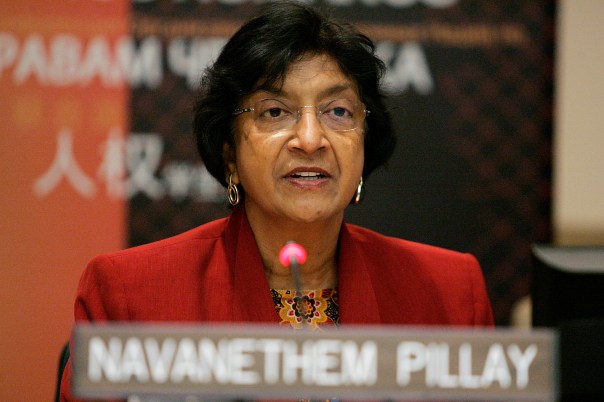
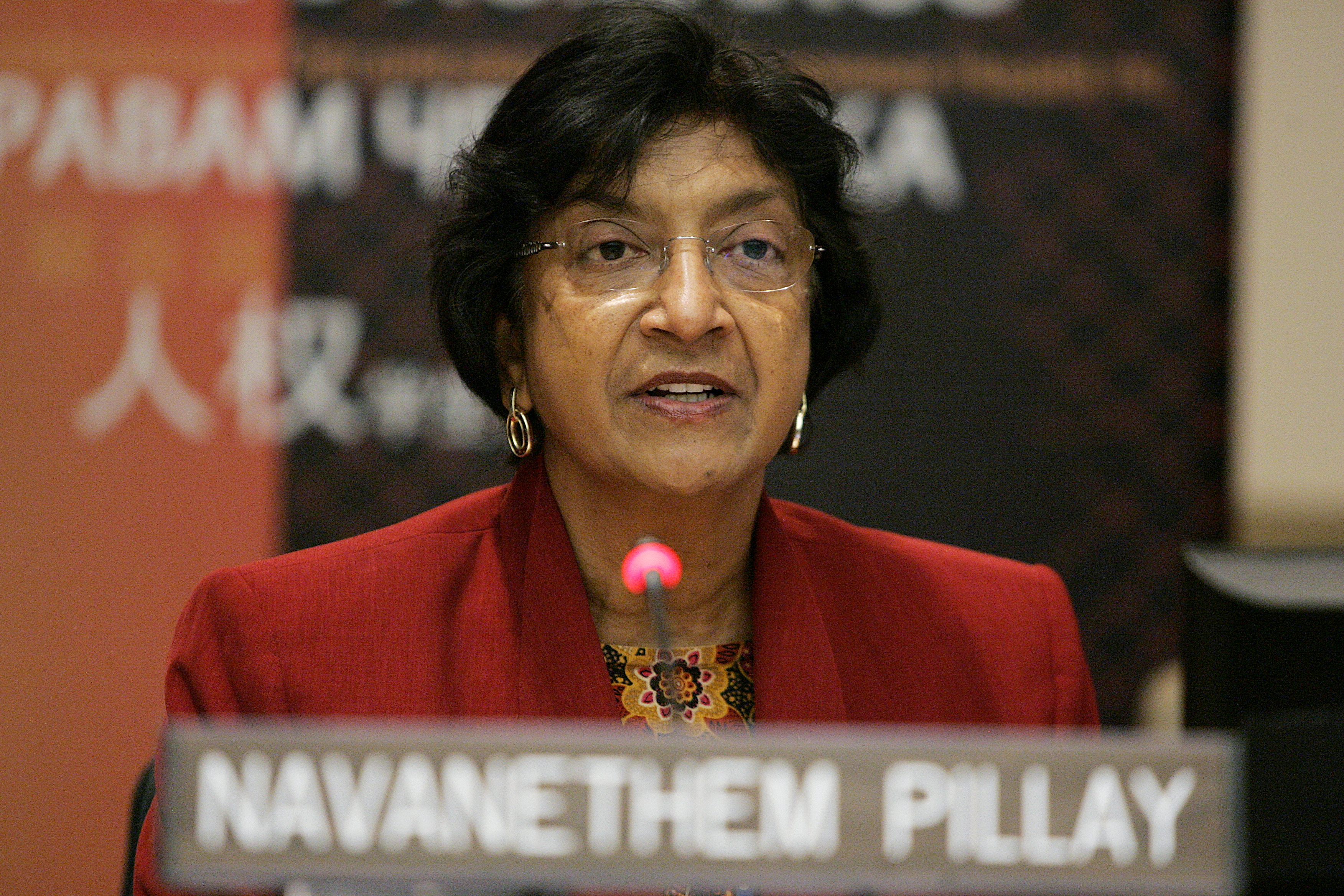
It was under Navanethem Pillay, who was the United Nations High Commissioner for Human Rights from 2008 to September 2014, that all of the existing four UN Commissions of Inquiry were created. The world has the former High Commissioner to thank for such valuable efforts in defense of human rights.

It was under Navanethem Pillay, who was the United Nations High Commissioner for Human Rights from 2008 to September 2014, that all of the existing four UN Commissions of Inquiry were created. The world has the former High Commissioner to thank for such valuable efforts in defense of human rights.

Each commission has three, sometimes four, members each from a different geographic zone. The members have usually had experience in UN activities, and the chair is usually someone who has a reputation beyond his UN efforts.

Since the commissions are usually not welcomed by the government of the country to be studies, the fact-finding is done by interviewing exiles and refugees. NGOs, scholars as well as governments can also provide information in writing. The commission reports rarely contain information that is not already available from specialized NGOs, journalists, and increasingly the Internet. However, the commission reports give an official coloring to the information, and some UN follow up action can be based on the reports.

It takes a good deal of time to put these commissions together as there must be regional balance, increasingly gender balance, as well as a balance of expertise. Moreover, the people approached to be a commission member are often busy and have other professional duties. It can sometimes take a month or more to put together a commission. In light of the pressing need presented by the situation in Iraq, it was decided that the members of the fact-finding group for Iraq would be members of the Secretariat of the Office of the High Commissioner for Human Rights so that they can get to work immediately.

For the UN, this is a major step forward and must have led to a good deal of discussion before the proposal was presented in the resolution. As it is, India and China objected publicly in official statements just before the final resolution was accepted. Both States maintained that using Secretariat members went beyond the mandate of the Office of the High Commissioner. They were worried by the increasing investigative role of the Office which should be limited only to helping develop national capacity building. Iraq today, Kashmir and Tibet tomorrow. The Indians and the Chinese are probably not the only governments worried, but they were the only States which spoke on the issue, Objecting strongly but saying they would not block consensus on the resolution.

In contrast to these steps: I had followed as closely as possible, from Geneva, the events in East Pakistan, having at one stage helped a representative of the Bangladesh opposition to speak to relevant diplomats in Geneva. Later, he became the Ambassador of Bangladesh to the UN in Geneva, and for a year was president of the Commission on Human Rights.

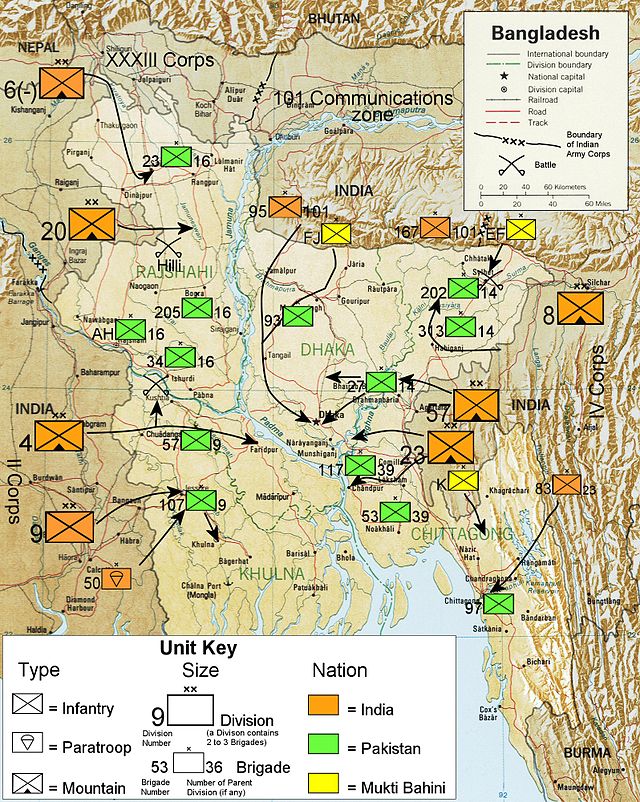
In December 1970, the Awami League led by Sheik Mujib Rahman won a majority of seats in the national assembly. The government of Pakistan refused to convene the national assembly, since it would result in shifting political power from West to East Pakistan. For three months, the government and the Awami League tried to negotiate a political settlement. On March 25, 1971, the government discontinued negotiations and unleashed the Pakistan army against the civilian population of East Pakistan. Hindus, members and sympathizers of the Awami League, students and faculty of the universities and women were especially singled out.

These atrocities continued until the Indian army which had been drawn into the conflict, in part by the large number of refugees that had fled to India, took control of Dacca on December 1, 1971.
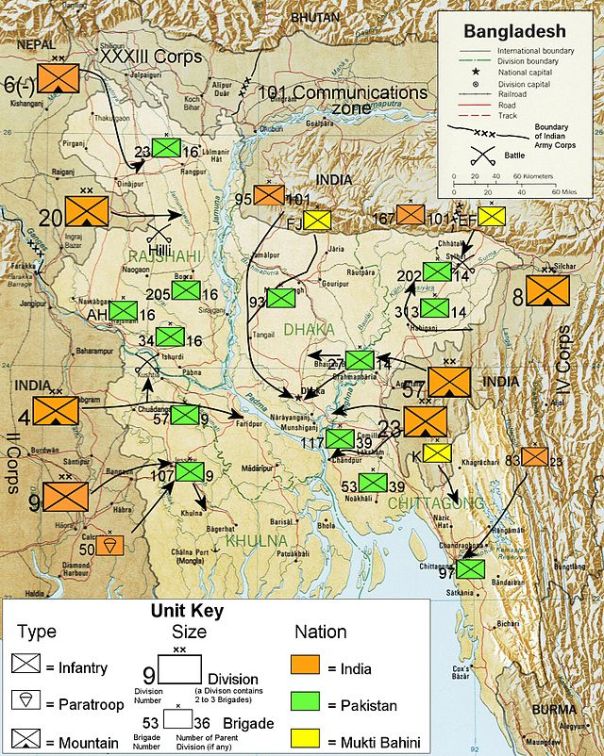
When India gained independence from Britain in 1947, the predominantly Muslim-inhabited parts of the former colony became a separate country called Pakistan. Originally a Dominion within the British Empire, Pakistan eventually established a republic of its own in 1956. In March 1971 the province of East Pakistan launched a war of independence, waged by an armed force called the Mukti Bahini, also called the Bengali Liberation Army, and the Indian military which came to the aid of the rebels. Eventually, in December 1971 Pakistani troops were defeated and East Pakistan became a sovereign nation with the name of Bangladesh.

When India gained independence from Britain in 1947, the predominantly Muslim-inhabited parts of the former colony became a separate country called Pakistan. Originally a Dominion within the British Empire, Pakistan eventually established a republic of its own in 1956.
In March 1971 the province of East Pakistan launched a war of independence, waged by an armed force called the Mukti Bahini, also called the Bengali Liberation Army, and the Indian military which came to the aid of the rebels. Eventually, in December 1971 Pakistani troops were defeated and East Pakistan became a sovereign nation with the name of Bangladesh.

The UN Security Council was unwilling or unable to deal with the human rights situations in East Pakistan. The U. S. government strongly supported the Pakistan army while the Soviet Union supported India. For NGO representatives our hopes rested on the Sub-Commission on the Prevention of Discrimination and Protection of Minorities which was to meet in Geneva from August 2 to 20, 1971. At the time, the Commission on Human Rights and the bulk of the human rights secretariat was still in New York. However, the Sub-Commission would meet in Geneva once a year, usually in July or August.

The Sub-Commission members were not diplomatic representatives of governments as was the Commission on Human Rights. Rather they were “independent experts”. The saying among NGOs was that some were more independent than others, and some were more expert than others. Most were professors of law in their countries − thus the August dates when universities were on vacation. It was easier to have informal relations with Sub-Commission members than with diplomats, and NGO representatives could get advice on the best avenues of action.

NGOs had two formal avenues of action. We could present written statements that were distributed as official documents, and we could make oral statements, usually 10 minutes in which to develop ideas and to call attention to additional elements in the written statement. Written statements could be that of a single NGO or, often to give more weight, there could be a “joint statement”. On the East Pakistan situation, with the violence being covered by the world media, it was decided to have a joint statement. The statement called upon the Sub-Commission “to examine all available information regarding allegations of the violation of human rights and fundamental freedoms in East Pakistan and to recommend measures which might be taken to protect the human rights and fundamental freedoms of the people of East Pakistan”. Twenty-two NGOs with representatives in Geneva signed the joint statement, and John Salzberg, a representative of the International Commission of Jurists, made an oral statement presenting the written joint statement.

Government representatives were always present in the room and had the right to make statements (and also to try to influence the independent experts behind the scene). Najmul Saguib Khan, the independent expert from Pakistan contended that the Sub-Commission could not consider East Pakistan since the UN role in human rights “did not extend to questions arising out of situations affecting the sovereignty and territorial integrity of Member States and that attention to such situations would encourage those seeking the dismemberment of Member States.” The Indian diplomat, N.P. Jain, replied highlighting the influx of eight million refugees into India.
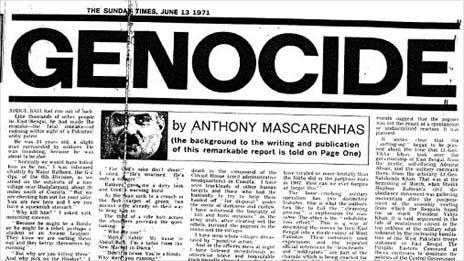
"On 13 June 1971, an article in the UK's Sunday Times exposed the brutality of Pakistan's suppression of the Bangladeshi uprising. It forced the reporter's family into hiding and changed history. (...) Written by Anthony Mascarenhas, a Pakistani reporter, and printed in the UK's Sunday Times, it exposed for the first time the scale of the Pakistan army's brutal campaign to suppress its breakaway eastern province in 1971. (...) There is little doubt that Mascarenhas' reportage played its part in ending the war. It helped turn world opinion against Pakistan and encouraged India to play a decisive role." (C) BBC News

“On 13 June 1971, an article in the UK’s Sunday Times exposed the brutality of Pakistan’s suppression of the Bangladeshi uprising. It forced the reporter’s family into hiding and changed history. (…)
Written by Anthony Mascarenhas, a Pakistani reporter, and printed in the UK’s Sunday Times, it exposed for the first time the scale of the Pakistan army’s brutal campaign to suppress its breakaway eastern province in 1971. (…)
There is little doubt that Mascarenhas’ reportage played its part in ending the war. It helped turn world opinion against Pakistan and encouraged India to play a decisive role.”
(C) BBC News

The Sub-Commission members took the “diplomatic way out” and said nothing. In drafting the report of the session, one member, Adamu Mohammed from Nigeria proposed deleting any reference to the discussion on East Pakistan. He held that the Sub-Commission had listened to, but had not considered the statements made by the representative of the International Commission of Jurists, the Sub-Commission member from Pakistan and the observer of India.

The NGO representatives were saddened by the lack of action but not totally surprised. No other UN human rights body took action, and the massacres stopped only after the ‘lightning war’ of India defeated the Pakistan army and occupied the country until a Bangladesh government could be set up.

There remains real danger that the situation in Iraq and Syria will continue through military means, but at least progress has been made within the UN in calling attention to conflicts within a State and holding all parties responsible for maintaining the standards of human rights.

Prof. René Wadlow is President of the Association of World Citizens.
Iraq: Yazidis’ Genocide?

In Cultural Bridges, Current Events, Human Rights, International Justice, Middle East & North Africa, Religious Freedom, Uncategorized, United Nations, War Crimes, World Law on August 11, 2014 at 7:05 PM

IRAQ: YAZIDIS’ GENOCIDE?

By René Wadlow


A mix of United States (U. S.) humanitarian airdrops of food and water to the stranded displaced people on Mount Sinjar as well as U. S. military air strikes against some of the positions of the Islamic State in Iraq and Syria (ISIS) has focused international attention on the area. The Christian Peacemaker Teams have had a group working toward human rights protection and reconciliation in the Iraq Kurdistan for some years and are now posting daily updates on their website and Facebook [i].

I will not deal here with the broader issues of the impact of the ISIS on the possible geographic fragmentation and re-structuring of Iraq and Syria.

As a Nongovernmental Organization (NGO) representative to the United Nations, Geneva, and active on human rights issues, I had already raised the issues of two major religious minorities in Iraq at the UN Commission on Human Rights: the Yazidis and the Mandaeans. Here I ask if their fate can be identified as genocide under the 1948 Convention for the Prevention and Punishment of the Crime of Genocide. My concern with the Yazidi (also written as Yezidi) dates from the early 1990s and the creation of the Kurdish Autonomous Region. Many of the Yazidis are ethnic Kurds, and the government of Saddam Hussein was opposed to them not so much for their religious beliefs but rather that some Yazidis played important roles in the Kurdish community seen as largely opposed to the government. The Yazidis also had some old ownership claims on land on which oil reserves are found in northern Iraq.

My concern with the Mandaeans (also written as Sabean-Mandeans) came in the early 2000s after the U. S. invasion when the Mandaeans were persecuted as being supporters of Saddam Hussein and most fled to Syria. A word about the faiths of the two groups which helps to explain their special status. Although both are called “sects” and are closed religious communities which one can only enter by birth, they are faiths even if the number of the faithful is small.

The Mandaeans are a religious group formed in the first centuries of the Common Era in what is now Israel-Palestine-Jordan. Over time, they migrated to southern Iraq in the area of Basra as well as to what is now the Islamic Republic of Iran. One of their distinctive signs is the frequent purification by running water − baptism. They honor John the Baptist, described in the Christian Gospel of Luke, but are probably not direct descendents of his followers. At the time of John and Jesus, there were a good number of movements which had purification by water as one of their rituals. The Mandaean scripture The Book of John is probably a third-century collection. The Book of John was used in Mandaean rituals and services but was never published to be read by others. Given intellectual and historic interest in the Mandaeans, the Mandaean leadership authorized the publication of their scriptures. As a sign of respect, the first printed copy was given to Saddam Hussein as President of the country. In the confused situation after the U. S. occupation of Iraq, the book presentation was enough to have some accuse the Mandaeans of being Saddam Hussein supporters. Under increasing pressure, the vast majority of Mandaeans left Iraq for Syria (the frying pan into the fire image). Now they are caught in the Syrian civil war, unable or unwilling to return to Iraq. A small number of Mandaeans have been granted refugee status in the US and Western Europe.

There has been some intellectual mutual interplay among the Mandaeans and the Yazidis, but they are separate faiths and located in different parts of Iraq. The structure of the Yazidi worldview is Zoroastrian, a faith born in Persia proclaiming that two great cosmic forces, that of light and good, and that of darkness and evil are in constant battle. Man is called upon to help light overcome evil.

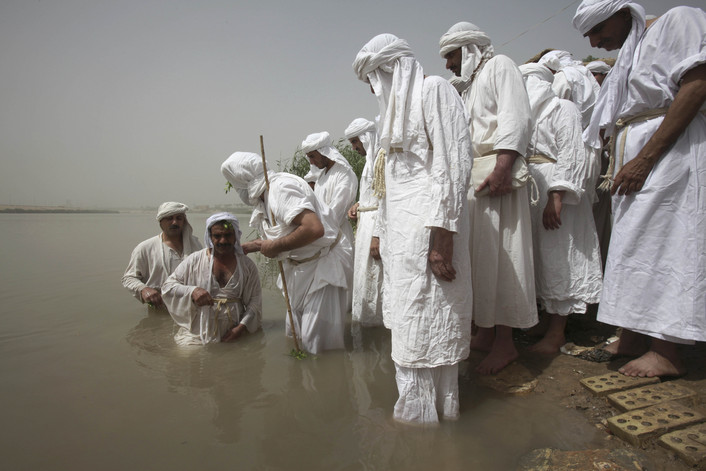
Sabean Mandeans perform baptisms for the faithful, in Iraq's Tigris River. (C) The Washington Post

Sabean Mandeans perform baptisms for the faithful, in Iraq’s Tigris River.
(C) The Washington Post

However, the strict dualistic thinking of Zoroastrianism was modified by another Persian prophet, Mani of Ctesiphon in the third century CE who had to deal with a situation very close of that of ours today. Mani tried to create a synthesis of religious teachings that were increasingly coming into contact through travcl and trade: Buddhism and Hinduism from India, Jewish and Christian thought, Helenistic Gnostic philosophy from Egypt and Greece as well as many smaller, traditional and “animist” beliefs. He kept the Zoroastrian dualism as the most easily understood intellectual framework, though giving it a somewhat more Taoist (yin-yang) flexibility, Mani having traveled in China. He developed the idea of the progression of the soul by individual effort through reincarnation − a main feature of Indian thought combined with the ethical insights of Gnostic and Christian thought. Unfortunately, only the dualistic Zoroastrian framework is still attached to Mani’s name − Manichaeism. This is somewhat ironic as it was the Zoroastrian Magi who had him put to death as a dangerous rival.

Within the Mani-Zoroastrian framework, the Yazidi added the presence of angels who are to help man in his constant battle for light and good, in particular Melek Tawis, the peacock angel. Although there are angels in Islam, angels that one does not know could well be demons, and so the Yazidis are regularly accused of being “demon worshipers” [ii].

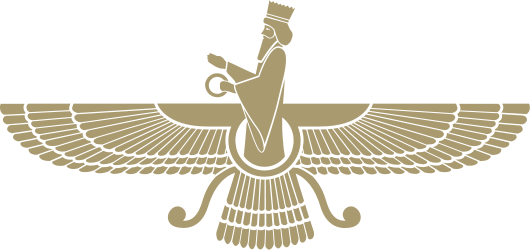
The faravahar is one of the best-known symbols of Zoroastrianism, the state religion of ancient Iran.

The faravahar is one of the best-known symbols of Zoroastrianism, the state religion of ancient Iran.

With the smaller Mandaean faith, originally some 60,000 people, now virtually destroyed in Iraq and unable to function effectively in Syria, the idea of ridding a country of the near totality of a faith is not for the ISIS an “impossible dream”. There are probably some 500,000 Yazidis in Iraq. Iraq demographic statistics are not fully reliable, and Yazidi leaders may give larger estimates by counting Kurds who had been Yazidis but had been converted to Islam. There had been some 200,000 Yazidis among the Kurds of Turkey but now nearly all have migrated to Western Europe, Australia and Canada.

Already in the last days, some 150,000 Yazidis have been uprooted and have fled to Iraqi Kurdistan. Thus most Yazidis could be pushed into an ever-smaller Kurdish-controlled zone of Iraq and Syria. The rest could be converted to Islam or killed. The government of the autonomous Kurdish region of Iraq has done little (if anything) to help the socio-economic development of the Yazidis, probably fearing competition for the Kurdish families now in control of the autonomous Kurdish government and society. Now the Kurdistan government and civil society groups are stretched well beyond capacity with displaced persons from Iraq and Syria.

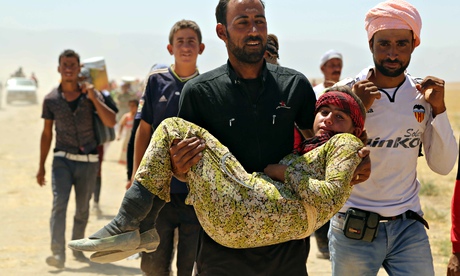
Thousands of Yazidis previously trapped by Isis have been rescued by Kurdish peshmerga forces. (C) Anadolu Agency/Getty Images

Thousands of Yazidis previously trapped by Isis have been rescued by Kurdish peshmerga forces.
(C) Anadolu Agency/Getty Images

If one is to take seriously the statements of the ISIS leadership, genocide − the destruction in whole or in part of a group − is a stated aim. The killing of the Yazidis is a policy and not “collateral damage” from fighting. The 1948 Convention for the Prevention and Punishment of the Crime of Genocide allows any State party to the Convention to “call upon the competent organs of the United Nations to take such action under the Charter of the United Nations as they consider appropriate for the prevention and suppression of acts of genocide.” Thus far no State has done so by making a formal proposal to deal with the Convention.

With the incomplete evidence at hand, I would maintain that the ISIS policy is genocide and not just a control of territory. Although the UN “track record” of dealing with genocide is very mixed, the first immediate step is for a State to raise the issue within the UN in order to set a legal approach in motion [iii].

Prof. René Wadlow is President of the Association of World Citizens.
 

[i] See the website of the Christian Peacemaker Teams: www.cpt.org.

[ii] A Yazidi website has been set up by Iraqis living in Lincoln, Nebraska. The website is uneven but of interest as a self presentation: www.yeziditruth.org.

[iii] See the very complete study: William A. Schabas, Genocide in International Law (Cambridge Univesity Press, 2000).

Tribal Societies: Survival and Transformations

In Being a World Citizen, Cultural Bridges, Current Events, Environmental protection, Foundations for the New Humanism, Human Development, Human Rights, International Justice, Solidarity, The Search for Peace, United Nations, World Law on August 9, 2014 at 10:46 AM

TRIBAL SOCIETIES: SURVIVAL AND TRANSFORMATIONS

by René Wadlow


August 9 has been chosen by the UN General Assembly as the International Day of the World’s Indigenous Peoples.

As Paulo Freire has written, “While both humanization and dehumanization are real alternatives, only the first is man’s vocation. This vocation is constantly negated. It is hindered by injustice, exploitation, oppression, and the violence of the oppressors; it is affirmed by the yearning of the oppressed for freedom and justice, and by their struggle to recover their lost humanity.

The world society is filled with many different types of collective actors: clans, tribes, castes, ethnic groups, cities, races, social classes, religious organizations, nation-states, multi-state alliances for military or economic goals, transnational corporations and associations. Each is the creation of individuals who have grouped together − or have been grouped together − to achieve goals considered common to the group’s members. All such collective groups have techniques to socialize new members to share the common values, to accept the ideology and beliefs of the tribe, the nation-state or the association. This socialization process goes so deeply that a person’s sense of identity becomes associated with these collective identity, the school, the army, the church, the political process and institutions − each propose a sense of group purpose.

Yet none of these groups is static and unchanging. Even clans and tribes whose members often consider that they have a common ancestor do, in fact, change. Tribes merge and divide; new identities are formed; new ancestors are created to justify the new groupings.

Some types of collective belonging are more easily left than others. One can move relatively easily from a city and take on the character, the values and the goals of a new city. Social mobility can produce changes in social class, and even caste lines become blurred. Persons change nationality or acquire new nationalities as frontiers are modified. Race is less easily changed but definitions of what constitutes a race do change. Ethnic identity is often associated with birth, but parents can belong to different ethnic communities, although the child is usually raised as belonging to the more dominant group. However the socialization process of group identity goes to the level of sub-conscious behavior and is not easily set aside.

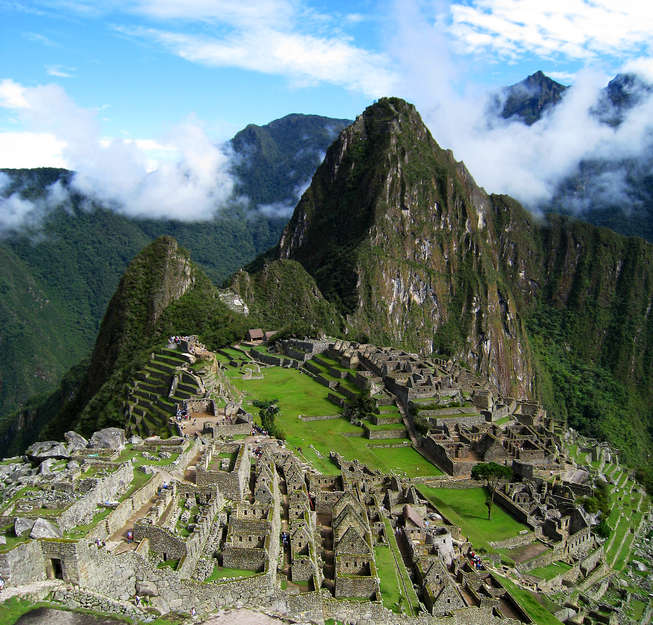
In Peru, some tribes remain uncontacted. Some live no more than 100 kms from the legendary mountain site of Machu Picchu. Today, however, the future of these tribes who live in the heartland of the ancient Inca Empire is threatened by a gas project. (C) Survival International

In Peru, some tribes remain uncontacted. Some live no more than 100 kms from the legendary mountain site of Machu Picchu. Today, however, the future of these tribes who live in the heartland of the ancient Inca Empire is threatened by a gas project. (C) Survival International

Today the nation-state claims to be the dominant collective association − setting the boundaries of loyalty and identity. The State claims the right to set out the major collective goals and values. Through laws, the State claims the right to set out the rules by which other collective entities may pursue their goals; through taxation the State draws the resources to further the goals it has set, and the State claims to have the only legitimate use of violence to punish those who break the laws and rules it has set.

There have always been tensions between these collective groups for their spheres of goal-setting and value-setting have overlapped. Thus there have been tensions between religious organizations and the State as to who should set what goals and the means to achieve these goals. There have also been tensions between economic classes and the State when it was felt that the State was dominated by another economic class who used its power within State institutions not for the good of all but only to advance class interests. The same is true of other collective units − races or ethnic groups − excluded from power within State institutions.

Today in many parts of the world those most excluded from power within State institutions are people living in alternative structures of authority, goal-setting and rule-making: persons living in tribal societies.

Tribal societies predated most of today’s nation-state. A tribal society usually has all the same functions as the nation-state: it sets out membership, loyalties, common goals and rules of behavior. It has sanctions against those breaking the laws of the tribe and has − or had − the monopoly of the legitimacy of using violence against those breaking the laws. Tribes are, in fact, more realistically “nation-states” if one defines nation as a common language, a common history and a common will to act together.

Thus because the tribal society is the closest in function to that of the nation-state, it is also the most feared. Tribes are institutions with whom it is difficult to compromise because they have the same pretensions as the State. It is relatively easy for a government to offer higher wages to the industrial worker or higher prices to the farmer as these social classes do not claim to carry out an alternative way the functions of the State. It is more of a challenge to the State’s image of its role to allow tribal societies to set out a land policy or fishing rights or trans-frontier trading rights because these activities conflict directly with the functions that the government has set for itself.

Thus there has been a long history of the State destroying alternative institutions of governance on its territory. The nation-states of Europe were built upon the ruins of feudal institutions; much of Asia on the destruction of local rulers. We see the pattern today as we watch traditional chiefs in Africa lose their authority to the heads of State and the military. In the Americas, many of the indigenous tribal societies were destroyed. Others were pushed into areas that those who controlled the government did not want − the “reservations” of the USA and Canada.

In Latin America and Asia, there is still active struggle going on between those trying to preserve their tribal institutions and homelands and the State which claims complete authority over all its territory and who often wished to put new settlers on tribal lands.

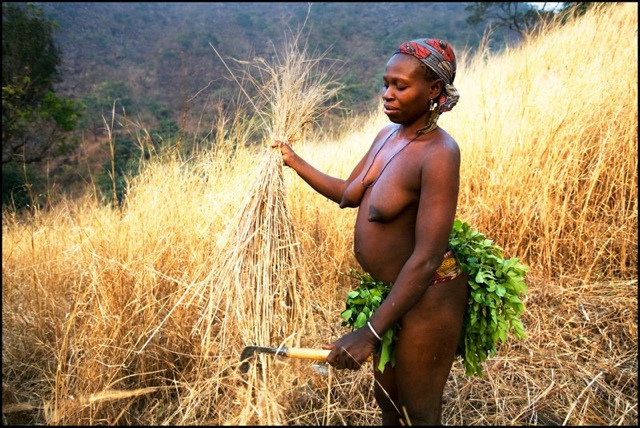
A Koma tribe woman at her farm. Alantika Mountain, Cameroon. (C) Middle Africa The Koma people are indigenous hill-dwelling people occupying the Alantika Mountains in northern Adamawa State, Nigeria and in Northern Cameroon (Faro National Park), near the border with Adamawa State.

A Koma tribe woman at her farm. Alantika Mountain, Cameroon. (C) Middle Africa
The Koma people are indigenous hill-dwelling people living in the Alantika Mountains in northern Adamawa State, Nigeria and in Northern Cameroon (Faro National Park), near the border with Adamawa State.

The amount of violence and suffering is considerable. Slowly, the fate of tribal societies has come to the attention of the United Nations (UN). The UN was set up to facilitate relations among nation-states. However, because wide-spread violations of individual rights had been one of the consequences of the Second World War, a Universal Declaration of Human Rights was drafted and proclaimed by the UN General Assembly in December 1948. The aim of the Declaration is to stress the rights of the individual − a natural consequence of the philosophy of the drafters. The rights of collective bodies which the drafters knew were also protected: trade unions, churches, professional associations. However tribal societies were not particularly thought of as one sees by reading the drafting negotiations. Thus, the Universal Declaration protects the rights of all individuals − including, of course, individuals living in tribal societies − but there is no direct recognition of the functions of tribal societies.

Thus for many years, indigenous and tribal peoples were the forgotten stepchildren of the UN system dealing with human rights. Yet they needed protection at least as much as those on whom the political limelight had focused. The situation began to change with the publication by the International Labor Organization’s study Indigenous Peoples: Living and working conditions of aboriginal populations in independent countries (1953). This was followed by the study by Jose Martinez Cobo Study of the Problem of Discrimination Against Indigenous Populations of the UN Commission on Human Rights (1986). While the Cobo study was being written, a Working Group on Indigenous Populations was set up under the then-existing Sub-Commission on Prevention of Discrimination and Protection of Minorities under the dynamic leadership of Erica-Irene Daes.

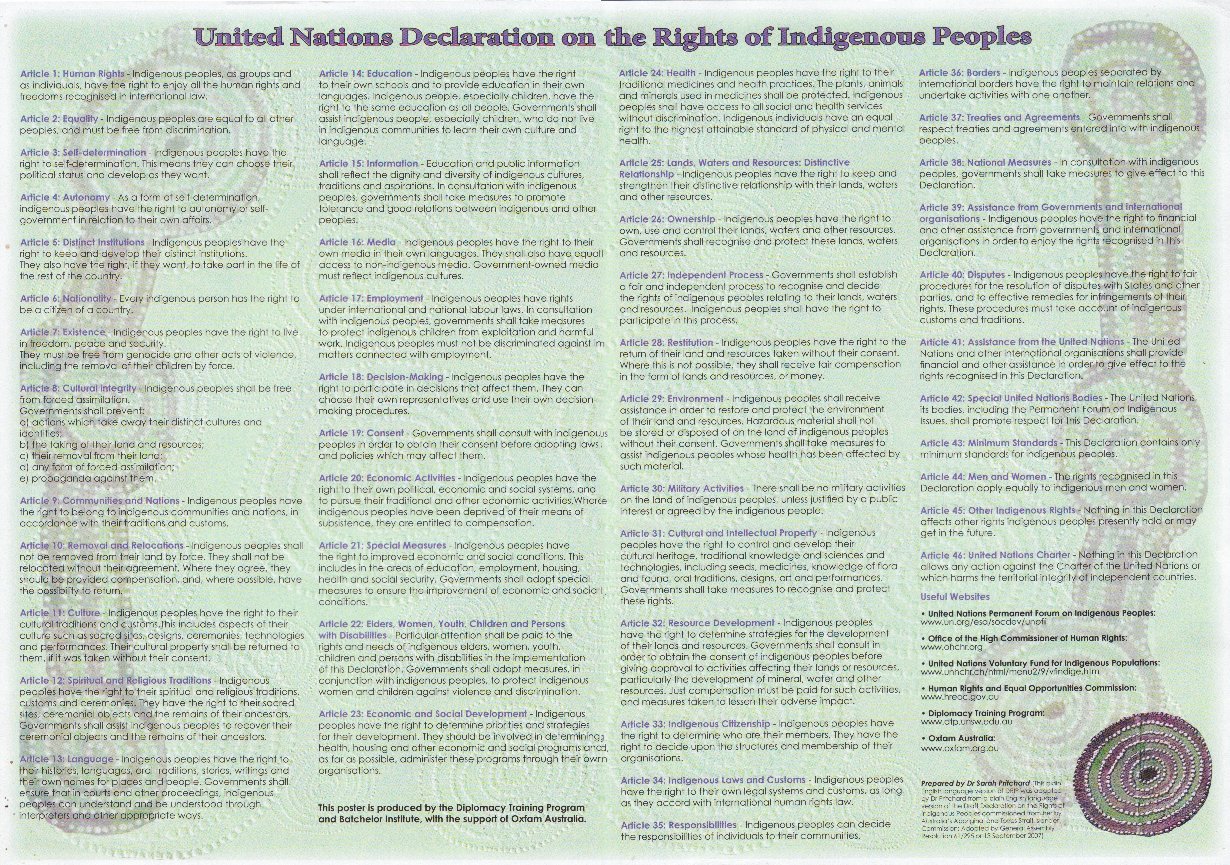
The United Nations Declaration on the Rights of Indigenous Peoples, a document that was long awaited by indigenous peoples and their defenders throughout the world.

The United Nations Declaration on the Rights of Indigenous Peoples, a document that was long awaited by indigenous peoples and their defenders throughout the world.

From the Working Group, with a good deal of interaction with the representatives of Nongovernmental Organizations and tribal groups came a United Nations Declaration on the Rights of Indigenous Peoples (A61/295) in 2007 after some 20 years of efforts. The Declaration sets out a useful framework for action. A UN Permanent Forum on Indigenous Issues has been created and meets once a year in New York. Conditions “on the ground” change slowly but there is now a UN institutions where issues can be raised. It is still the task of non-government organizations and tribal groups to continue to draw attention and to seek cooperation with governments.

See the useful Making the Declaration Work published by the International Work Group for Indigenous Affairs (Copenhagen) available on their website: www.iwgia.org.


********************************************************************


Prof. René Wadlow is President of the Association of World Citizens.
Lettre au Ministre des Affaires Etrangères de la République française

In Anticolonialism, Being a World Citizen, Children's Rights, Conflict Resolution, Cultural Bridges, Current Events, Human Rights, International Justice, Middle East & North Africa, Solidarity, The Search for Peace, United Nations, War Crimes, World Law on July 30, 2014 at 9:07 PM

awc-un-geneva-logo

ASSOCIATION OF WORLD CITIZENS

ASSOCIATION DES CITOYENS DU MONDE


The External Relations Desk


Monsieur Laurent FABIUS

Ministre des Affaires Etrangères de la République française

Ministère des Affaires Etrangères

37 Quai d’Orsay

75700 PARIS


Le 25 juillet 2014


Monsieur le Ministre,

En tant qu’Organisation Non-Gouvernementale dotée du Statut Consultatif auprès de l’ONU et active à ce titre au sein du Conseil des Droits de l’Homme, l’Association of World Citizens (ci-après, AWC) tient à vous exprimer sa plus vive préoccupation quant aux positions adoptées par la République française au sujet des actuels événements violents et tragiques au Proche-Orient.

Depuis que l’Etat d’Israël a lancé, à travers la Force de Défense israélienne (ci-après, Tsahal), une opération dénommée « Gardiens de nos Frères », en réaction à l’enlèvement et l’assassinat, non élucidés à ce jour, de trois jeunes Israéliens originaires des colonies le 12 juin dernier, complétée par une autre opération de Tsahal portant pour sa part le nom de « Bordure de protection », celle-ci en réponse aux tirs de roquettes depuis la Bande de Gaza, votre pays exprime des positions favorables au seul Etat d’Israël, cependant que la population civile palestinienne de Gaza en semble oubliée.

Autant l’AWC ne peut que partager la méfiance des autorités françaises quant aux manières de faire avérées et intentions probables du Mouvement de la Résistance islamique (ci-après, Hamas), lequel contrôle la Bande de Gaza depuis sept ans, autant, pour une organisation telle que la nôtre qui a toujours dénoncé les atteintes aux Droits de l’Homme et appelé au respect de la dignité humaine sans considération de frontières, pas même de celles séparant l’Etat hébreu du Hamas ou de l’Autorité palestinienne, cette position de la part de la France est purement et simplement incompréhensible.

En particulier, nous ne pouvons pas nous expliquer que la France ait choisi, lors du vote du 22 écoulé au Conseil des Droits de l’Homme d’une résolution sur le respect du droit international dans les Territoires palestiniens occupés, de s’abstenir. Sachant quelle est l’histoire de la France au Proche-Orient, notamment à quel point votre pays s’est souvent distingué comme un interlocuteur hors pair entre les uns et les autres des belligérants, nous y voyons une occasion manquée d’aider à affirmer le principe de justice internationale et de favoriser un retour à la recherche de la paix.

Ensuite, l’AWC ne peut qu’attirer votre attention sur le rôle que joue inéluctablement la France dans le bombardement de zones civiles dans la Bande de Gaza, de par son statut de cinquième exportateur mondial d’armement à l’Etat d’Israël.

Selon le Quinzième Rapport de l’Union européenne sur les Autorisations d’Exportation d’Armes, pour la seule année 2012, votre pays a délivré des autorisations d’exportations à Tel Aviv pour plus de 200 millions d’euros.

A ce jour, plus de cinq cents Palestiniens ont été tués dans des attaques par les forces israéliennes, la grande majorité d’entre eux étant des civils, dont des femmes et des enfants. Du côté de l’Etat d’Israël, deux civils ont été tués ainsi que dix-huit membres de Tsahal.

L’AWC entend vous rappeler, à cet égard, la déclaration de Madame Navi PILLAY, Haute Commissaire des Nations Unies pour les Droits de l’Homme, rappelant aux parties en conflit à Gaza l’obligation qui leur est faite de se conformer aux principes de distinction, de proportionnalité et de précaution des attaques afin d’éviter les dommages civils, les exhortant au surabondant à mener des enquêtes promptes, indépendantes et sérieuses sur les allégations de violation du droit international.

A cette fin, il incombe à chaque pays du monde, plus particulièrement encore aux Membres Permanents du Conseil de Sécurité de l’ONU, de prendre en compte toutes les souffrances causées par ce conflit et de manière juste, non l’une plutôt que l’autre, ainsi que de tarir à la source la possibilité pour l’une ou l’autre des deux parties de faire perdurer le conflit, bien entendu en termes d’armement.

Seul l’avènement d’un système viable de droit mondial peut fournir le cadre travail propre à la création d’une société mondiale qui soit tout à la fois juste et pacifique. En tant que Citoyens du Monde, nous travaillons au renforcement du droit mondial ainsi que de son acceptation, de son fonctionnement ainsi que d’un système d’observation et de sanctions ô combien nécessaire en pareil cas.

C’est pourquoi nous sommes certains que votre Gouvernement ne manquera pas d’entreprendre tous les efforts afin,

D’une part,

– de condamner publiquement et fermement les attaques menées par Israël à l’encontre des Palestiniens tout autant qu’il condamne, à juste titre, les tirs de roquettes sur Israël en provenance de la Bande de Gaza,

– de soutenir dans les faits, malgré le vote français au Conseil des Droits de l’Homme, la création par les Nations Unies d’une mission d’enquête internationale qui soit chargée de faire la lumière sur les violations du droit international humanitaire et du droit international des Droits de l’Homme commises par les différentes parties depuis le 12 juin 2014,

D’autre part,

– de suspendre immédiatement toutes les livraisons de matériel militaire à l’Etat d’Israël et toute autorisation d’exportation délivrée en ce sens,

– d’œuvrer au Conseil de Sécurité pour un embargo général sur les armes à destination d’Israël, du Hamas et des groupes armés palestiniens, avec obligation préalable à toute fin à celui-ci de voir éliminé tout risque substantiel de voir ces armes utilisées pour commettre ou faciliter des violations graves du droit international humanitaire et du droit international des Droits de l’Homme.

Nous vous remercions par avance de mettre ainsi la France en conformité avec les normes internationales de Droits de l’Homme telles que définies par l’ONU, et ce faisant de rendre à votre pays le statut particulier que lui a depuis toujours conféré l’histoire dans la défense de ces droits au Proche et Moyen-Orient.

Nous vous prions de croire, Monsieur le Ministre, en l’assurance de notre haute considération.


Prof. René Wadlow

Président


Bernard Henry

Officier des Relations Extérieures


Cherifa Maaoui

Officier de Liaison

Afrique du Nord & Moyen-Orient


Noura Addad, Avocat

Officier juridique

Attack on Gaza: Letter to the President of the UN Security Council

In Anticolonialism, Conflict Resolution, Cultural Bridges, Current Events, Human Development, Human Rights, International Justice, Middle East & North Africa, Solidarity, The Search for Peace, United Nations, War Crimes, World Law on July 15, 2014 at 7:24 PM

-- AWC-UN Geneva Logo --

ASSOCIATION OF WORLD CITIZENS

THE EXTERNAL RELATIONS DESK


July 14, 2014


H. E. Mr. Eugène-Richard Gasana

Ambassador, Permanent Representative

of the Republic of Rwanda

to the United Nations

President of the United Nations Security Council


Excellency:

The Association of World Citizens (AWC), a Nongovernmental Organization in Consultative Status with the United Nations Economic and Social Council (ECOSOC), has been concerned with the status of Gaza as well as the broader Israel-Palestine context.

The current manifestations of violence are part of a recurrent cycle of violence and counter-violence with which You are familiar.

The AWC believes that there must be a sharp break in this pattern of violence by creating institutions of security, development, and cooperation. Such a break requires more than the ceasefire proposed by the Security Council. The Association believes that longer-lasting measures must be undertaken that will allow new patterns of understanding and cooperation to be established.

In an earlier United Nations (UN) discussion of Gaza tensions, the AWC had proposed in a written statement to the Human Rights Council, “Human Rights in Gaza: Need for a Special Focus and Specific Policy Recommendations” (A/HRC/S-12/NGO-1, October 14, 2009; see attached copy) that a Gaza Development Authority be created – a transnational economic effort that would bring together the skills, knowledge and finance from Gaza, Israel, the Palestinian Authority on the West Bank, and Egypt to create conditions which would facilitate the entry of other partners.

Our proposal was obviously inspired by the Tennessee Valley Authority (TVA) of the “New Deal” in the USA. The TVA was a path-making measure to overcome the deep economic depression of the 1930s in the USA and the difficulties of cooperative action across state frontiers in the federal structure of the USA.

Today, the deep divisions in the Israel-Palestine area require more than economic measures – although economy and raising the standards of living remain important elements. Today, there should be a structure that provides security as well as economic advancement.

Therefore, the AWC would like to propose the creation of an International Temporary Transition Administration for Gaza that would promote security, stabilization, economic development, and institution building. Such a Transitional Administration would be limited in time from the start, perhaps five years.

Unlike the earlier UN Trusteeship agreements which followed upon the League of Nations mandate pattern, the Gaza Transitional Authority would welcome civil society cooperation from outside the area.

Such a Transitional Administration cannot be imposed. We believe that the Members of the Security Council can raise the possibility publicly, request a UN Secretariat study on what such a Transitional Administration would require, and encourage’ discussion among those most directly involved.

As Jean Monnet, one of the fathers of the European Common Market, had said, “Men take great decisions only when crisis stares them in the face.” We believe that the current violence is such a time of crisis. Our hope is that the Members of the Security Council are prepared to take great decisions.

Please accept, Excellency, the assurance of our highest consideration.


Prof. René Wadlow

President


Bernard Henry

External Relations Officer


Iraq: What does one do with the broken pieces?

In Anticolonialism, Conflict Resolution, Cultural Bridges, Current Events, Democracy, Human Rights, Middle East & North Africa, The Search for Peace, United Nations, War Crimes, World Law on June 23, 2014 at 9:31 PM

IRAQ: WHAT DOES ONE DO WITH THE BROKEN PIECES?

By René Wadlow


There is the legendary sign in shops selling china and porcelain “Do not touch; If you break it, you buy it”. The same sign should have been hung at the entry to Baghdad rather than portraits of Saddam Hussein. With Iraq in armed confusion as sectors of the country change side, and the Iraqi government seems incapable of an adequate response other than to call for military help, as concerned world citizens we must ask ourselves “What can we do?”

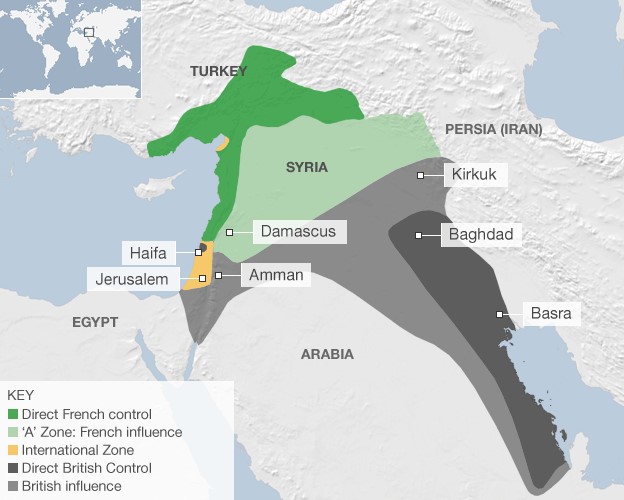
The forces of the Islamic State of Iraq and Syria (ISIS) have broken down a wall on the frontier between Iraq and Syria as a symbol of abolishing national frontiers to be replaced by a community of the Islamic faithful − the umma. In some ways, we are back to the early days of the post-World War One period when France and England tried to re-structure that part of the Ottoman Empire that is now Iraq, Syria, Lebanon, Israel-Palestine, Jordan, Turkey and an ill-defined Kurdistan.


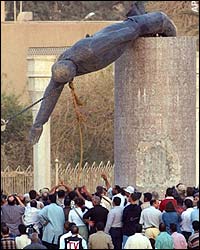
In March 2003 an international "coalition" led by the United States attacked Iraq in violation of international law and overthrew the country's dictator, Saddam Hussein. The problem is that, having acted without prior permission from the Security Council, the "coalition" was never able to garner support from the international community and build a real, stable democracy in Iraq. As a result, a significant part of the country is now in the hands of radical Islamist fighters.

In March 2003 an international “coalition” led by the United States attacked Iraq in violation of international law and overthrew the country’s dictator, Saddam Hussein. The problem is that, having acted without prior permission from the Security Council, the “coalition” was never able to garner support from the international community and build a real, stable democracy in Iraq. As a result, a significant part of the country is now in the hands of radical Islamist fighters.


During 1915, Sir Mark Sykes, a Tory Member of Parliament and a specialist on  Turkish affairs and Francois Georges-Picot, a French political figure with strong links to colonial factions in the French Senate negotiated how to re-structure the Ottoman Empire to the benefit of England and France. Although these were considered “secret negotiations” Sykes reported to Lord Kitchener, the War Minister, and Picot had joined the French Foreign Ministry as war service. However, both operated largely as “free agents”. Today Sykes and Picot are recalled for no other achievement than their talent in dividing. The agreement between them was signed in January 1916 but kept in a draw until the war was over. In April 1920 at San Remo, France and England made the divisions official.

History has moved on, but dividing and re-structuring remains the order of the day. The political structures of Israel-Palestine as one state, two states, or one state and occupied territories have confronted the best of mediators − and less talented mediators as well. With the war in Syria continuing, there have been suggestions to divide − or federate − the state into three parts: an Alawite-Shi’ite area, a Sunni area, and a Kurdish area. The same divisions had been suggested for Iraq earlier and are again being discussed in the light of the ISIS advances: a Shi’ite area in the south, Kurds in the north − already largely independent − and Sunnis in the Middle. Lebanon, although not a federal state, is largely structured on sectarian-geographic divisions.


In 1916 the Sykes-Picot agreement carved the Middle East into two "spheres of influence", one British, the other French, plus two zones of direct control by either of the colonial powers.

In 1916 the Sykes-Picot agreement carved the Middle East into two “spheres of influence”, one British, the other French, plus two zones of direct control by either of the colonial powers.


Constitution-making under duress is not the best way of doing things. Forced federalism presents even more difficulties than creating a federal state when people are not fighting each other. We have seen the difficulties of proposing federal structures for Ukraine, federalism seen by some as a prelude to the disintegration of the state. The difficulties in the wider Middle East are even greater, as we have three states directly involved: Iraq, Syria, Turkey with a well-organized and armed Kurdish community in Iraq and parts of Syria.

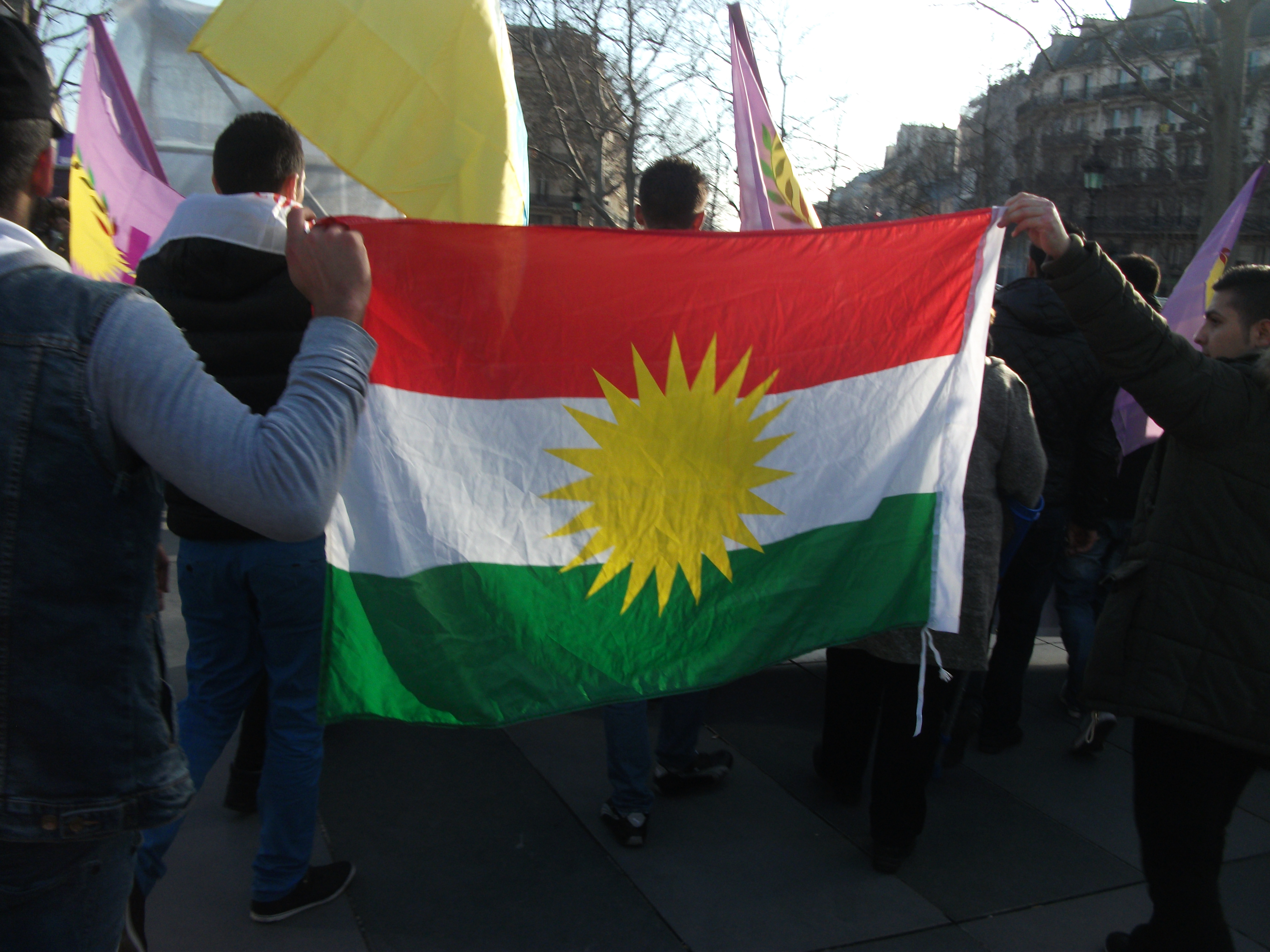
The Kurds had expected that a Kurdistan would be recognized after World War One. The issue was raised at a conference to set Middle East frontiers held in June 1923 in Lausanne. The failure of the Kurds to achieve their goal for independence and the forced inclusion of their mountainous homeland within the then newly created states of Iraq, Syria and Turkey caused resentment and unrest. All the Kurds received in 1923 was a pledge to respect minority rights. By 1924, the Turkish government had banned all Kurdish schools, organizations, publications, and religious Sufi brotherhoods. In 1925, there was the first of the Kurdish revolts in Turkey, which, on-and-off, continue to today.


The flag of the Kurdish people, a people without a nation, a people without a land, to whom the promises of history ring hollow today more than they ever have. (C) Bernard J. Henry/AWC

The flag of the Kurdish people, a people without a nation, a people without a land, to whom the promises of history ring hollow today more than they ever have. (C) Bernard J. Henry/AWC


As outsiders but as specialists in federal forms of government, is there anything which we can do to be helpful? Maps are deceptive, and what is drawn as Shi’ite, Sunni and Kurdish area in Iraq and Syria have, in fact, mixed populations. Nor are religious-sectarian divisions the only lines of fracture.

Nevertheless, discussions among Syrians, Iraqis, Turks, Iranians and outside specialists on forms of government may be of greater use than sending Special Forces as ‘intelligence’ specialists. Such discussions will not be easy to organize or to facilitate but in a period of constitutional disorder and flux, such efforts are necessary.


Prof. René Wadlow is President of the Association of World Citizens.
Hugh Joseph Schonfield, the World Citizen Pioneer who Tried to Unite the Holy Land

In Being a World Citizen, Conflict Resolution, Cultural Bridges, Current Events, Middle East & North Africa, Solidarity, The Search for Peace, United Nations, World Law on May 24, 2014 at 8:50 PM

HUGH JOSEPH SCHONFIELD, THE WORLD CITIZEN PIONEER WHO TRIED TO UNITE THE HOLY LAND

By René Wadlow


Hugh Joseph Schonfield (1901-1988) was the first to incorporate the term “world citizen” into the name of a nongovernmental organization: the Commonwealth of World Citizens in 1938. The Commonwealth of World Citizens was to have an emphasis on service to humanity and a potential role as impartial mediator in international disputes. The founding was what he called a “revolt into sanity” from a mentally-deranged world in which Fascism, Nazism, Communism and militarized Shintoism flourished. From 1941 to 1948, Schonfield published a magazine called The World Citizen. As he said in a speech to the Constructive World Peace Conference in April 1940 “External forces, the agents of God, have caused the emergence in the world itself of ideas of World Community and World Citizenship. It is seen by serious political thinkers that if peace and justice are to reign here there must be a loyalty above that which is due from subjects to their own nation state. Much is being done, and rightly, to encourage such ideas. What we have to concern ourselves with is the bridge that will bring us safely to that farther shore. The bridge must be one that will carry us eventually to the New Jerusalem, not to a new Babylon.”

He wrote, “So many of the grave problems of our time are due to the fact that we are living in a radical transition, having to relate to the rapid advances of science which are requiring us to move forward into a wholeness and interdependence for which we are not sufficiently prepared. There are inevitable consequences, which chiefly affect our self-consciousness. The problems of the transition period affect individuals just as much as nations. Multitudes find themselves incapable of adjusting to the new demands and fear loss of identity.”

In his Mondcivitan Writings ('mondcivitan" coming from "mondcivitano" which is the Esperanto for "World Citizen"), Schonfield developed a comprehensive World Citizen thought, long before the Association of World Citizen was created.

In his Mondcivitan Writings (‘mondcivitan” coming from “mondcivitano” which is the Esperanto for “World Citizen”), Schonfield developed a comprehensive World Citizen thought and ideology, long before the Association of World Citizens itself was created.

Hugh Schonfield drew parallels between the current period of transition with the Jewish society at the time of Jesus, a period which was the focus of most of his writings. He wrote in 1936 History of Jewish Christianity and in 1939 Jesus: A Biography. During the Second World War while working on Middle East issues for the British government, he published in 1943 Judaism and World Order. Shortly afterwards he published Jesus: Man and Messiah, Readings from the Aprocryphal Gospels. A major work was published in 1955, a translation of the New Testament with notes relating the work to the thoughts of the period in which it was written and linking it to Jewish writings of the same period. As a Jew, he did not want his translation to become known as the “Schonfield New Testament” so it was published in 1955 as The Authentic New Testament. He continued his research on Jesus and messianic expectations and in 1965 published The Passover Plot which became a ‘best seller’ selling over two million copies. He became very interested in the Dead Sea scrolls and one of his last books in 1984 was The Essene Odyssey.

With his interest in the Holy Land, he was particularly concerned with Arab-Jewish relations and became an active champion for the idea of an Israel-Palestine Confederation, setting out proposals in 1944 which also concerned what is now Jordan, the pre-Independence Mandate area.

As Dr. Schonfield wrote in Transnational Perspectives in 1982, “What is clearly called for is a Confederation, possibly on the Swiss model, composed of the states of Palestine and Israel, with Jerusalem as the federal capital. The city would not have to be divided or fought over as to who should possess it. Palestine could have a state capital in the eastern part and Israel in the western sector, if they so desired, but the city as a whole would represent the Confederation.

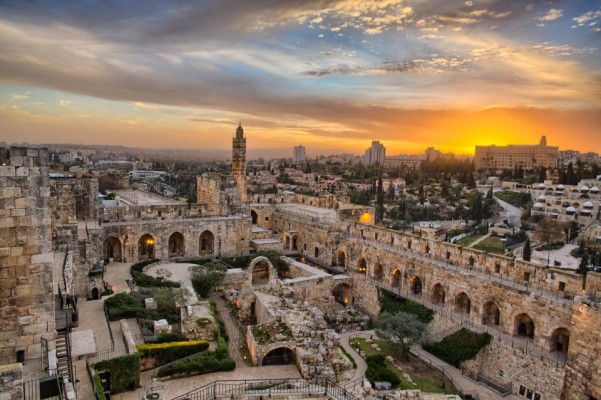
Jerusalem is the cradle of the world's two major religions, Islam and Christianity, as well as of Judaism. Therefore, why should it have to be a place of hatred and division, and not a place of brotherhood and unity?

Jerusalem is the cradle of the world’s two major religions, Islam and Christianity, as well as of Judaism. Therefore, why should it have to be a place of hatred and division, and not a place of brotherhood and unity instead?

“The advantage of this plan should be obvious. The frontiers between the two states would be internal and unfortified, and would therefore not create a risk of future war. As citizens of the Confederation, both Palestinians and Israelis would enjoy rights of access to all parts for purposes of travel and commerce, and questions of settlement would be covered by federal laws. There should be freedom of conscience for all citizens of the Confederation, but if so desired the religious laws of Islam and Judaism could be operative in the respective component states. The important thing would be that the Confederation would be the common homeland of both Palestinians and Israelis, who would yet have their own states.

“This is not a dream and could readily become a practical reality. What has been provided here is no more than a plan in outline, but it does keep the Holy Land as a unity, a common homeland for both Israelis and Palestinians, and satisfies their aspirations for self-governing statehood. With imagination and goodwill, it would inaugurate a new era in the Near East, and become an inspiration to mankind.” He saw that forms of regional integration are increasingly considered as the principal methodology for general security, development and the safeguard of human rights. Individual, national and regional security should be accompanied by a spirit of mutual acceptance – with economic cooperation and development as a by-product for a future Israel-Jordan-Palestine grouping.

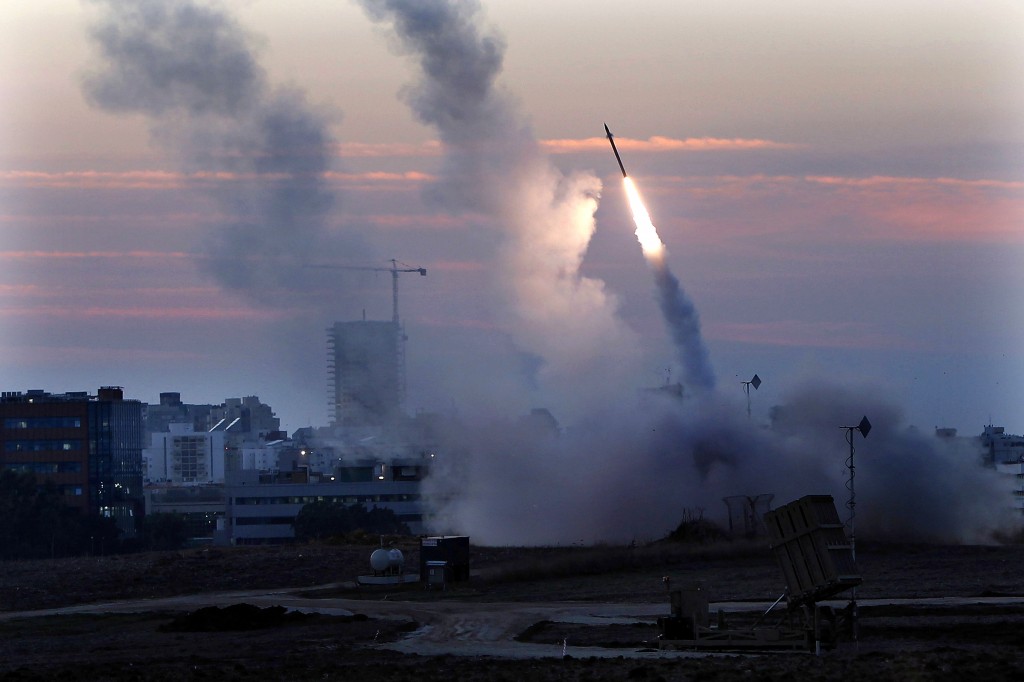
A rocket being fired by the Israeli Defense Force (IDF) to counter an incoming rocket attack from Gaza. (AP Photo/Tsafrir Abayov)

As the Middle East remains hopelessly plagued by violence, a rocket is being fired by the Israeli Defense Force (IDF) to counter an incoming rocket attack on Israel coming from Gaza. (AP Photo/Tsafrir Abayov)

However, the World Citizen proposals have not been followed by the strong national political leadership needed to bring them to the fore of real political negotiations. The quality of government leadership in the Middle East has been uneven at best. But even the Israeli-Palestinian problems are more complex than the quality of leadership. A new spirit of mutual acceptance will only flourish in the region when individual security and dignity for all will become rooted in law – everywhere in the region. This can happen with a general process of democratization and respect for human rights, with safeguards for ethnic and religious minorities. Such democratic values and practices must become the natural bedrock of society in all the countries of the Middle East.

World Citizens can take inspiration from Hugh Schonfield and in their Middle East efforts put an emphasis on unity rather than division.


Prof. René Wadlow is President and Chief Representative to the United Nations in Geneva of the Association of World Citizens.
World Citizens Welcome Serious Considerations of Federalist Government Structures for Ukraine, but Warn Against Simplified Concepts

In Conflict Resolution, Cultural Bridges, Current Events, Europe, The former Soviet Union, The Search for Peace on April 16, 2014 at 2:22 PM

WORLD CITIZENS WELCOME SERIOUS CONSIDERATIONS OF FEDERALIST GOVERNMENT STRUCTURES FOR UKRAINE, BUT WARN AGAINST SIMPLIFIED CONCEPTS

-- AWC-UN Geneva Logo --

The Association of World Citizens (AWC), in an April 14, 2014 message to the Secretary-General of the Organization for Security and Cooperation in Europe (OSCE), welcomed the serious consideration of federalist government structures for Ukraine being proposed both by the current President of Ukraine in an April 13 statement and by the authorities of the Russian Federation.

As Professor René Wadlow, President of the AWC, pointed out in the message, such proposals can have a positive impact to lessen the growing tensions both within Ukraine and among the Russian Federation, Ukraine, and the European Union. The President recalled that World Citizens have always stressed that government structures should be as close as possible to the people so that their views can have a direct impact on government decisions. Federalist forms of government can facilitate the balance between the need for larger government units for policy making and units close to local communities so that those impacted are able to influence policy.

The current tensions, first within the Ukraine, followed by the change of status of Crimea and its integration into the Russian Federation, the massing of Russian troops on the Ukraine frontier with Russia, and the violent demonstrations within parts of Ukraine have created the most serious European tensions since the conflicts related to the breakup of the Yugoslav federation.

Efforts of both governments and nongovernmental organizations (NGOs) must be undertaken to lessen tensions and to create opportunities for creative dialogue. Proposals for new governmental forms within Ukraine offer a possibility for such creative dialogue.

The current tensions in Ukraine highlight two crucial political and economic orientations possible for Ukraine. On one side, there is a growing but not clearly defined revival of an economic and strategic zone with the Russian Federation as the main motor. This possible “Eurasian Customs Union” could include Russia, Belarus, Kazakhstan, Armenia, Azerbaijan and perhaps Moldova and Ukraine. Such a Eurasian association would probably develop into more than a common market. However, the full structure and tasks of such a Eurasian association have not been fully discussed publicly.

On the other side is the European Union (EU) with which Ukraine has already some treaty agreements. The refusal by the then President of Ukraine, Viktor Yanukovich, to sign a more detailed plan of action with the EU was the reason or a pretext for the start of the massive demonstrations in Kiev.

The current situation in Ukraine does not lead itself to calm considerations of basic orientations or for compromises. Both the EU and Russian diplomacy will weigh in the Ukraine decisions, and the USA and Chinese diplomacy is not likely to be absent.

World Citizens who have a long history of reflection on federalist approaches, warn against simplified concepts in the Ukraine discussions. Federalism is not a first-step to the disintegration of the Ukraine. But it is not a “magic solution” either. Government structures are closely related to the aims which people wish to achieve. The aims of the Ukrainians are multiple. Dialogue and open discussion is needed so that these aims are seen more clearly and then structures created to facilitate these aims. Those outside Ukraine, both governments and NGOs must facilitate discussions of aims and structures so that common interests may be found and current tensions reduced.