The Official Blog of the

Archive for the ‘Anticolonialism’ Category

M.K. Gandhi: “The Free Spirit: One and manifold”

In Anticolonialism, Asia, Being a World Citizen, Conflict Resolution, Cultural Bridges, The Search for Peace on January 30, 2014 at 1:41 PM

M. K. GANDHI: “THE FREE SPIRIT: ONE AND MANIFOLD”

By René Wadlow

I do daily perceive that while every thing around me is ever changing, ever dying, there is underlying all that change, a living power that is changeless, that holds all together, that creates, dissolves, and re-creates.  That informing power or spirit is God. I see it as purely benevolent, for I can see in the midst of death, life persists.  In the midst of untruth, truth persists.  In the midst of darkness, light persists.  Hence I gather that God is life, God is light, God is love. God is the supreme good.”

Mahatma Gandhi

On the anniversary of the assassination of Mahatma Gandhi, January 30, we still try to find peaceful ways to resolve conflicts.  Mahatma Gandhi was a man of dialogue and compromise.  A British-trained lawyer, he always knew the limits of the law and when not to push too far or ask for more than what could be seen as reasonable to the authorities in South Africa or British-controlled India even if the authorities were not willing to accept the demands at the time.

Yet what does one do when opponents refuse dialogue and when events move so fast that no compromise seems possible?  These questions are crucial as difficult negotiations on the armed conflict in Syria have started in Switzerland — first one day in the calm of the resort Montreux on Lake Geneva with some 40 states present, some directly involved, others to give moral support to the UN-led negotiations. The negotiations then moved to the UN’s Palais des Nations in Geneva and, no doubt, to restaurants for small groups.

To make matters more complex, some key actors are not officially there, though they are not very hidden in the shadows: Iran has a large mission to the UN in Geneva; the Kurds from Syria-Iraq-Turkey- and Iran have a permanently strong presence in Geneva and gather from outside when events merit; there is a large community of people from Lebanon — some bankers but also, no doubt, representative from Hezbollah as well.  The foothills of the Alps above Montreux have long been the home of international arms merchants — though the arms are stocked elsewhere. If they were unable to make sales on the sideline of the Montreux meeting, they can afford to drive to Geneva to see what factions may want to buy arms which they cannot receive supplied by governments.

Among the dangerous aspects of the armed conflict in Syria is the extent to which all factions use images of the “eternal enemy” — Arabs and Iranians, Kurds and Arab, Christian, Alawit and Muslim, Sunni and Shia.  These enemy images make compromise all the more difficult.  It is sad to see the writing of history deformed, intellectual short cuts taken, the media used to strengthen prejudice rather than to inform.

Thus for the anniversary of Gandhi’s assassination, carried out by a narrow Hindu to cut short Gandhi’s efforts at Hindu-Muslim reconciliation in the middle of the Partition Riots, it is useful to recall the appeal of Romain Rolland, biographer of Tolstoy, Gandhi, Ramakrishna and Vivekananda, who Gandhi visited on his journey to Europe.  In 1919, shortly after the end of the First World War which had divided the intellectual community, Romain Rolland wrote to a wide range of intellectuals to raise the Arch of the Free Spirit.
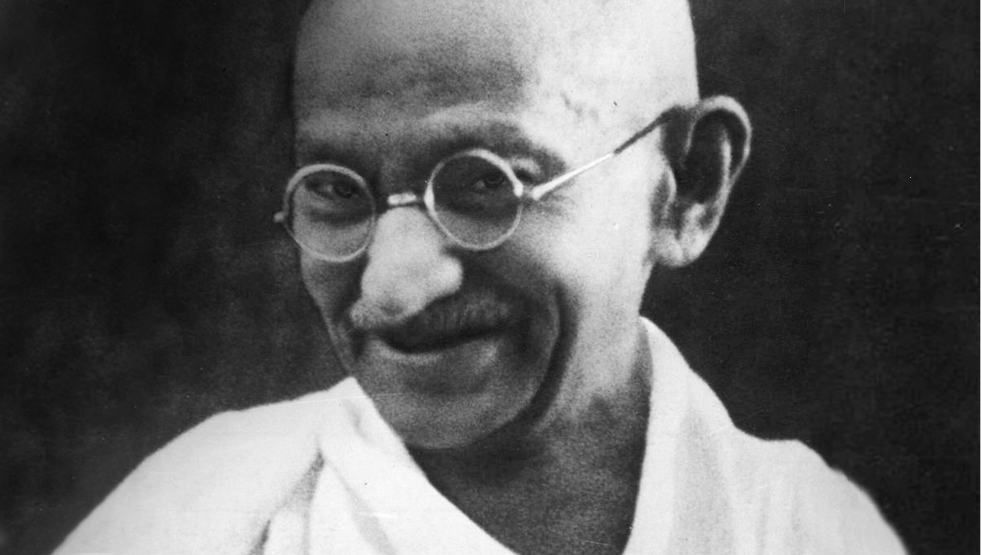
When asked once by his fellow Hindus to allow retaliatory action against India's Muslims after sectarian violence struck the Hindu community, Mohandas Karamchand Gandhi, the Mahatma, had this to say about revenge: "An eye for an eye only ends up making the whole world blind."

When asked once by his fellow Hindus to allow retaliatory action against India’s Muslims after sectarian violence had struck the Hindu community, Mohandas Karamchand Gandhi, the Mahatma, had this to say about revenge: “An eye for an eye only ends up making the whole world blind.”

“To the pestilence which is corroding in body and spirit, thinkers and artists have added an incalculable amount of poisoned hate; they have searched in the arsenal of their knowledge, their memory and their imagination for old and new reasons, historical, scientific, logical and poetic reasons, for hating; they have laboured to destroy love and understanding. And in so doing they have disfigured, dishonoured, debased and degraded Thought, whose ambassadors they were. They have made it an instrument of passions and (perhaps without knowing it) of the egotistic interests of a social or political clan, of a state, of a country or a class…

“Let us extricate the spirit from these humiliating alliances, this secret slavery!… We serve Truth alone, which is free, with no frontiers, with no limits, with no prejudices of race or caste.  Of course, we shall not dissociate ourselves from the interests of Humanity!  We shall work for it, but for it as a whole. We do not recognise nations.  We recognise the People — one and universal — the People who suffer, who struggle, who fall and rise again and who ever march forward on the rough road, drenched with their sweat and their blood — the People comprising all men, all equally our brothers.  And it is in order to make them, like ourselves, aware of this fraternity, that we raise above their blind battles the Arch of Alliance, of the Free Spirit, one and manifold, eternal.”[i]

* * *

Prof. René Wadlow is President and Chief Representative to the United Nations in Geneva of the Association of World Citizens.


[i] Quoted from Rolland and Tagore (Calcutta: Visva-Bharati, 1945, pp 20-24)
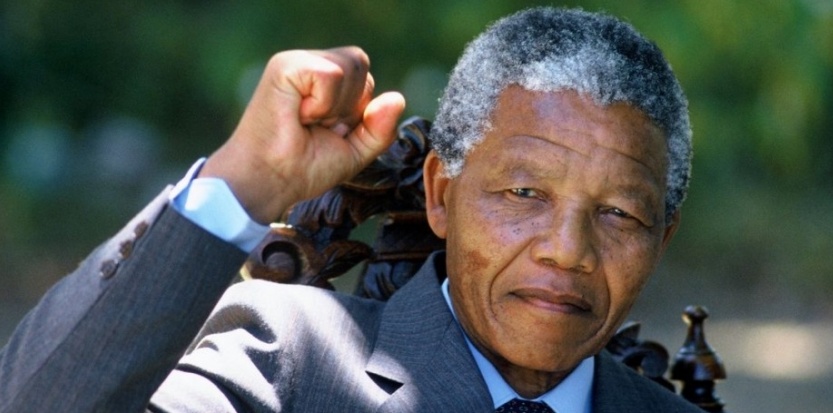
Nelson Mandela and the Struggle for Universal Human Rights

In Africa, Anticolonialism, Being a World Citizen, Current Events, Fighting Racism, Human Rights, International Justice, The Search for Peace, Uncategorized, World Law on December 10, 2013 at 12:43 PM

NELSON MANDELA AND THE STRUGGLE FOR UNIVERSAL HUMAN RIGHTS

By René Wadlow


It is appropriate that a major part of the commemoration for Nelson Mandela should fall on December 10, the anniversary of the Universal Declaration of Human Rights. Mandela was both a major actor in developing human rights in South Africa and a symbol of the worldwide struggle for the respect of human rights.  Pressure from human rights groups worldwide played an important part in his release from prison in 1990 as well as bringing an end to the deeply entrenched system of apartheid that enforced racial segregation in every aspect of South African life.

The efforts on the part of the Afrikaner-led National Party Government to enforce apartheid and to prevent opposition had led to many violations of human rights in South Africa: limits on press and expression, on the freedom of association, and the right to fair trial. Therefore, the dismantling of the apartheid system was a necessary pre-requisite for the establishment of the rule of law and respect for human rights.

Nelson Mandela led the efforts to end apartheid, a victory without the blood bath that so many had predicted and feared. He led on the path of constructive reconciliation and an inclusive society.

There is still much to do to develop equality of opportunity in South African society.  Years of discrimination, of lack of education and training, of lack of access to resources leave deep structural divides.  However, much has been undertaken, and South Africa has the potential to be an economic and political leader in Africa.

Nelson Mandela is an example of courage and conviction to secure human rights, both in his own country and worldwide, an example of the long and continuing efforts needed for human freedom.

Prof. René Wadlow is President and Chief Representative to the United Nations Office at Geneva of the Association of World Citizens.


5583290-la-sante-de-nelson-mandela-s-ameliore-selon-la-presidence

The UN and the Disappearing State of the Central African Republic

In Africa, Anticolonialism, Conflict Resolution, Current Events, Democracy, Human Rights, International Justice, The Search for Peace, United Nations, War Crimes, World Law on November 22, 2013 at 10:36 AM

THE UN AND THE DISAPPEARING STATE OF THE CENTRAL AFRICAN REPUBLIC

By René Wadlow

In a November 19, 2013 statement to the United Nations (UN) Security Council, the Secretary General, Mr. Ban Ki-moon, warned that communal violence in the Central African Republic (CAR) was spiraling out of control and backed the possibility of an armed UN peacekeeping force to complement the civilian UN staff, the Integrated Peacebuilding Office in the Central African Republic (BINUCA).

The UN faces a double task in the CAR. There is the immediate problem of violence among tribal-based militias in the absence of a national army or central government security forces. The militias basically pit the north of the country against the south. In addition, there are other militias from the Democratic Republic of the Congo which use the CAR as a “safe haven” and live off the land by looting villages. There are also segments of the Lord’s Resistance Army, largely from the Acholi tribes of northern Uganda who also use the CAR as a safe area looting as they move about.

In the absence of a standing UN peacekeeping force, UN peacekeepers would have to be redeployed from the eastern areas of the Democratic Republic of Congo, an area also torn apart by fighting among different militias and an incompetent Congolese national army. Although the UN forces have been in the Congo for a number of years, it is only in the last couple of months that they have had a mandate to be active in a military way and have started to make an impact on the security situation. By deploying UN troops away from the Congo, there is a danger that the security progress made will fade away.

The longer range task of the UN, the peacebuilding effort, is to create a national administration which provides services beyond the capital city, Bangui. This is the aim of the BINUCA, but its work is largely impossible in the light of the ongoing violence. The challenge is “State-building” which was not done during the colonial period by France.

The area covered by the current State had no pre-colonial common history, but was incorporated into French Equatorial Africa when it could have been as easily part of the Belgium Congo or added to Uganda as part of British East Africa.

Oubangui-Chari as it was then known was the poor cousin of French Equatorial Africa (AEF) whose administrative center was Brazzaville, Congo, with Gabon as the natural resource base. The Cameroon, although legally a League of Nations Mandate, was basically part of AEF. Oubangui-Chari was used as an “exile post” for African civil servants considered “trouble makers”. French colonial administrators also considered Oubangui-Chari as a posting in exile, a place to get away from as soon as possible. Schools were few, and secondary school students were sent away to Brazzaville.

There was only one political figure of standing who emerged from Oubangui-Chari, Barthelemy Boganda (1910-1959). He was the first Roman Catholic priest ordained in 1938. After the Second World War, he was elected to serve in the French Parliament as a member of the Catholic-influenced MRP Party, although he was stripped of his priesthood for going into politics and also for marrying his legislative assistant.

Boganda advocated keeping the AEF together as a federation of independent States knowing that Oubangui-Chari was the poorest of the AEF States and most in need of help from its neighbours. Unfortunately, he was killed in a plane crash on the eve of independence, and with him disappeared all enlightened leadership.

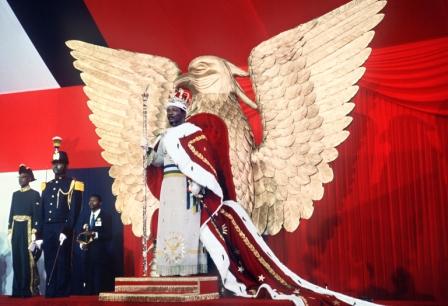
However, his stature in the political life of Oubangui-Chari was such that political power passed on to two cousins, David Dacko, first President of the independent Central African Republic and then Jean-Bedel Bokassa in 1965 who changed the name of the country to Central African Empire and ruled (or misruled) as Bokassa 1er. His dreams of being a new Napoleon was ended in 1979 by a French military intervention after Bokassa had too visibly killed young school children who were protesting.

Jean-Bedel Bokassa aka Bokassa the First, the man who would be emperor – even if it meant reigning over scorched earth.

Jean-Bedel Bokassa aka Bokassa the First, the man who would be emperor – even if it meant reigning over scorched earth.

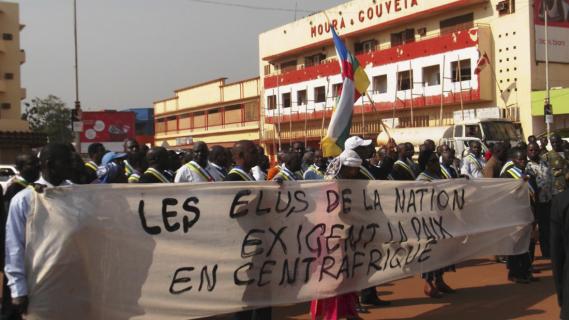
Since Bokassa, all pretext of a unified administration has disappeared. General Kolingba, Ange-Felix Patassé, followed by Francois Bozizé were considered “Head of State”, but the State had no visible administration. Bozizé was overthrown in March 2013 by Michel Djotodia and his Seleka (alliance in the Sango language) militia. The Alliance has now been dissolved by Djotodia but replaced by nothing. A fact-finding mission sent by the UN Human Rights Council concluded that “both the forces of the former government of President Bozizé and the non-State armed group Seleka committed serious violations of international humanitarian law and international human rights law during the conflict”.

Creating order from disorder is a difficult task, especially as the pre-colonial tribal structures no longer function. There were very few inter-tribal mechanisms to settle disputes in any case. The State-building process merits close attention. Somalia remains a good example of the difficulties. The UN faces real challenges in the Central African Republic and requires help from national governments and NGOs.

Politically, Africa has always been a continent of many dramas. Hopefully, if the international community finally decides to take quick, decisive action at last, the Central African Republic will not be just another name on the list.

Politically, Africa has always been a continent of many dramas. Hopefully, if the international community finally decides to take quick, decisive action, the Central African Republic will not be just another name on the list.

René Wadlow is the President and Chief Representative to the United Nations Office at Geneva of the Association of World Citizens.

Does the Non-Aligned Movement Still Matter?

In Africa, Anticolonialism, Asia, Cultural Bridges, Current Events, Middle East & North Africa, United Nations, World Law on August 27, 2012 at 11:36 AM

DOES THE NON-ALIGNED MOVEMENT STILL MATTER?

by René Wadlow

With Iran taking over the three-year term of the presidency of the Non-Aligned Movement (N.A.M.) at the end of August 2012, the question arises: Does the Non-Aligned Movement still matters in world politics and how will Iran use the presidency?

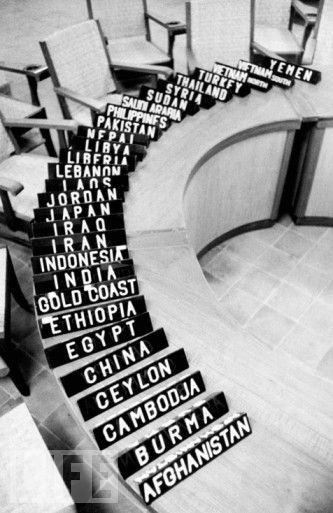
At the time of its founding at the Bandung Conference in April 1955, the major world powers were aligned in Soviet- and United States-led blocs. The war in Korea had recently ended in an armistice with the same frontiers as at the start but could have been the forerunner of a world war. The French war in Indochina had ended with independence of the three Indochina states, but a new independence conflict had just started in Algeria. Basically Bandung marked the end of formal colonialism. As Sir John Kotelawala, Premier of Ceylon (now Sri Lanka), said at the end of the conference “Bandung will be a name to reverberate in history and earn the gratitude and blessings of ages to come.”

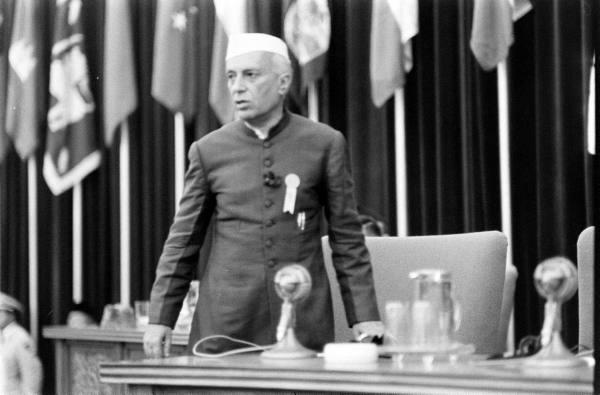
Prime Minister Jawaharlal Nehru of India delivering the closing speech at the Bandung Conference that created the Non-Aligned Movement.

For fear that the new Non-Aligned movement might supplement or weaken the United Nations (UN), no implementary organization was set up. Later, the pattern of three-year rotating presidency was developed, but without a permanent secretariat. The country holding the presidency offers its own diplomats and civil servants to carry on Non-Aligned tasks. The outgoing presidency — Egypt — was so taken up with its own political changes that it virtually played no role on behalf of the N.A.M. Will Iran be able to do more than use the prestige of the Movement to defend its own interests?

In time, the Non-Aligned Movement grew up to become a major player in international relations, providing the Third World with a voice of its own on the world stage.

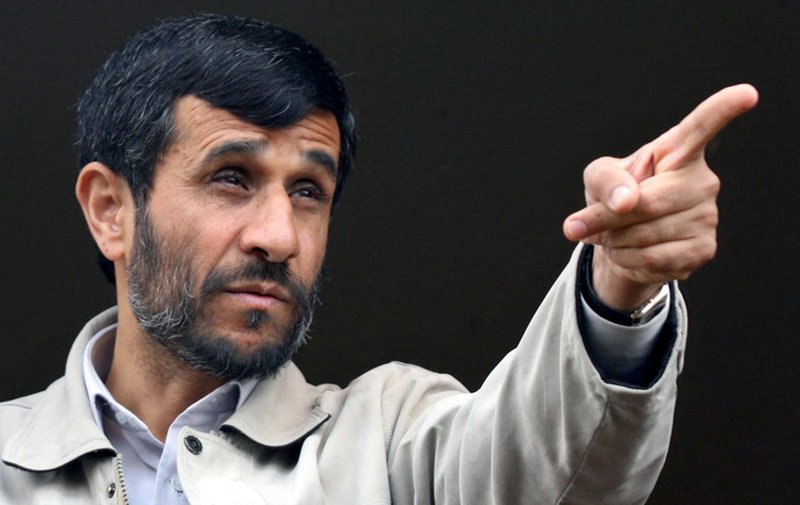
President Mahmoud Ahmadinejad will become the N.A.M. representative for its 118 members. His first presentation will be to the UN General Assembly in September. His talk should be analyzed closely to see if his presentation goes beyond the usual Iranian positions to be more inclusive of the interests of the N.A.M. members. A large conference at the end of August in Tehran will be the formal start of Iran’s presidency. Some Iranian leaders have called for the creation of a permanent secretariat. Thus it will be important to note what structural reforms are made within the N.A.M.

While in 1955, the idea of a “third camp” was a possibility — a wedge of sanity and restraint between the two atomic giants —, now there are real conflicts of interest among the N.A.M. members — the conflict in Syria being a prime example, along with differing territorial claims within the South China Sea among China and its neighbors.

The direct threats issued against the State of Israel by Iran’s President, Mahmoud Ahmadinejad, albeit in response to Israeli Prime Minister Benjamin Netanyahu’s own warmongering rhetoric against Iran, raises serious questions as to what Ahmadinejad can be expected to make of his presidency of the Non-Aligned Movement.

Iran itself is at the center of an international storm, and it is not clear if its diplomats and political leaders will have the energy to deal with the host of current conflicts among N.A.M. states as well as making proposition concerning the important economic, financial and ecological issues that the world faces. Moreover, the N.A.M. states are members of regional, intergovernmental organizations and therefore look less to N.A.M. leadership to structure economic and cultural cooperation.

Yet the N.A.M. does provide a structure for states and a large percentage of the people of the world. N.A.M. leadership has had an erratic relation with non-governmental organizations (NGOs) — sometimes encouraging their participation in meetings and programs and at other times ignoring them completely. Without a permanent secretariat, the N.A.M. has not developed the sort of consultative status that the UN has with NGOs. The Indian government at one stage had encouraged NGO-related activities within the N.A.M. Given the challenges facing the Iranian presidency of the N.A.M. it would be useful for NGOs to propose a more structured and formal relation with the N.A.M. especially if a permanent secretariat is created.

René Wadlow is President and Chief Representative to the United Nations, Geneva, of the Association of World Citizens.

A New Mali Federation?

In Africa, Anticolonialism, Conflict Resolution, Current Events, The Search for Peace, United Nations, World Law on April 21, 2012 at 9:55 PM

A NEW MALI FEDERATION?

By René Wadlow


Since the fall of northern Mali to the forces of the Tuareg at the end of March 2012, the situation has grown in complexity. The group of young officers, more or less led by Captain Amadou Sanogo, had taken control of the government buildings of the Central Government in Bamako on March 23, but they had little idea of what else to do.

There was an immediate counter-reaction on the part of Western States such as France and the USA who provide most of the financial and technical assistance to Mali. Both France and the USA cut their aid to Mali—a country currently facing a severe drought and food shortages.  Likewise, the 15 states of the Economic Organization of West African States (ECOWAS) called for a speedy return to the civilian government. Captain Sanogo saw the “handwriting on the wall” and agreed to turn over the government to the President of the National Assembly who is the constitutional replacement when the President is absent.

In the meantime, the country is divided into two roughly equal areas—a north with the Tuareg holding the two major cities of Timbuktu and Gao, and the more populated south whose population provides most of the civil service, the army and the agricultural wealth of the country.

The Tuareg along with various armed groups probably from Mauritania, south Algeria and fighters who had been recruited for Libya are divided on what strategy to follow. There are two broad options. The largest group, Mouvement national de libération de l’Azawad (MNLA) wants an independent state of northern Mali (and probably part of the Tuareg-inhabited Niger) to be called Azawad. The second faction, called Ansar Dine, is smaller but is more heavily armed and contains the bulk of armed foreigners. Their stated aim is to take control of all of Mali and to install Islamic law.

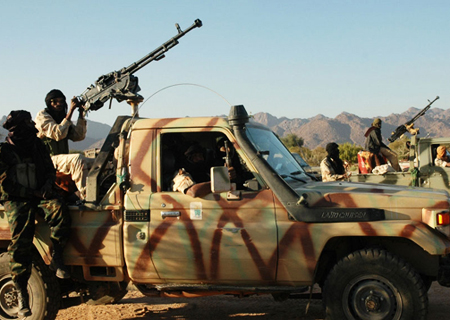
Tuareg rebels near the Sahara desert

Both options have difficulties. Northern Mali as an independent state of Azawad has no natural resources, a small population and few educated people to administer a state or to develop any economy beyond that of camel nomadism. In addition, most African states are opposed to carving up existing states or changing frontiers—a Pandora’s box as many states could be redrawn on ethnic lines and frontiers changed. Thus “territorial integrity” is an article of faith.

Ansar Dine’s option of an Islamist Mali is also difficult to realize. The Bambara and the Malinké are the largest groups in the country and hold economic, military, and political power. Ideologically, they are opposed to the Islamic vision of Ansar Dine, being more Sufi-influenced with a large measure of traditional African beliefs and practices mixed in.(1) Thus the possibility of Ansar Dine gaining support in the south of Mali is slight.  However, they may be able with force of arms to impose their views on Timbuktu and Gao but not on the northern countryside.  The Tuareg are not Islamist by tradition.  Yet in the two cities, the Ansar Dine may be able to force women to cover their hair, prevent the sale of wine and cut the hands of robbers—these three practices being the extent of their knowledge of Islamic law.

Faced with the difficulties of having a northern Malian state—Azawad—accepted by the power-holders of Mali and the neighboring states, there have been some discussions among Tuareg leaders and a former Malian government leader in Nouahchott, Mauritania. There have been no official statements coming from these talks, in part because both north and south Mali are in administrative disorder.  No one knows how much authority the persons involved have.  For the moment, it is probably at best “Track II” diplomacy, trying to see what are the aspirations, the limits of the acceptable, and the degree of the willingness to compromise. In the past France and Algeria have mediated disputes between the Tuareg and the central government of Mali. There have been past agreements on autonomy for the Tuareg.  However, these agreements have rarely held and more centralized government was slowly restored. I believe that this is due more to the incapacity of the Tuareg to provide trained people to run a decentralized administration than ill will or a desire of control on the part of the central government.

Yet, in the past, a “declaration of independence” for northern Mali was never proclaimed. Now that a powerful segment has declared the independence of Azawad, can they go “backward” and accept greater autonomy within a unified Mali?

Echoes from the current Nouachott talks have spoken of a “Federation of Mali”. The name has already been used. The Mali Federation with Senegal was achieved briefly on the eve of independence and lasted for 506 days from April 1, 1959 until August 19, 1960 when it fell apart during the conflict between the President of Senegal, L. S. Senghor and his Prime Minister Mamadou Dia, largely over the division of authority between the two posts.

Because of the way these events occurred, Mali was deprived of its principle outlet to the sea —Dakar, for three years.  Attempts to revive federalism between Mali, Guinea, and Ghana, two other states which had also chosen an anti-colonial “socialist” policy, proved futile.(2) Mali, which had been known as Soudan during the French colonial period, took the name Mali on the suggestion of President Senghor of Senegal from the 14th century empire which covered much of what is today Senegal, Mali and part of Niger.(3)

Can a new Mali Federation of the two sections of the current Mali work better than the earlier Federation of Mali?  With good will and imagination, federalist structures should be able to be worked out. Yet there are times when good will and imagination are in short supply.


Rene Wadlow is the President and Chief Representative to the United Nations, Geneva of the Association of World Citizens.

Notes:

1) See the classic study: Germaine Dieterlen, Essai sur le religion Bambara (Paris,:Presses Universitaires de France,1951)

2) See: Ruth Schachter Morgenthau, Political Parties in French-speaking West Africa (Oxford: Clarendon Press, 1964)

William J. Foltz, From French West Africa to the Mali Federation (New Haven: Yale University Press, 1965)

3) Raymond Mauny, Tableau géographique de l’Ouest africain au Moyen Age (Dakar: IFAN, 1961)

Aimé Césaire (1913 – 2008): A Black Orpheus

In Anticolonialism, Human Rights, Literature on April 7, 2011 at 10:29 PM

AIME CESAIRE (1913 – 2008): A BLACK ORPHEUS

By René Wadlow


My negritude is not a stone,

nor deafness flung out against the clamor

of the day

my negritude is not a white speck of dead water

on the dead eye of the earth

my negritude is neither tower nor cathedral.


Return to My Native Land


On April 6, 2011, Aimé Césaire was honored by the President of the French Republic, Nicolas Sarkozy, at the Pantheon, a monument in Paris where persons who have contributed to French political culture are honored. Aimé Césaire, the Martinique poet and political figure, was a cultural bridge builder between the West Indies, Europe and Africa. A poet, teacher, and political figure, he had been mayor of the capital city, Fort-de-France for 56 years from 1945 to 2001, and a member of the French Parliament without a break from 1945 to 1993 — the French political system allowing a person to be a member of the national parliament and an elected local official at the same time. First elected to Parliament as a member of the Communist Party, he had left the Party in 1956 when he felt that the Communist Party did not put anti-colonialism at the center of its efforts.

The Communist Party’s position was that colonialism would end by itself once the workers had come to power. Césaire went on to form a local political party which existed only in Martinique and was largely his political machine for creating municipal jobs. Césaire faced a massive rural to urban migration on the 400,000 person West Indian department of France. One answer to unemployment was to create municipal posts largely paid for from the central government budget — a ready pool of steady political supporters. Césaire also did much to develop cultural activities from his mayor’s office— encouraging theater, music and handicrafts.

Aimé Césaire’s wider fame was due to his poetry and his plays — all with political implications, but heavily influenced by images from the subconscious. Thus it was that André Breton (1896-1966) writer and ideologue of the Surrealists saw in Césaire a kindred soul and became a champion of Césaire’s writing. Breton had been interested in African art and culture, by its sense of motion, color and myth. Breton often projected his own ideas onto African culture seeing it as spontaneous and mystical when much African art is, in fact, conventional and material. Nevertheless, Breton, who spent some of the Second World War years in Martinique, was able to interest many French writers and painters in African culture. It was Breton who encouraged Jean Paul Sartre to do an early anthology of African and West Indian poetry – Black Orpheus and to write an important introduction stressing the revolutionary character of the poems.

Aimé Césaire’s parents placed high value on education — his father was a civil servant who encouraged his children to read and to take school seriously. Thus Césaire ranked first in his secondary school class and received a scholarship in 1931 to go to France to study at l’Ecole Normale Supérieure — a university-level institution which trains university professors and elite secondary school teachers. He was in the same class with Léopold Sédar Senghor of Senegal and Leon Damas. They, along with Birago Diop also from Senegal, started a publication in Paris L’étudiant noir (The Black Student) as an expression of African culture. One of Césaire’s styles in poetry was to string together every cliché that the French used when speaking about Africa and turning these largely negative views into complements. Thus he and Senghor took the most commonly used term for Blacks, Nègre, which was not an insult but which incorporated all the clichés about Africans and West Indians and put a positive light upon the term. Thus negritude became the term for a large group of French-speaking Africans and French-speaking West Indians – including Haiti – writers. They stressed the positive aspects of African society but also the pain and agony in the experience of Black people, especially slavery and colonialism.

In 1938, just as he finished his university studies, Césaire took a few weeks’ vacation on the coast of Yugoslavia. There he wrote in a burst of energy his Cahier d’un retour au pays natal (Notebook of the Return to My Native Land), his best known series of poems. In 1939, he returned to Martinique having married another teacher from Martinique who was also trained in Paris. Both started teaching at the major secondary school of Martinique and started being politically active. However, by 1940, Martinique was under the control of the Vichy government of France and political activity was firmly discouraged. Thus Césaire concentrated on his writing. He met André Breton who spent the war years in the USA. Breton encouraged an interest in the history and culture of Haiti. While Haiti is physically close to Martinique, Haitian history and culture is often overlooked — if not looked down upon — in Martinique. Césaire wrote on the Haitian independence leader Toussaint Louverture as a hero, and later a play in 1963 La Tragédie du roi Christophe largely influenced by the early years of the dictatorship of Francois Duvalier.

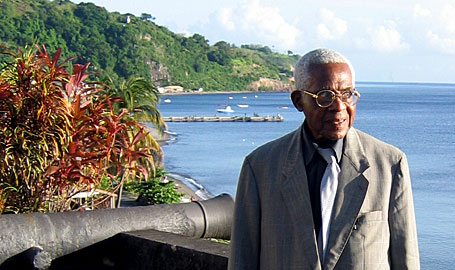
Aimé Césaire (1913-2008)

With the end of the Second World War, the French Communist Party had one third of the seats in the Parliament of the newly created Fourth Republic. The French Communists were looking for potential candidates from Martinique where the Party was not particularly well structured. They turned to young, educated persons who had a local base. Césaire, with his Paris education and as a popular teacher at the major secondary school fitted that bill. He was elected the same year both to Parliament and to the town hall. When in Paris, he took an active part in cultural life, especially with African students and young intellectuals. In 1947, along with the Senegalese Alioune Diop and Senghor, he founded the journal Présence africaine which later became also a publisher of books and the leading voice of the negritude movement.

As the French Communist Party had a rule of tight party discipline, Césaire played no independent role in the French Parliament until he left the Party in 1956. However, his 1950 Discours sur le Colonialisme, at the same time violent and satiric became the most widely read anti-colonial tract of the times, calling attention to the deep cultural roots of colonial attitudes. After 1956, most of his efforts in Parliament were devoted to socio-economic development for Martinique. His strong anti-colonial efforts were made outside Parliament, especially in the cultural sphere. Nevertheless, as a member of Parliament he could open doors that poets do not usually enter.

Césaire, who read English well, was interested in the writings of Langston Hughes whose poems were close in spirit and style. He translated into French some of the poems of the Negro poet Sterling A. Brown.

In the 1960s, Césaire turned increasingly to writing plays, especially on the history of Haiti, as the earliest independent State of the West Indies. These were verse plays as the actors’ dialogues were nearly poems. As the French African colonies became independent in the 1960s, he stressed that the end of colonialism was not enough but that colonial culture had to be replaced by a new culture, a culture of the universal, a culture of renewal. “It is a universal, rich with all that is particular, rich with all the particulars that are, the deepening of each particular, the coexistence of them all.”


René Wadlow is Senior Vice President and Chief Representative to  the United Nations Office in Geneva of the Association of World  Citizens.