The Official Blog of the

Village Bank Founder Becomes Interim Leader of Bangladesh

In Asia, Being a World Citizen, Current Events, Democracy, Human Rights, NGOs, Social Rights, Solidarity, The Search for Peace, Women's Rights on August 12, 2024 at 1:00 PM

By René Wadlow

Muhammad Yunus, the founder of the microcredit banking system in Bangladesh, the Grameen Bank (which translates as “Village Bank”), was sworn in as the interim leader of the Bangladesh government on August 8, 2024. The former leader, Sheikh Hasina, resigned and then fled to India, driven out by the protests first of students and then by other sectors of the population during which some 400 persons were killed by the military and the police. Muhammed Yunus has called for calm and an end to uncontrolled violence often directed against the minority Hindu population.

Muhammad Yunus is an economist. Now 84 years old, he is retired from teaching, originally at the University of Chittagong, the port city of Bangladesh. As an economist, he was quickly aware of rural poverty in many parts of the country and the unrest of the tribal minorities in the Chittagong Hill Tracks. He developed the concept of the Grameen Bank, small loans, especially to women, in order to improve their trading efforts. Much of what is called “the informal sector” – marginal to the more developed economy – are the efforts of market women and women small producers. With small loans which must be repaid before a new loan is possible, women are able to have more security and can expand their business.
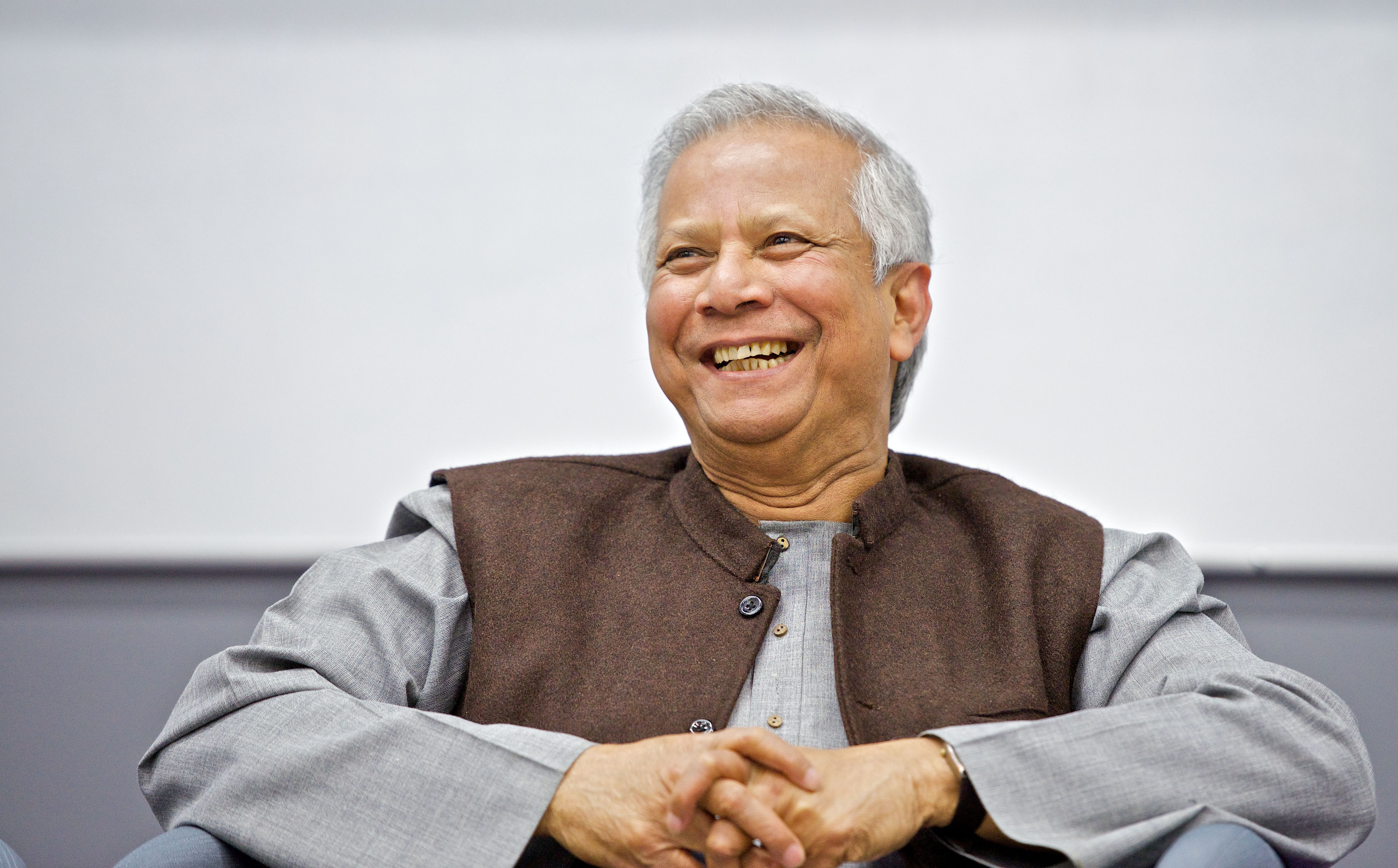
Prof. Muhammad Yunus at the University of Salford, UK, on May 18, 2013
(C) University of Salford Press Service

The Grameen Bank approach spread to nearly all areas of Bangladesh and then to other countries, especially in Africa. The success of the Grameen Bank approach has lifted many from the cycle of poverty and instability. In recognition of the impact of the Grameen Banks, Muhammad Yunus was awarded the Nobel Prize for Peace in 2006.

Muhammad Yunus has formed an interim government of 16 persons, mostly drawn from civil society organizations, including two, Nahid Islam and Asif Mahmud, both 26 years old, who were leaders of the student movements which overthrew Sheikh Hasina who had been in power for 15 years – whose government had become increasingly authoritarian. Muhammad Yunus has promised that elections will be held shortly but that calm must be restored first. He faces difficult tasks, but he is a fresh mind outside the narrow political milieu. We must wish him well in his vital efforts.

Prof. René Wadlow is President of the Association of World Citizens.

رابطة مواطني العالم تدعو السلطات العراقية لسحب مشروع قانونها الذي يسمح بزواج الفتيات بعمر 9 سنوات

In Being a World Citizen, Children's Rights, Current Events, Human Rights, Middle East & North Africa, NGOs, Solidarity, United Nations, Women's Rights, World Law on August 11, 2024 at 1:37 PM

مواطنو العالم يطالبون السلطات العراقية بسحب مشروع قانونها الذي يسمح بزواج الفتيات بعمر 9 سنوات

The AWC Calls on the Authorities of Iraq to Withdraw Their Draft Law Allowing the Marriage of 9-Year-Old Girls

In Being a World Citizen, Children's Rights, Current Events, Democracy, Human Rights, Middle East & North Africa, NGOs, Solidarity, United Nations, Women's Rights, World Law on August 11, 2024 at 11:55 AM

WORLD CITIZENS CALL ON THE AUTHORITIES OF IRAQ TO WITHDRAW THEIR DRAFT LAW ALLOWING THE MARRIAGE OF 9-YEAR-OLD GIRLS

The AWC is alarmed to hear that a draft law under consideration in Iraq may make it legal for a man to marry a girl as young as nine.

We hear many individuals and civil society groups in the country have rightly spoken out about the said draft law.

We firmly believe the Iraqi authorities should by no means make it the law of the land.

For seventy years, Iraqi law has considered the “full age” for marriage, in the very words of the Universal Declaration of Human Rights, to be eighteen. That is consistent with the Convention on the Rights of Child under whose Article 1 “a child means every human being below the age of eighteen years”.

Lowering the marriageable age for girls to nine would send a disastrous signal for girls in Iraq and, in a broader manner, throughout the entire Arab and Muslim world and, ultimately, throughout the entire world, beyond the borders of states, cultures, languages, religions, ethnic groups or of any other nature. It would mean the end of the very notion of child abuse.

Since the draft law would make it possible for a man to marry a young girl but not, conversely, for a woman to marry a young boy – and, even then, it would only be equally condemnable – the draft law also sends a discriminatory message toward women, signifying that a female life is of lesser value.

The AWC condemns in the strongest terms any legislative attempt, whether in Iraq or anywhere else for this purpose, to turn a child into a person’s property, let alone their sexual object of pleasure.

We hereby call on the Iraqi Government and Parliament to immediately withdraw the draft bill and ensure that Iraqi law remains steadily consistent with UN human rights standards.