The Official Blog of the

Archive for the ‘The Search for Peace’ Category

June 8 – Day of the Law of the Sea: Introducing Ralph Townley

In The Search for Peace, World Law on June 7, 2011 at 7:16 PM

JUNE 8: DAY OF THE LAW OF THE SEA

By René Wadlow


The United Nations (UN) General Assembly has designated June 8 each year to be the The Day of Oceans and the Law of the Sea. For a decade, from 1973 to 1982, the United Nations negotiated a far-reaching Convention on the Law of the Sea which declared that the oceans beyond the limits of national jurisdiction to be the common heritage of mankind.

Much of the spirit for the law of the sea and the regulation of trade by ships is due to the pioneer international law writing of Hugo Grotius. Ralph Townley, a former high UN secretariat member had outlined the contribution of Grotius in an article in Transnational Perspectives (www.transnational-perspectives.org) republished here:


Ruit Hora!: Hugo Grotius and the Rule of Law

By Ralph Townley

Hugo Grotius was born in Delft on Easter Sunday 1583 into a family with a long tradition of public service and one characterized by deep religious devotion. Similar in this respect to the background of Dag Hammarskjold, their lives were an expression and an elaboration of this dual heritage. An infant prodigy, Grotius received his first primer at the age of one from the renowned Lipsius. At three, he could read it and recite the psalms. At six Grotius was a passable astronomer, and at eight wrote a Latin elegy on the death of his infant brother. When eleven, Grotius entered Leyden University and graduated covered in honours three years later. Rather like the young Mozart, Grotius was hawked around Holland at public expense to display his erudition. Not unexpectedly he grew up a little arrogant, touchy, priggish, sanctimonius, and sensitive to criticism.

Grotius’ entry into the world of diplomacy, jurisprudence and statecraft began at fifteen when he was appointed as a diplomatic envoy in a mission to Henri IV. On the way, he had his first experience of a naval battle between Dutch and Spanish men-o’-war. On the way back, he stopped off to take a doctorate in laws at the University of Orleans. Called to the bar at sixteen he soon held high office as Advocate-Fiscal and State Historian. At that time he translated from Dutch into Latin the latest navigational and astronomical commentaries by Mercator and others. He also wrote and published in 1601 his first play Adamus Exul to serve, as he put it, “as a little exercise in Latin.”

As a jurist, Grotius first found international recognition when the Dutch East Indies Company captured a Portuguese treasure ship: Portugal at that time being ruled by Spain. The Company retained him to prepare a brief which was, in essence, a defence of piracy. De jure Pradae provided him with the elements of his first major work of international law Mare liberum published anonymously in 1608. That year he married Marie Van Reigersberch with whom he exchanged love letters in Greek and who was to bear him seven children.

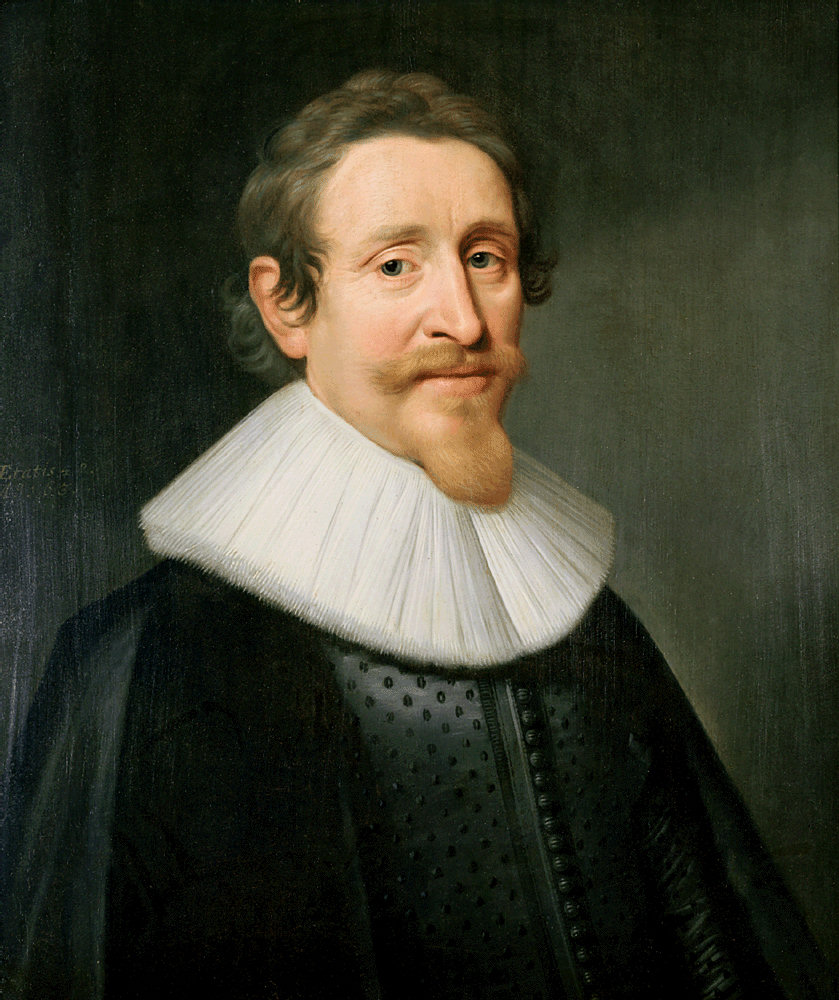
A portrait of Hugo de Groot, aka Grotius, by Michiel Jansz van Mierevelt.

His career was interrupted abruptly when, in 1619, he was condemned to life imprisonment. Two years later, his resourceful wife arranged his escape from the fortress of Loevestein in the library chest in which she normally sent his books and in which he had dutifully returned those he had read. Disguised as a plumber, Grotius escaped with Marie to Paris where, as all good internationalists do when unemployed, he tutored students.

It was in Paris in 1625 that he published his magisterial work De jure Belli ac Pacis. It was a masterpiece commanding instant recognition, and receiving an enduring reputation. Two years later, he finished “Concerning the Truth of the Christian Religion”. It rivals The Imitation of Christ in its popularity. Both have been translated into almost every language and have remained in print ever since.

Grotius’ attempts to return to his own country were well-nigh disastrous and, in due course, he entered the service of the Swedish court serving as ambassador to France. He justified his decision by stating that, like Joseph in Egypt, his people having no further use for him, he was at liberty to enter the service of others. His public probity, however, was never questioned. Throughout his exile, he steadfastly refused all commissions that might have injured the commerce or the political interests of Holland.

While on his grand tour, the young poet John Milton was sent to Grotius by Lord Scudamore, the British ambassador, who, as Milton wrote, “gave me a card of introduction to the learned Hugo Grotius at that time ambassador from the queen of Sweden to the French Court.” It is from Adamus Exul that Milton lifted much of the language for Paradise Lost. (As my friend and colleague Dr Calvin Plimpton once stated “You British never plagiarize, you plunder!”)

As ambassador, the position of Grotius was not enviable. Serving under the redoubtable Chancellor Oxenstierna, he had to attempt to extricate Sweden from an offensive alliance it had had no business concluding with France. With that country at the height of its powers and Sweden by then in decline, Sweden was no match for France. Nor was Grotius a match for Richelieu: Grotius was incapable of dissembling or deceit – very much the tools of the trade of diplomacy in those days – or of demonstrating those vulpine qualities of Richelieu that reveal themselves so startlingly in de Campaigne’s triple portrait of him.

"De jure belli ac pacis", title page from the second edition of 1631.

In 1645, while returning from a visit to Queen Christina, Grotius was shipwrecked in the Baltic and died shortly afterwards in Rostock. He lies buried in his native Delft alongside those princes of the House of Orange who, in life, hounded him so relentlessly.

Grotius’ contribution to his world was two-fold: in an age of unbridled religious passion and persecution: tolerance; and at a time of the brutality and horror of the Thirty Years War: the precepts by which nations should govern their conduct with one another and with their subjects.

The sacerdotal, obscurantist, Catholic south of Europe was then locked in a bitter struggle with the Protestant north. With the Huguenots defeated in France, the standard bearers of Calvinism became the House of Orange. Their belief in a dour and awesome God, and a mankind whose fate was predestined became an obsession in the face of Catholic persecution. They sought to establish a highly authoritarian, rigid theocracy in Holland and particularly in that country’s South American colonies under Prince Maurice the absolutism of Bacon and the leviathan of Hobbes came close to reality. While the House of Orange found strong support in the lower classes, the patrician scholars and businessmen rejected Calvinism in favour of a more generous and liberal Lutheranism. Holland had by its own industry and the accidents of history replaced Venice. Holland became the centre of world trade, banking, shipping, agriculture, industry, and scientific inquiry. With a congruence, that can often be remarked in history, politics, religion and the needs of commerce all called for a liberal and spacious government making treaties with any state, a commerce that traded with anyone and a freedom of scientific inquiry unfettered by religious constraints.

That wise and resourceful statesman Oldenbarneveldt, one of the founding fathers of his country, led this movement of enlightenment. The Calvinist synod sought support from Armenius, the noted theologian from Leyden. Instead of helping to scotch the viper in their midst, his research led him to the conclusions that there were no biblical grounds for the belief in predestination, and that man had free will which enabled him to accept – or reject – God’s grace.

Prince Maurice moved swiftly. In 1619 Oldenbarneveldt was executed, Armenius disgraced and Grotius condemned to life imprisonment. Amidst all this, Grotius remained an apostle of tolerance, believing with Erasmus and Nicholas of Cusa that “to know nothing completely is the surest faith.” Grotius continued to translate and write commentaries on the Old and New Testaments as well as to translate Euripides and write his own plays. He advocated reconciliation between Catholic and Protestant to give freedom to the many sects and schools of thought to which Holland was rapidly becoming host. But the separation of man from nature and both from God was already in evidence in Dutch life, art and belief. Some historians have seen the rapidly expanding glass industry as being particularly significant in this process. The wide use of glass and the invention of the lens not only extended the working day and the workman’s working life, but through the invention of the telescope and microscope ushered in the secular era.

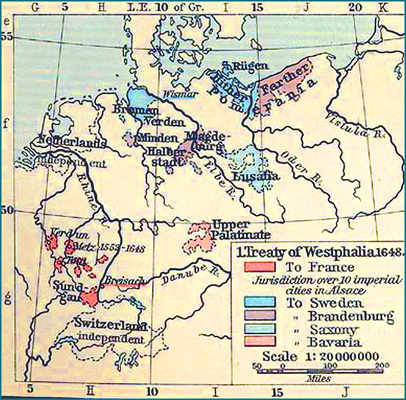
This process was most visible in the collapse of Christendom and the rise of the nation-state. Historians date the Treaty of Westphalia of 1648 as the beginning of a world of sovereign independence. But in Grotius’ time this was already a reality, and Grotius did not seek to change it. The nation-state was here to stay. What he sought to do was to rescue from the old order the works of early writers on international law so as to restore the jus naturalis as the overriding obligation not only of mankind but of states as well.

A historical Map of the Treaty of Westphalia.

The natural law to the earlier writers was divine law. It was that which was right and just and the righteous man would be a just man. Grotius saw natural law regardless whether it was divine or secular in origin, as binding on the conduct of nations as well as on man. In his major works, Grotius drew on the Spanish school of de Vitoria, Soto, Vasquez, and Suarez as well as the Italian Gentile, and through them reached back to Aquinas and Augustine. Grotius’ writings lacked the sharp edge of the Spanish School and being a practicing lawyer preferred to quote precedent 2,000 years old rather than contemporary cases.

But he codified the law as it applies to the rights, duties and obligations of states on land, at sea, in war and at peace. He sought to create a moral cosmos in which states not only observed the law in international relations with one another but also towards their own citizenry. This social order paralleled in his mind the physical order of the heavens then being revealed by Galileo and his precursors. Much of this thinking can be found in Adamus Exul in which, at seventeen, Grotius was already exploring the moral as well as the physical order of the universe.

His importance today? It is not difficult to trace the Grotian legacy in what is called the constitutive process. Beginning with Jay’s Treaty (when Jay graduated from King’s College, he travelled to Delft on a fellowship to study the Grotius papers), arrangements for arbitration and other methods of peaceful settlement began to feature in international instruments. The Alabama Claims Arbitration was a triumph for Grotian principles. The Hague Conventions and the League of Nations were similar expressions. Less visible but of much greater importance have been the everyday observance of international rules of conduct. This observance gives the lie, I think, to those positivists who regard law as only that which can be enforced.

The Grotian legacy can be found in the pursuit of human rights although it is unlikely, given his rather shaky stand on slavery, that Grotius would have seen the role of the state as an enhancer of human rights. As a realist he only hoped that the observance of natural law would restrain the state from becoming an instrument of oppression.

Many international lawyers see the Grotian legacy slipping away. The seas that for 300 years have been used by everyone as being inclusive, will, under the United Nations Law of the Sea Convention, fall for the most part under exclusive jurisdiction. Law may still have a role but it does not rule. There were more cases before the old Hague Court in the first year of the League of Nations than during the first twenty of the United Nations. As Antony Eden once remarked, “There is too much accommodation between the fire brigade and the fire.” In fact, as Kurt Waldheim has demonstrated, you can get away with almost anything as long as your timing is right.

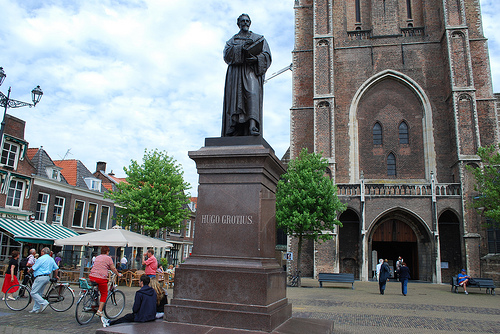
With a statue of Grotius in front of its Gothic-style Nieuwe Kerk (New Church), birthplace Delft proudly celebrates the native son.

So many say. But these trends are not a refutation of Grotius’ moral cosmos but the product of new voices raised in the international community who state that it was an immoral cosmos and one in the making of which they had had no voice: hence the search for new approaches to an equitable sharing of the world’s resources, one where the benefits of science and technology can be made universally available and one where even information would be transmitted with a greater sense of international responsibility. These new voices call not for a rejection but a redefinition of the rules that should govern the conduct of the international community.

The Grotius family motto was Ruit Hora. This was not just a Calvinist reminder not to waste time; but, that man has but a brief spell before he exchanges time for eternity and that in that period he has certain obligations to fulfil. In our international activities particularly, we are more likely to run into the would-be-Richelieu than a would-be-Grotius. All the more reason then that we should take his family’s motto and restore ourselves by making it our own.

************


Ralph Townley, a retired director in the United Nations Secretariat, is the author of United Nations: A View from Within.

Ratko Mladić: Arrest and Coming Trial – A Step Forward for World Law

In Current Events, Human Rights, International Justice, The Balkan Wars, The Search for Peace, United Nations on May 27, 2011 at 7:23 PM

RATKO MLADIĆ: ARREST AND COMING TRIAL – A STEP FORWARD FOR WORLD LAW

By René Wadlow

On May 26, 2011, President Boris Tadić of Serbia announced the arrest of General Ratko Mladić, the Yugoslav general become head of the Bosnian Serb forces of Republika Srpska. General Mladić had been charged by the War Crimes Tribunal for ex-Yugoslavia in the Hague for genocide, crimes against humanity and war crimes and thus should be sent from Belgrade to the Hague to stand trial shortly. General Mladić is particularly charged with commending the 1992-1995 siege of Sarajevo during which much of the city was destroyed and some 10,000 persons killed, often shot by snipers. The genocide charge arises mainly from the killing in July 1995 of some 8,000 Muslim men at Srebrenica which had been declared a neutral safe haven guarded by UN troops.

Mladić had been forced from his position in Republika Srpska after the 1995 Dayton Agreement, largely facilitated by the US envoy Richard Holbrooke. Mladić moved to Serbia and lived mostly in Belgrade, having changed his name. He was arrested at the farm of a cousin some 50 miles north of Belgrade in the Vojvodina area. His arrest and trial was one of the conditions set by the European Union for advancing with negotiations on Serbia joining the EU. Negotiations are now at a serious stage, and the arrest of Mladić was necessary to open the door further. Mladić kept out of sight, but he was not hiding. He had supporters in the Serbian army, police and in certain nationalist political circles. Thus an arrest earlier would not have been worth the political outcries and tensions an arrest might have provoked. Now, when EU membership and the economic future of the country are at stake, his arrest is not a very high price to pay.

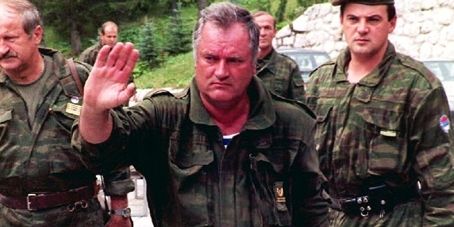
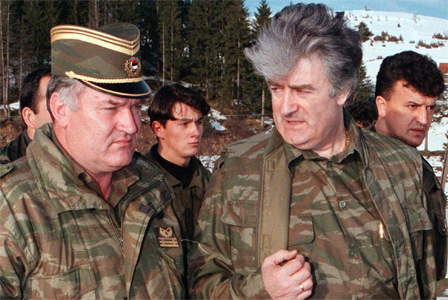
Ratko Mladić, here as the Bosnian Serb forces' top general during the civil war in Bosnia-Herzegovina (1922-1995).

It is not really satisfaction when one sees those who have betrayed one’s proposals are finally taken down. However, there is a sense of “closure” – a recognition that karma is finally at work. I did not know Ratko Mladić but saw him a number of times in the halls of the Palais des Nations — the European Headquarters of the United Nations (UN). I was in contact with Radovan Karadžić, the political head of the Bosnian Serbs — officially Prime Minister of Republika Srpska. I had been asked to be an advisor to Karadžić on UN procedures when negotiations began in Geneva in 1992. After discussions, I turned down the offer although it would have been a possibility to be a direct participant in the negotiations.

Whatever credibility I had in the Yugoslav conflict came from being a neutral and not linked to one side, although I was generally seen as pro-Serb. My first efforts had been to help Milan Babić, the leader of the Serb enclave in Croatia called Krajina. I had Babić address the UN Commission on Human Rights in February 1991 to warn of the consequences if Yugoslavia broke up. His presentation was filmed and widely shown on Yugoslav TV. I am still convinced that had his warning been taken seriously, things might have been different. However, the Commission on Human Rights was not really equipped to deal with “early warning”, and nothing was done until fighting broke out in June 1991.

Here with then General Ratko Mladić, former Bosnian Serb political leader Radovan Karadžić.

In June, Krajina declared its independence from Croatia, calling itself the Republic of Serbian Krajina. Babić was named Prime Minister. From August to December 1991, Serbs from Krajina killed hundreds of Croats and drove some 80,000 from their homes. Ratko Mladić was the head of the Krajina forces at the time and a close co-worker with Babić.

In 1992, Babić was eased out of power by behind-the-scenes pressures by Prime Minister of Serbia, Slobodan Milosevic, who wanted someone with a less independent character, at which time Mladić left Krajina and went to Bosnia where he had been born.

In 2004 Babić was sentenced to 13 years in prison for war crimes by the Yugoslav War Crimes Tribunal in The Hague and shortly afterwards committed suicide.

On July 11, 1995, General Ratko Mladić and his troops stormed the Bosnian Safe Haven of Srebrenica. With the most unwelcome participation of UN peacekeepers there, they secured the place for the Bosnian Serb army and took some 7,000 unarmed Bosnian civilians to their death.

In March 1992, Bosnia-Herzegovina declared its independence from Yugoslavia, and at the same time, Republika Srpska declared itself independent under the leadership of Radovan Karadžić. Many at the time questioned the wisdom of a unilateral splitting of Bosnia, but Mladić said “The existence of the Republika Srpska may be contested internationally, but the existence of its army cannot be contested. The Republika Srpska exists because we have our territory, our nation, our government and all the attributes of a state. Whether they acknowledge it or not — that’s their problem. The army is the fact.”

A month later, in April 1992, the siege of Sarajevo began with Ratko Mladić in charge of the Serb forces. The siege was to illustrate that a multi-ethnic society could not exist, Sarajevo being the Yugoslav city with the most ethnically-mixed population.

I had been in Belgrade in 1991 at the start of the Yugoslav fighting, just at the time of the fall of Vukovar, the first major battle, to see if NGOs could play any role in conflict reduction. But once the fighting had broken out there was really nothing that NGOs could do to prevent the spread of the conflict. The International Committee of the Red Cross tried, with great difficulty, to maintain some humanitarian efforts, but NGO conflict mediation was not really possible.

In September 1992, with fighting still going on, the Geneva Peace Conference on Bosnia began at the UN headquarters under the co-leadership of Lord David Owen on behalf of the EC and Mr. Cyrus Vance, former U. S. Secretary of State for the UN. Vance later withdrew, discouraged by the lack of progress and was replaced by Thorvald Stoltenberg, a former Minister of Foreign Affairs of Norway.

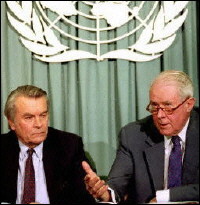
Lord David Owen, Special Representative of the European Community for Bosnia-Herzegovina, and the UN Special Envoy, former U. S. Secretary of State Cyrus Vance.

Late in 1992, as fighting was increasing and political proposals for the future of Bosnia were bogged down, David Arnott, an English Buddhist who had been working with me on Burma issues and I were the first to propose in the UN Commission on Human Rights and in a text sent to the members of the UN Security Council the creation of a number of security zones or “safe areas” within Bosnia-Herzegovina. I had been working closely with Tadeusz Mazowiecki, a former Prime Minister of Poland, who was the Special Rapporteur of the Commission on Human Rights on ex-Yugoslavia. In his November 1992 Report to the Commission, he had proposed the establishment of a security zone encompassing Sarajevo and its airport in order to facilitate the delivery of humanitarian supplies.

Building on this proposal, in an oral statement of December 1, 1992 to the “Special Session of the Commission on Human Rights devoted to Human Rights in Former Yugoslavia”, I stressed the need to create a larger number of safe havens and emphasized “that the declaration of protected Safe Haven Zones is an interim arrangement with a humanitarian purpose and in no way reduces the urgent and imperative need to find negotiated political solutions.”

Safe havens, called neutralized zones, are provided for in article 15 of the 4th Geneva Convention of August 12, 1949. On October 30, 1992, the International Committee of the Red Cross had proposed that “protected zones be set up for the civilian population at risk, away from combat areas. They would not be intended for the inhabitants of besieged towns for whose protection other solutions should be found, such as a cessation of hostilities.” This was basically a call for protected refugee camps while ours was for “protected cities” since ‘cessation of hostilities’ were not in the cards.

General Sir Michael Rose, the British senior military man who in 1994 served as Commander of the Bosnian segment of the United Nations Protection Force (UNPROFOR Bosnia). When the Bosnian Serb army attacked a UN-declared Safe Haven for the first time (that was Goražde in April 1994), General Rose and his UNPROFOR troops stood idle and let the Bosnian Serbs invade the city.

Thus our proposal was not original but rather what was needed for the hour. On April 16, 1993, the UN Security Council proclaimed Srebrenica a safety zone and on May 6 added Sarajevo, Žepa, Goražde, Bihać and Tuzla to the list. Our proposal was quoted by the then Ambassador of Afghanistan, Mr. Farhadi, during the debate on safe havens.

Thus I followed with interest how the safe havens were put into place. Srebrenica had been a middle-sized town of 6,000 prior to the fighting. It had grown to over 70,000 as families left the countryside for the relative safety of the town; infrastructure, however, could not keep up.

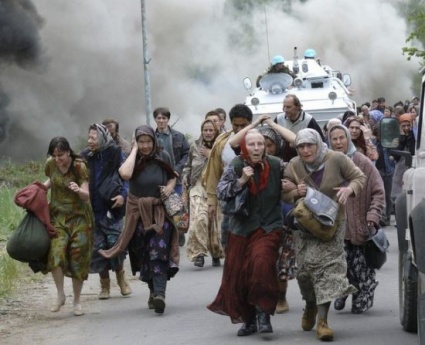
In July 1995, the “safe havens” of Žepa and Srebrenica were taken over by the forces led by Ratko Mladić. The UN forces led by soldiers from the Netherlands did not try to resist. A month earlier in June, UN forces had been taken hostage for two weeks but finally were released. Although NATO planes were dropping bombs on Serb positions at the time, it is not clear that any NATO forces would have come to the defense of the Dutch. The UN troops stood by as Mladić separated the women and children from the men. He had his soldiers kill some 8,000 male prisoners and had their bodies put into mass graves.

General Philippe Morillon, the French peacekeeper whose efforts to protect the UN-designated Safe Havens quickly made him a living legend in Bosnia-Herzegovina.

There had been so many violations of the laws of war and human rights in the Yugoslav conflicts, that there was not much public outcry at the time, although Tadeusz Mazowiecki resigned his UN position as Special Rapporteur writing to the UN Secretary-General Boutros Boutros-Ghali and making his letter public that his resignation was forced by the “horrendous tragedy which has beset the population of those ‘safe havens’ guaranteed by international agreement…I believe we have a certain hypocrisy as far as Bosnia is concerned when we are claiming to defend it but in fact we are abandoning it. The same goes for hypocrisy about the protection of human rights. I hope that my decision will also be understood as a protest against this hypocrisy.”

The wheels of karma turn slowly. As there is no longer anything at stake, more people today will agree that killing people who thought that they were protected in UN-proclaimed safe havens is not a good thing. There have been no new proposals for safe havens since and thus none has been created. I still think that it was a good idea at the time. Yet I share the observation of Michèle Mercier who had been for a long time part of the International Committee of the Red Cross team in former Yugoslavia “The word most frequently heard in the ranks of humanitarian workers is frustration. Their leaders are powerless to settle by themselves the problems involved with security and they have worn themselves out negotiating and renegotiating with opposite numbers of the most unlikely kind agreements that lose all their meaning before they are reached.” (1)

René Wadlow is Senior Vice-President and Chief Representative to the United Nations Office at Geneva of the Association of World Citizens.

(1)  Michèle Mercier Crimes Without Punishment: Humanitarian Action in Former Yugoslavia (London: Pluto Press, 1995, p. 165)

UN Peacekeeping Forces: Limits and Opportunities

In Conflict Resolution, The Search for Peace, United Nations on May 24, 2011 at 8:40 PM

UN PEACEKEEPING FORCES: LIMITS AND OPPORTUNITIES

By René Wadlow


May 29 has been designated by the United Nations (UN) General Assembly as a Day to honor UN Peacekeeping troops. Thus we are reminded that the UN remains the only universally representative and comprehensively empowered body the world has to deal with threats to international peace and security.

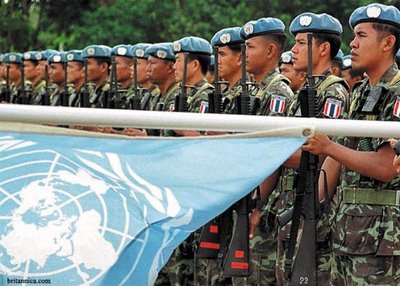
Peacekeeping operations have made the UN visible in many parts of the world, and the “blue helmets” have symbolized the peacemaking and conciliation role of the UN. The Nobel Peace Prize awarded to the “blue helmets” in 1988 testifies to the respect and confidence placed in them. The UN is the logical choice to provide a framework for multilateral engagement. The UN operates under its Charter which outlines norms of behavior, establishes means for the settlement of disputes and gives sweeping powers to the Security Council under Chapter VII for enforcement of peace. These powers are internationally binding and in many countries, carry the force of domestic laws.

Yet the UN does not have its own peacekeeping forces and must always rely on the goodwill of a relatively small number of Member States to provide soldiers and finance. Often the UN peacekeeping operations are determined not by the situation but by the resources available. In practice, the UN must accept what it can get from any state that offers units. The UN Secretariat is designed to serve its member states and does not have the authority to impose standards on contributing countries — except where UN soldiers break national laws, such as having sexual relations with under-age children.

There are situations which objectively threaten international peace and security, and the maintenance or restoration of order would require police actions, often swift and prolonged. However, for some types of action, the military working for the UN are only relatively trained. Most come from the ex-British Empire: India, Pakistan, Bangladesh, Nepal and Nigeria. They share the methods of training of the British Army and speak English. Now China is starting to provide troops with a non-English tradition.

In 1988 the UN Peacekeeping Forces were awarded the Nobel Peace Prize.

There have been a good number of suggestions that the UN create a “ready response” force of its own that would be on call and would have had special training for the broad tasks which UN troops now undertake. These suggestions have always come up against the “wall of costs” and some fears that the UN would become a “super-state” if ever it had its own forces. The UN Secretariat has established a “standby forces” study group to study equipment compatibility, standardization and shaping national units tasked for multilateral activities. Nothing visible has arisen from these studies, but they may be dusted off in future emergencies.

The ending of the “East-West Cold War” confrontation has seen the proliferation and diversification of UN peacekeeping missions, increasingly complex and difficult to conduct. Yet, “blue helmets” are increasingly called upon not so much to safeguard a peace agreement but to create a situation of peace and to transform earlier relationships, as we see in Darfur, Sudan and the eastern provinces of the Democratic Republic of Congo (basically North and South Kivu).

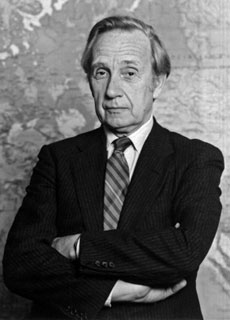
Sir Brian Urquhart, former UN Undersecretary-general for Peacekeeping Operations. The British diplomat is widely regarded as the father of UN peacekeeping as we know it today.

Currently, there is no such thing as consistency and predictability in UN actions to preserve order. The world is too complex, and UN Security Council resolutions are voted on the basis of national interests and political power considerations. UN “blue helmet” operations have grown both in numbers and complexity. Even with the best planning, the situation in which one deploys troops will always be fluid, and the assumption on which the planning was based may change by the time the force is ready for deployment or even as the force hits the ground.

Policemen, civilian political officers, human rights monitors, electoral officials, refugee and humanitarian aid specialists all play important roles along with the military. To be successful, UN peacekeeping operations need clear objectives, but such objectives cannot be set by the force commanders themselves. Peacemaking forces are temporary measures that should give time for political leaders to work out a political settlement. The parties in conflict need to have a sense of urgency about resolving the conflict. Without that sense of urgency peacekeeping operations can become eternal as they have in Cyprus and Lebanon. There needs to be real international support for UN peacekeeping operations, otherwise there is a danger that they will be overburdened, under-funded and overstretched.

UN Forces do not exist in a vacuum. They are part of world politics. They have limited but crucial roles. UN forces are one element in a peacemakers tool kit, but there needs to be a wide range of peace-building techniques available. It is not enough to say “Support our UN troops”; there must be concerned efforts by both diplomatic representatives and non-governmental organizations to resolve the conflicts where UN troops serve, as in Darfur, in the Congo, in the Middle East.


René Wadlow is Senior Vice-President and Chief Representative to the United Nations Office at Geneva of the Association of World Citizens.

Somalia: Signs of Danger

In Africa, Conflict Resolution, The Search for Peace on May 17, 2011 at 10:44 PM

SOMALIA: SIGNS OF DANGER

By René Wadlow


            Although Somalia is in a crucial geo-strategic position on the Horn of Africa facing the Arabian peninsula, the country had largely slipped from world attention except for African specialists. The government had disappeared in 1991, proving that people can live without a State if there are sub-State institutions of order and dispute settlement. Thus what order existed was the result of local warlords and clanic chiefs who provided order in very small areas, often only one town and a small area around it. In July 2006, a revitalized Islamic movement — the Union of Shari’a Courts — took control of the capital Mogadishu and in the months following extended its control to much of the country. There was a fear in other countries that Somalia could serve as a base for terrorist activities on the pattern of Afghanistan. On December 6, 2006, the UN Security Council passed Resolution 1725 which authorized the creation of a regional African peacekeeping force to enter Somalia. The creation of such a multi-state force under the authority of the African Union seemed unlikely in the near term. The African Union forces are tied up in the Darfur, Sudan conflict. Therefore, Ethiopian troops moved in at the request, it is said, of the Transitional Federal Government. Ethiopia has the best trained and equipped army in the Horn of Africa. The Ethiopian forces quickly defeated the loose coalition of clanic militias which were supporting the Union of Shari’a Courts. On December 28, 2006, Ethiopian troops and representatives of the Transitional Federal Government moved into the capital Mogadishu. Thus an analysis of the background of the conflict in Somalia is merited as the conflict has potentially wider implications.

            As William Zartman points out in his recent book  Cowardly Lions  “In a world scarred by State collapse and deadly conflict, external actors can no longer sit by and watch, mesmerized by the blood on their television screens. Nor can they hide behind the fear of their own casualties or long-term involvement as an excuse for inaction. External engagement is required when it is necessary to protect populations from their rulers and from each other. Such protective engagement is justified for its own sake, for humanitarian reasons, and for preventive security purposes, because these conflicts will continue to destabilize their regions and impose costlier involvement later on… The terrible fact is that in the major cases of state collapse in the post Cold-War era, specific actions identified and discussed at the time could have been taken that would have gone far to prevent the enormously costly catastrophes that eventually occurred… The reason why no action was taken also varies, ranging from loss of nerve to preoccupation elsewhere.” (1)

            The UN General Assembly resolution on Somalia is an indication of a growing consciousness that international action must be taken early in a conflict before positions harden. The longer a conflict lasts, the more likely the parties will harden their positions to justify the costs in lives and money that has gone on before. With the entry of Ethiopian troops into Somalia in support of the Transitional Federal Government (TFG), the Somalia crisis seems to observers to be at a critical stage when the intensity of the conflict could escalate.  Thus the need for action, although there is no clear view on what action should be taken. The first step to analyze the possibilities of action is to place the Somalia conflict into a historical and sociological framework so that alternative international actions stand out clearly.
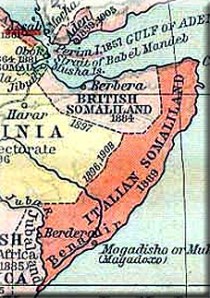
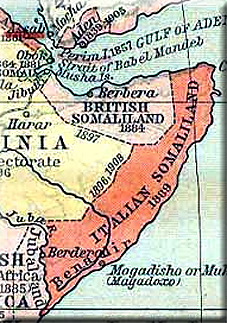
An old map of Somalia as a colony of Britain and Italy.

            In 1960, the Somali Republic was created by the union of a British colony and an Italian trusteeship area. The start of European involvement in Somali affairs began in 1902 when Italy, France, and Britain signed a Tripartite Convention that saw the Somalis divided between France taking Djibouti — a potentially important port and the terminal of the railroad to Ethiopia, the British which created Somaliland and also attached a separate area of Somali-speaking people to its Kenya colony, and Italy which created a separate colony of Italian Somaliland. The European powers recognized the expansion of the Ethiopian Empire under the leadership of Emperor Menelik which had taken control of the Ogaden area, inhabited largely by Somalis.

            The British and Italian Somali colonies existed from 1902 until 1945. At the end of the Second World War, the Italian colony was placed under a UN administration as was all of Italy’s former African holdings. From 1945 to 1950, Somalia was governed by UN administrators. By 1950 Italy had regained international respectability and so Italian Somaliland was returned to Italy under a UN Trusteeship Council mandate.

            1960 was a turning point for African independence. Although there was not among the Somalis a strong anti-colonial movement as there had been in North and West Africa, by 1960 both the French and the English believed that the colonial system as it had existed in Africa since the 1880s could no longer continue. There was a systematic granting of independence of the French colonies in 1960 and a drawn out granting of independence to the British colonies. Italy went along with the tide. Thus in 1960, both the UK and Italy granted independence to its Somali holdings and combined the two into the new state of the Somali Republic. However, there was a five day gap between the granting of independence to the UK colony and its integration into a united Somalia. This five-day status of independence now serves as the basis for the independence of the former British colony called again Somaliland, declared in 1991.
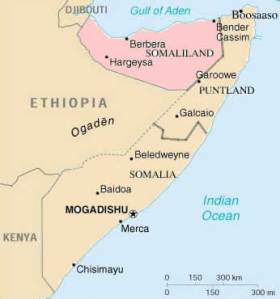
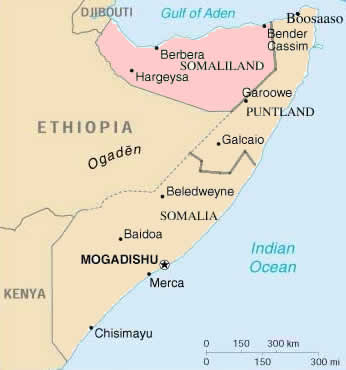
The once-united nation of Somalia now stands divided in three separate entities: Somalia proper, Puntland, and Somaliland.

           By and large, the different colonial administrations had little impact on the lives of the Somali populations. The Somalis speak the same language and practice the same forms of Sunni Islam.  The divisions among the Somalis are not tribal but clanic, with clans being followed by sub-clans, lineages, and extended families. Lineage is the most important identity. Thus one has frequent intra-clan tensions as well as inter-clan disputes. The sub-clan and lineage are the core social institutions providing personal identity, mutual support, access to local resources, and the framework of customary law, called xeer in Somali. It has been said that Somalis live in societies with rules but without rulers.

           The pastoral clan organization in Somalia is a fragile system characterized at all levels by shifting allegiances, temporary coalitions and ephemeral alliances. Lineages usually exist for three generations at which time they split and form new lineages. In such a clanic, largely pastoral society, one does not need state institutions to function. Clans are not all equal; some are severely disadvantaged due to their social status and therefore had less access to water and grazing land. There are, however, some people who lived outside the Somali clanic system. There is a small minority on the frontier with Kenya who are agriculturalists and not Somalis.  There are also a small number of urbanized Somalis, especially those living in the coastal cities who no longer followed clanic authority, as well as a small but growing educated bourgeoisie. (2)

            The great majority of Somalis are Muslim. Somali Islam is largely Sufi based with three major Sufi orders: Qaadariya, Saalihiya and Ahmadiya with other smaller groups or followers of particular saintly figures. By and large, the Sufi orders have been non-political, but the best known of the anti-colonial Somali leaders was a member of the S aalihiya order. Sayed Mohammed Abdille Hasan, called by the English “the Mad Mullah” led a 20 year struggle against Ethiopia, Italy and England starting in 1899 against Ethiopia and ending with his death in 1920.  He had been influenced by the earlier Madhi movement in Sudan.

            Sufi Islam is largely non-legalistic, placing a large emphasis on the teachings and lives of local saintly persons. Somali Sufi orders have integrated into the customary law (xeer) certain elements of Shari’a law especially as concerns family law – divorce and inheritance.

            During the last 25 years, and especially since 1991 with the end of state institutions, three other currents of Islam have been present and which are important in the analysis of the current political situation. Somalia is in the orbit of Wahhabist preaching sponsored by Saudi Arabia. This is a conservative, legalistic Islam, part of a wider Salafist movement. The Wahhabist school of thought has a good deal of Saudi money to open schools and medical clinics at a time when state facilities have largely disappeared.  There is a reformist Islamic movement, Al Islah, which is heavily influenced by the Egyptian Muslim Brotherhood and has some contacts within Pakistan. More important politically, there is a more radical At Itihad al Islamiya movement which is willing to use violence to further its aims. These non-Sufi movements are largely limited to larger towns and the few cities, but they have support from outside Somalia. (3)

            The first 10 years of independent Somali political life was largely a reflection of clan and sub-clan reality. The Parliament and the higher administration was structured on clanic reality. Government posts, seats in Parliament and government favors were distributed along clanic lines. The army was the only institution of the state that was not originally structured along clanic lines. Then in 1969, General Mohamed Siad Barre took control of the government.  His ideology was an anti-clanic “scientific socialism” drawn from his limited reading of Soviet philosophy. However, he received support from the USSR, thus bringing Somalia into the Cold War. The Cold War helped to partition Africa into ideological spheres of influence. In order to counter Soviet influence in Somalia, the USA increased its support for conservative Emperor Haile Selassie of Ethiopia.
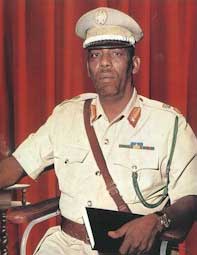
General Mohamed Siad Barre, President of Somalia from 1969 to 1991 and the country's very last head of state.

            Siad Barre, with the help of Soviet advisors, increased the size of the Army and the paramilitary forces. By 1982 there were some 120,000 men in the army with political commissars to develop ideological purity. Unlike the colonial period and the first years of independence during which the rural areas were left alone, Siad Barre extended government control to the rural areas, weakening clanic chiefs. Siad Barre also largely destroyed the independent bourgeoisies; some were jailed, more left the country to work elsewhere.

           Siad Barre, followed by probably the majority of Somali leaders, had a pan-Somali ideology which maintained that those areas of Kenya and Ethiopia where Somalis live should be joined to Somalia. The ideology had already led in the mid-1960s to attacks on Kenya which were quickly pushed back and then a much bloodier 1977-1978 war with Ethiopia in an effort to annex the Ogaden area where most of Ethiopia’s Somalis live. The fighting in Ogaden brought heavy losses to both armies. While Ethiopia pushed back Somali troops, the losses have left deep scars in Ethiopia and a persistent fear of Somali policies.

           At the time of the 1977-1978 Ogaden War with Ethiopia, there was a classic Cold War switch of alliances. A Marxist, Mengistu Haile Mariam, overthrew the emperor of Ethiopia and looked to the Soviet Union for help. In 1978, Siad Barre abrogated the USSR/Somali Treaty of Friendship and turned to the USA for help with weapons and training of the military. As Barre was uninterested in U. S. liberal-democratic ideology, he returned to governing on a clanic basis with members of his lineage, that of his mother and that of his principal son-in-law. His style of government under U. S. influence from 1978 until the end of 1991 ranged from autocratic to tyrannical.

            With the end of the Cold War, neither the USA nor the USSR had much interest in supporting difficult and unpredictable allies. Thus by 1991 both Siad Barre and Mengistu had been forced from power by rebel movements. While Ethiopia, having a long history of a weak but centralized government, was able to re-establish a state structure, Somalia returned to a precolonial structure but with few of the conflict-resolution techniques of precolonial times. Thus, in addition to traditional clanic conflicts over water and livestock, there was a clash between traditional clanic leaders and army officers who had gotten a taste of power under Siad Barre and who now wanted to set up little militarized kingdoms over which to rule.

            The 1960 merger of the Italian and British colonies had been more based on a desire of the Europeans to withdraw than any Somali urge to merge. The former British area reorganized itself after 1992 and took back the name of Somaliland. The Somaliland area is about the size of England with some 3,5 million people. In 1993, Somaliland reintroduced the structures of government: tax, customs, and banking. Somaliland has trade to Arabia and beyond through the busy port of Berbera and is helped by the remittances from the Somaliland disaspora of about one million in Saudi Arabia and the Gulf States, in East Africa and some in Europe. Somaliland, the former British colony is calm and its administration largely unchanged in Hargeisa, its capital which has become a magnet for displaced middle-class Somalis. However, there is a deep fear among many African governments that if one African state breaks up, many could follow the same pattern. Thus no African government wants to recognize the independent existence of Somaliland, and Europeans and others will not go against the African consensus by recognizing Somaliland.

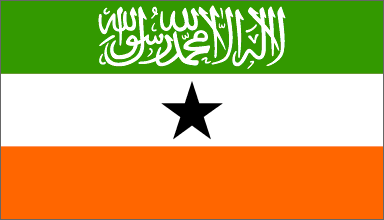
The flag of Somaliland as a would-be independent state.

            Thus, it is in the former Italian area and its capital Mogadishu where fighting is taking place and where the dangers of increased conflict exists. The following analysis concerns only this former Italian Somali colony.

            Siad Barre was in power from his coup in 1969 until January 1991. When he was forced from Mogadishu, he tried briefly to re-establish control but was finally forced into Kenya.  He died in exile in Nigeria in 1995. Those who had forced Siad Barre from power were never able to reorganize central control of the country, nor even of the former Italian area. The country was divided into small fiefdoms headed sometimes by clan leaders but more often by military officers who had served in the government of General Siad Barre and had gotten a taste for power and the wealth which came within. These “warlords” as they were called carved out fiefdoms which served as a base for the exploitation of confiscated properties; plantations for banana export, the arms trade, and drug trafficking.  Around the warlords are their business allies who run the plantations, make contacts with foreign companies  for banana exports, and especially organize the arms and drug traffics.

            The warlords used the clan and sub-clan organizations among ethnic Somalis to create alliances and build support. However, the warlords are not traditional clan leaders. There have always been conflicts among clans. However the violence in Somalia after 1991 was not caused by clan and sub-clan divisions but was a struggle for power among individuals. Once violence broke out, the clan and especially sub-clans provided a ready-made solidarity group, and old inter-clan disputes were reignited. (4)

            Fighting continued over the control of areas between two fiefs. The result was economic and political chaos, with most people living a day-to-day existence. Many of the youth have been taken into the forces of the warlords but receive no education  and even little military training. There are also independent bandit  bands interested in looting.

            Since governments do not like anarchy, there have been numerous efforts on the part of neighboring countries, in particular Kenya, to help the Somalis create a government. (5) After many failed efforts, there now exists a Transitional Federal Government (TFG) which is recognized by the African Union. The TFG is made up of some clan leaders, some warlords and some persons chosen from urban civil society. However, while people do not have much enthusiasm for a continuation of armed conflicts, there is little enthusiasm for the return of government either. Attitudes of animosity, suspicion, and hostility are dominant. It will have to be seen if the TFG is able to establish control over the country if the Ethiopian troops are withdrawn.

            The Transitional Federal Government is, no doubt, more transitional than federal. Most international mediators have preferred to focus on trying to stabilise Somalia before addressing the Somaliland issue. The TFG has as president Abdullahi Yussuf — a war lord turned president — but its authority was limited to one large town, Baidoa, 200 miles from Mogadishu. Into the political void, Islamic groups that have always been around tried starting in June 2006 to take the high ground. The al-Ittihad al Islaami (Islamic Unity, often called just al-Ittihad) is a loosely structured group which has taken in a few floating Islamic fighters, many of whom had been been in Afghanistan or Pakistan. They see the similarities between the chaos in Somalia and the time after the departure of the Soviets from Afghanistan when the resistance forces were fighting for control among themselves. They hope that with a Taliban-like ideology of “Order and Islam will solve all your problems”, the people would help them come to power to put an end to the divisions among the warlords.

           Most of these Islamist groups have created a loose structure called the Union of Shari’a Courts, sometimes called the Union of Islamic Courts. The current leader Sheikh Hassan Dahir Aweys is a former Army colonel as well as a former leader of the al-Ittihad though he claims that the Shari’a Courts have a broader base al-Ittihad. The Union of Shari’a Courts received funds but no troops from Saudi Arabian sources. The line between public and private funds in Saudi Arabia is never clear.

            Ethiopia was the regional state most concerned by the rise of the Shari’a Courts and their potential control of the country.  Ethiopia feared that the Shari’a Courts could revive the pan-Somali ideology as a way of rebuilding national unity and so might again try to join the Somali-populated Ogaden to Somalia. Since the 1977-1978 war, the Ogaden has taken on increased importance to Ethiopia. The area could have large quantities of gas but further exploration is needed to verify the amount and the possibilities to develop the field.

           As Ethiopia is helping the TFG, the Eritrean government angry with Ethiopia for unresolved frontier issues and resentments from the long struggle for independence from Ethiopia has sent some troops to aid the Union of Shari’a courts. Thus the TFG, in the spirit of “the enemy of my enemy is my friend” is trying to build links with the Eritrean Liberation Front, an armed insurgency against the Eritrean government.

            Kenya also has direct interests in Somalia — Kenya’s northeast province is populated by ethnic Somalis. From 1963 to 1967 there was on-and-off fighting between Somalia and Kenya as part of the then “Greater Somalia” policy. There are also some 135,000 Somali refugees living in Kenya, some of them involved in an active arms trade.

            Into these lands of intrigue, few want to adventure. Some countries, in particular the U. S. government, see the possibility of Somalia turning into a safe haven for al-Qaada networks. Sheikh Aweys of the Union of Shari’a Courts has already been designated as a terrorist by the USA for suspected links to al-Qaada. The USA has some 1,800 troops based nearby in Djibouti specializing in intelligence gathering and counter-terrorism. These U. S. troops are especially active since the 1998 attacks on U. S. embassies in Nairobi and Dar es Salaam which had been prepared in Somalia. The USA is unlikely to get directly involved, but they sponsored the 6 December 2006 UN Security Council resolution which opens the door to African peacekeeping troops.   

            Once Ethiopian troops moved massively into Somalia in mid-December 2006, the fighting in Somalia was brought to the attention of the UN Security Council. The USA and the UK prevented a resolution calling on all foreign troops to leave the country from being presented. The delay in passing any resolution gave time to the Ethiopian troops to fight the forces of the Union of Shari’a Courts. In fact, the Courts had few foreign forces helping them. In a tightly structured clanic society as Somalia, foreigners, even Muslims, stand out and are not welcome. There is a real risk of betrayal of foreigners who can not be integrated into the protective network of a sub-clan. The Shari’a Courts were able to draw on the militias of some sub-clans, drawing upon clanic loyalties rather than on ideological conviction. The support of these sub-clans melted away once they saw the superior fighting force of the Ethiopian army.  On December 28, Ethiopian troops and representatives of the TFG including Prime Minister Ali Muhamad Gedi and Vice Prime Minister Mohamed Hussein Aidid moved into Mogadishu with the top Shari’a Courts leaders going into exile in Yemen.

            It is too early to know if the TFG will be able to consolidate its authority since it is a coalition of clans, warlords and former administrators who have little in common. It is also too soon to know what policy Ethiopia will follow. Ethiopian Prime Minister Meles Zenawi has said that the troops will be withdrawn as soon as order is established. But who is to define “order”? It is important that those working for peace from outside Somalia follow developments closely. Somalia requires our constant concern.     


References

1)      I. William Zartman.Cowardly Lions: Missed Opportunities to Prevent Deadly Conflict and State Collapse (Boulder, CO: Lynne Rienner, 2005)

2)      I. Lewis. A Pastoral Democracy (Oxford: Oxford University Press, 1991)

3)      I. Lewis. Saints and Somalis: popular Islam in a clan-based society (London: Haan, 1998)

4)      I. Lewis. A Modern History of Somalia (Oxford: James Currey, 2002)

5)      International Crisis Group. Negotiating a Blueprint for Peace in Somalia (Brussels: ICG, 2003)


Rene Wadlow is the editor of the online journal of world politics www.transnational-perspectives.org. He is also the Senior Vice President and Chief Representative to the United Nations Office at Geneva of the Association of World Citizens. Formerly, he was professor and Director of Research of the Graduate Institute of Development Studies, University of Geneva.

الأرض هي بيتنا المشترك

In Middle East & North Africa, Poetry, The Search for Peace on May 5, 2011 at 10:00 PM
 الأرض هي بيتنا المشترك

رينيه وادلو

حياتي مشتركة
مع حياة أخرى لا تحصر،

سوى بشرية أوغيرها ؛

معا يمكننا أبداع الكمال

هذه هي الأرض.

لا استطيع ان اكون إلا كجزء

هذا الكمال؛

بسبب ذلك الكمال

أنا مواطن عالمي.

في الإنسانية،

ويمكن أن تعكس على من هو

وبالتالي يمكن فتح البوابة

لإمكانيات جديدة ولدت

معرفة النفس.

أنا المبدع.

كما الحياة ، وأنا احد قوة

النمو والتقدم.

كما وعي، ويمكنني مباشرة

هذه القوة من الخيال و

ن العلم، من الحكمة والمهارة.

يمكنني بناء ما لم

تم بناؤه من قبل.

يمكننا أن نحب ونعرف

الحلم والتغيير.

معا ، يمكننا أننخدم

مصيرالحياةفيعالمنا
واطلاق العنان للامكانات عميقة.

هذهالخدمة

هيمفتاحهويتنا الإنسانية.

ومنخلالهذه الكفاءة

أستطيع أنأداء دوربلدي

(Drawing: Evgueni Bosyatski)

كمواطنعالمي..

ويمكنأنتنعكسعلىمن هو معي

وبالتالي يمكن فتحالبوابة

لإمكانيات جديدة وولادة

نفس مطلعة.

أناالمبدع.

  كالحياة ، وأنا احدقوة

  النمو والتقدم.

بوعيي، ويمكنني أستثمار

  قوة  الخيالو

العلم، معالحكمةوالمهارة.

يمكننيبناءمالم

تمبناؤهمن قبل.

يمكننا أن نحبونعرف

الحلموالتغيير.

معا ، يمكننا أننخدم

مصيرالحياةفيعالمنا
واطلاق العنان للامكانات عميقة.

هذهالخدمة

هيمفتاحهويتناوالإنسانية.

ومنخلالهذه المهارة

أستطيع أنأدي دوري فيبلدي

كمواطنعالمي

World Citizens Call for a Thai-Cambodian Peace Zone: From Periodic Flair-ups to Permanent Cooperation

In Asia, Conflict Resolution, The Search for Peace on April 23, 2011 at 8:36 PM

WORLD CITIZENS CALL FOR A THAI-CAMBODIAN PEACE ZONE:

FROM PERIODIC FLAIR-UPS TO PERMANENT COOPERATION

By René Wadlow


In an April 23 Appeal to the United Nations (UN) Secretary-General, Ban Ki-moon, Prof. René Wadlow, Senior Vice President and Chief Representative to the United Nations Office at Geneva of the Association of World Citizens (AWC), called for renewed efforts to promote a zone of peace along the Thai-Cambodian frontier where fighting had broken out on Good Friday, April 22, and was continuing on Saturday, April 23. “Quick UN action is required to halt these periodic flair-ups and to create a zone of peace that would facilitate permanent cooperation” said the World Citizen Appeal.

The early morning Good Friday fighting between Thai and Cambodian troops took place near the ancient temples of Ta Krabey and Ta Moan Thom some 150 kilometers southwest of the better-known 900-year-old Preah Vihear  Temple where fighting had broken out in February. There have been repeated clashes around the Preah Vihear Temple, especially after 2008 when UNESCO enshrined Preah Vihear as a World Heritage site for Cambodia over Thai objections. The World Court had in 1962 decided that Preah Vihear was on the Cambodian side of the frontier.  However the only roads for easy access to the temple are from Thailand.

The World Citizen proposal for a Thai-Cambodian peace zone is based on a “peace park-condominium zone of peace” between Ecuador and Peru proposed by Professor Johan Galtung at a time of growing military confrontations between the two South American countries and published in his collection of peace proposals: Johan Galtung 50 Years (Transcend University Press, 2008, 263pp.)

The Preah Vihear Temple, a World Heritage Site.

The troops of the two countries would disengage and withdraw, and procedures would be established for joint security, patrolling, and early warning of military movements.  A code of conduct would be drawn up.  Thus the two countries with a history of hostility could use conflict creatively to grow together at the disputed point and at the speed national sentiments would tolerate and demand.  Such a zone of peace would be important both for conflict resolution and for protection of the ecology.

The fighting in February had been brought for mediation to a meeting of the Foreign Ministers of the Association for South East Asian Nations (ASEAN). Indonesia which currently holds the rotating chairmanship agreed to send military observers to the frontier area.  However, they have not yet been sent, and Thai officials considered them unnecessary.

However, the new round of fighting and the evacuation of the population of villages near the frontier indicate that the situation remains volatile. Joint cooperation between the UN and ASEAN would be important to create a stable form of third-party mediation. As Prof. Wadlow pointed out in the World Citizen Appeal, “Buddhist groups in both Thailand and Cambodia have been working for reconciliation based on the common value of compassion. There is a growing role for citizen diplomacy and mediation efforts. The Thai-Cambodian conflict is one in which such citizen diplomacy can play an important role, especially in building up the institutions of a zone of peace with joint centers for Buddhist study and practice as well as increased protection of the fragile environment. However, in light of the increased dangers of renewed fighting, swift action by governments is needed. The UN Security Council is best structured for deciding on the swift action needed”.

René Wadlow is Senior Vice President and Chief Representative to  the United Nations Office in Geneva of the Association of World Citizens.