THE DAY THAT UKRAINE ENDED THE COLD WAR
By Bernard Henry
Along with Thailand, Ukraine has gotten the attention of the world’s media due to the nonviolent demonstrations for democracy in its capital lately. The Ukrainian President, Viktor Yanukovych, once Ukraine’s Prime Minister under authoritarian leader Leonid Kuchma, has come under fire for turning his back on the European Union and favoring instead closer ties with Moscow.
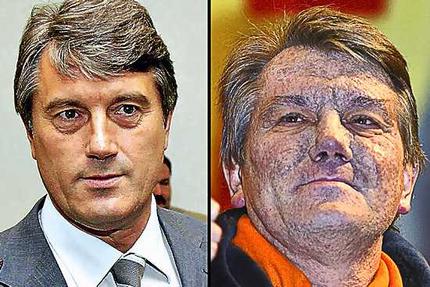
In 2004 Yanukovych had been opposed in the presidential ballot by Viktor Yushchenko, who had previously been Prime Minister too as the leader of an opposition alliance. With his face ravaged by an attempt at dioxin poisoning by agents of the Kuchma regime, Yushchenko was defeated at the polls but persistent allegations of fraud in favor of the Yanukovych camp prompted the Ukrainian people to take to the streets in what became known as the Orange Revolution. After an unprecedented three rounds of vote, Yushchenko finally won the presidency by a slight margin. Sworn in as President in January 2005, Yushchenko gradually turned his presidency into a mere sequence of revenge against both his opponents and his Orange Revolution allies, such as his iconic one-time Prime Minister Yulia Tymoshenko. Eventually, it was Yanukovych who got his revenge when in 2010 Yushchenko was shut out in the first round of the presidential election and Yanukovych won.
Seeing the country caught in such a vicious circle of political authoritarianism and uprising would almost make the world forget that, twenty-two years ago, it was the President of Ukraine who put the last nail in the coffin of the Soviet Union, thus ending the Cold War for good.
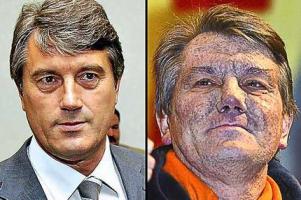
After the Orange Revolution took to power the opponent Viktor Yushchenko, who had barely escaped with his life after a dioxin poisoning attempt, Ukraine had a chance to make history once more.
Unfortunately, the one-time dissident turned authoritarian and rendered his own victory without purpose, so much so that his own people eventually had to evict him from power too.
In December 1991 Ukraine was a republic within the Union of Soviet of Socialist Republics, therefore not a sovereign state – although, oddly enough, Ukraine and Bielorussia, known today as Belarus, did have a seat at the United Nations alongside the Soviet seat. After the coup in August that year in which Communist hardliners almost removed reformist President Mikhail Gorbachev from power, the Union as its people had known it thus far found itself considerably weakened in many aspects.
Soon after the failed coup, the very communist system started to crumble. Article 6 of the Soviet Constitution, which made the Communist Party the central element of the state, was abolished. Gorbachev himself resigned from the Party, thus becoming the first-ever non-communist leader of a Soviet Union which was now down from fifteen to twelve republics. And that was only a beginning.
Gorbachev, who in December 1990 had violently repressed the declarations of independence of the three Baltic republics – Lithuania, Latvia, and Estonia, granted immediate independence to the three states which had been invaded by the Soviet Union during World War II. As for similar claims coming from others, though, Gorbachev stated clearly that those would never be granted.
On the contrary, Gorbachev was adamant that his very own plans for the country should be implemented come what may. Yet apart from the Muslim republics of the south, such as Kazakhstan, Azerbaijan and Uzbekistan, no one in the Union was supporting Gorbachev any longer. Russia’s President, Boris Yeltsin, who had risen to glory by leading the resistance against the August coup, was emerging of a natural leader of the breakaway movement.
Gorbachev had been campaigning for a “Treaty of the Union” which was to completely redesign the Soviet Union, very much in line with the perestroika (inner transformation) which he had advocated since his accession to power in 1985 after the death of Konstantin Chernyenko. With the treaty in force, the twelve republics were to become all but independent, the USSR becoming more like a confederation with little central powers left. No wonder the old guard didn’t like it. But now that his enemies were no longer a threat Gorbachev was determined to push for a wide adoption of the Treaty.
To achieve this goal, Gorbachev knew that without Russia on his side now, he desperately needed the support of the Soviet Union’s second leading republic – Ukraine, where a presidential election was planned for December 5. In the once single-party state that the Soviet Union had been, several candidates were now allowed to run for president in each of the republics. The Ukrainian election would see several rival factions compete for the presidency, among which the communist hardliners, Gorbachev’s own camp, and the chairman of Ukraine’s Supreme Soviet, Leonid Kravchuk. After the August coup Kravchuk, aged 57, had resigned from the Communist Party and declared Ukraine independent from the Soviet Union. Along with Yeltsin and Bielorussia’s President, Stanislaw Chukchievich, Kravchuk was ready to declare the death of the Soviet Union. Yet Gorbachev still hoped that Kravchuk would, if elected, sign the Treaty of the Union and have Ukraine rejoin a widely-reformed Soviet Union.
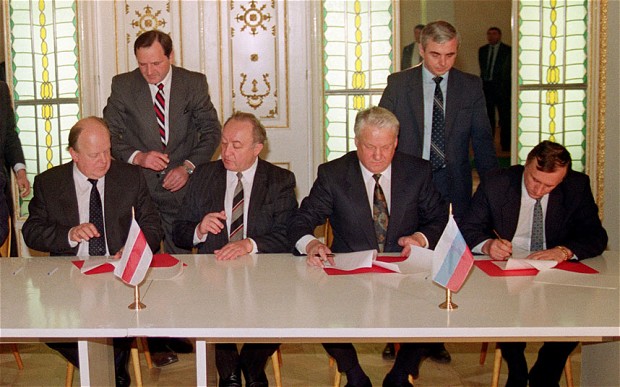
On December 5, 1991 Kravchuk won the election and immediately dozed Gorbachev’s hopes by stating that he would not sign the Treaty of the Union and Ukraine was now a sovereign state for good. Three days later Yeltsin, Chukchievich, and Kravchuk signed the Belavezha Accords, declaring the Soviet Union dissolved and replacing it with a Commonwealth of Independent States (CIS).
With a Union now comprised only by the southern Muslim republics, although the leaders of many of them had actually supported the failed coup against him, Gorbachev was forced to admit that the country he hoped to reform had now just died. On December 21 the Communist Party of the Soviet Union was banned and on December 25 Gorbachev resigned from the Soviet presidency, adding in a live television address that the Soviet Union had “ceased to exist as a subject of international law”. The Minsk-based CIS took over and Russia was recognized abroad as the legitimate successor to the Soviet Union.
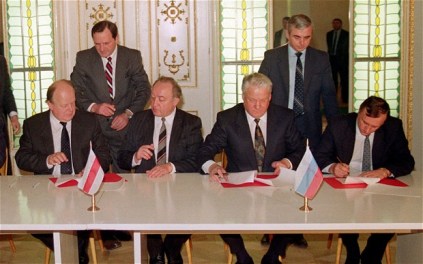
On December 8, 1991 Presidents Chukchievich of Bielorussia, Yeltsin of Russia, and Kravchuk of Ukraine (not pictured) signed the Belavezha Accords which effectively put an end to the existence of the Soviet Union and replaced it with the Commonwealth of Independent States, thus formally ending the Cold War.
If it hadn’t been for Ukraine and President Kravchuk none of this would have been possible.
Had Ukraine decided instead to support Gorbachev and sign the Treaty of the Union, history could have taken quite a different turn. Several leaders of the southern Muslim republics, such as Uzbekistan’s Islam Karimov, had supported the August 1991 coup against Gorbachev. Had he been forced to do with a downgraded union with several regional leaders openly seeking a return to the Stalin-era ways, Gorbachev likely would not have stood a second coup or a rally of hardliner leaders against him, leaving a weakened newly-independent Russia and its allies in Bielorussia and the Baltic republics hardly armed enough to face a nine-member Union poised to restore the old order by any means necessary.
As Ukraine grapples once again with democracy and rights issues today, its leaders on both sides certainly ought to take pride if only in this one thing – it is their country that saved the world from a possible Third World War, nuclear or not, by making it possible for Russia and its supporters to put an end to a Soviet Union which had failed to meet the challenges of history.
Bernard Henry is External Relations Officer of the Representative Office to the United Nations in Geneva of the Association of World Citizens.
 Association of World Citizens