The Official Blog of the

Archive for the ‘International Justice’ Category

World Citizens, Opposed to the Death Penalty, Question the Egyptian Government’s Sentencing to Death 528 People in a Mass Trial

In Current Events, Human Rights, International Justice, Middle East & North Africa, Uncategorized, World Law on March 25, 2014 at 5:51 PM

-- AWC-UN Geneva Logo --

WORLD CITIZENS, STRONGLY OPPOSED TO THE DEATH PENALTY, QUESTION THE EGYPTIAN GOVERNMENT’S SENTENCING TO DEATH 528 PEOPLE IN A SHORT MASS TRIAL

In a March 26, 2014 message to the Acting President of Egypt and to the United Nations High Commissioner for Human Rights, Prof. René Wadlow, President of the Association of World Citizens (AWC), stated that the mass trial of Muslim Brotherhood members accused of the murder of a police officer and terrorist acts during the August 2013 protests was an insult to the Spirit of Justice and a violation of the rule of law.

The AWC has repeatedly called upon governments to declare a moratorium on executions with a view to abolishing the death penalty – a penalty that extensive research has shown has little or no impact on the level of violent crime and too often opens the door to judicial errors and injustice.

The speed of the two-day trial during which defense lawyers were not able to develop their arguments is unprecedented and points to the political motivations of the current military-influenced Government.

There is a possibility to appeal the verdict, but the timing and modalities are unclear. There are some 1,200 Muslim Brotherhood supporters awaiting trial, and this trial in the Minya Criminal Count does not indicate a rule of law but rather of revenge and a desire to inspire fear of possible Government action.

The verdict now goes to Egypt’s Grand Mufti, a religious authority, for approval or rejection. It is not clear on what basis religious authorities review and make decisions on what are essentially secular trials. In practice, death sentences in Egypt are often handed down, but few have been carried out in recent years. The aims of the trials and the sentences are political: to show that death is a real possibility if one “steps out of line”.

Such a misuse of the court system undermines trust in the legal order and is in violation of the spirit and provisions of human rights law.

The AWC is devoted to the universal application of human rights law which includes fair trials and the right to adequate defense. Therefore, the AWC calls upon the Government of Egypt to revise this court case by a speedy appeal procedure and to see that the subsequent trials concerning Muslim Brotherhood members or supporters of former President Mohammed Morsi are carried out in conformity with established international norms.

Libérez Razan Zaïtouneh !

In Current Events, Human Rights, International Justice, Middle East & North Africa, United Nations, War Crimes, World Law on December 19, 2013 at 1:44 PM

-- AWC-UN Geneva Logo --

LES CITOYENS DU MONDE APPELLENT A LA LIBÉRATION IMMÉDIATE DE MAÎTRE RAZAN ZAITOUNEH ET TROIS AUTRES DÉFENSEURS DES DROITS DE L’HOMME CAPTURÉS AVEC ELLE DANS LA SYRIE EN GUERRE

Paris & Genève, le 19 décembre 2013

L’Association of World Citizens (AWC) appelle à la libération immédiate de Madame Razan Zaïtouneh, avocate syrienne des Droits de l’Homme, et de trois autres Défenseurs des Droits de l’Homme (DDH) – Monsieur Wael Hamada, Monsieur Nazem Hamadi et Madame Samira Khalil – qui ont été enlevés avec elle par des inconnus voici dix jours.

Le 9 décembre 2013, ces quatre DDH ont été capturés par des hommes masqués et armés puis conduits en un endroit inconnu, depuis les locaux du Centre pour la Documentation des Violations des Droits de l’Homme en Syrie situé à Douma.

Madame Razan Zaïtouneh défend sans relâche les droits des prisonniers politiques en Syrie. Quand la révolution, qui était au départ non-violente, a éclaté en 2011, elle a fondé les « comités locaux de coordination ». Cette même année, elle a été la lauréate du Prix Anna Politkovskaïa « RAW (Reach of Women) in WAR ».

Active également en tant que journaliste, Madame Razan Zaitouneh observe et informe sur les crimes de guerre et les atteintes aux Droits de l’Homme en Syrie. Dans le courant de cette année, le Prix « International Women of Courage » lui a été décerné pour son travail et ses efforts remarquables.

Depuis le 9 décembre, personne n’a revendiqué l’enlèvement, qui a eu lieu dans une zone où toutes les parties au conflit sont représentées et il est donc impossible de savoir avec certitude pour le compte de qui œuvraient les ravisseurs.

La seule certitude en la matière est que, qui qu’ils soient, les kidnappeurs ont commis un crime de guerre par l’enlèvement délibéré de civils dans un contexte de conflit armé, particulièrement s’agissant de DDH qui sont protégés de manière spéciale par le droit international des Droits de l’Homme.

En conséquence, l’AWC exige la libération immédiate de ces quatre DDH syriens.

Release Razan Zaitouneh!

In Current Events, Human Rights, International Justice, Middle East & North Africa, Uncategorized, United Nations, War Crimes, World Law on December 19, 2013 at 1:37 PM

-- AWC-UN Geneva Logo --

CITIZENS OF THE WORLD CALL FOR THE RELEASE OF ATTORNEY RAZAN ZAITOUNEH AND OTHER HUMAN RIGHTS DEFENDERS CAPTURED IN WAR-TORN SYRIA

Paris & Geneva, December 19, 2013

The Association of World Citizens (AWC) calls for the immediate release of Ms. Razan Zaitouneh, a Syrian human rights lawyer, and three other Human Rights Defenders (HRDs) – Mr. Wael Hamada, Mr. Nazem Hamadi, and Ms. Samira Khalil, who were kidnapped by unknown assailants ten days ago.

On December 9, 2013, the four HRDs were abducted by masked armed men and taken to unknown whereabouts from the premises of the Center for Documenting Human Rights Violations in Syria, located in Douma.

Ms. Razan Zaitouneh has tirelessly defended the rights of political prisoners in Syria. When the revolution, initially a nonviolent one, started in 2011 she founded the “local coordination committees”. That year she received the Anna Politkovskaya award “RAW (Reach All Women) in WAR”.

Also active as a journalist, Ms. Razan Zaitouneh has been monitoring and reporting war crimes and human rights violations in Syria. Earlier this year she received the International Women of Courage Award for her outstanding work and efforts.

Since December 9 no one has claimed responsibility for the abduction, which took place in a zone where all parties to the conflict are represented, making it impossible to know for sure who the kidnappers were working for.

The one thing we know for sure is that, whoever they are, the kidnappers committed a war crime by deliberately abducting civilians in a context of armed conflict, especially HRDs who are specially protected under international human rights law.

Consequently, the AWC demands the immediate release of the four Syrian HRDs.

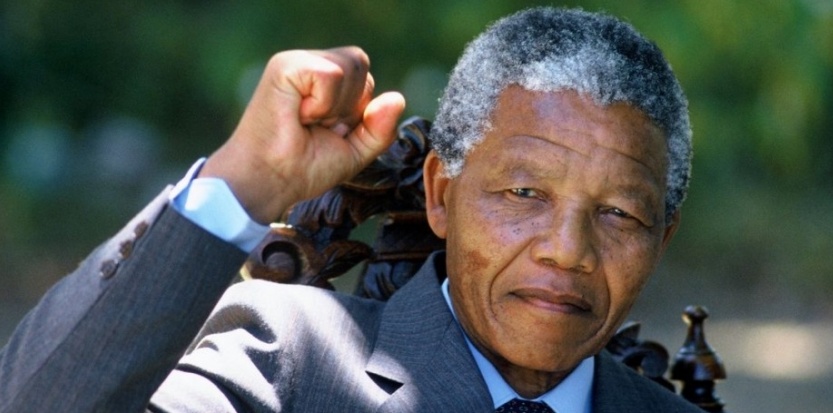
Nelson Mandela and the Struggle for Universal Human Rights

In Africa, Anticolonialism, Being a World Citizen, Current Events, Fighting Racism, Human Rights, International Justice, The Search for Peace, Uncategorized, World Law on December 10, 2013 at 12:43 PM

NELSON MANDELA AND THE STRUGGLE FOR UNIVERSAL HUMAN RIGHTS

By René Wadlow


It is appropriate that a major part of the commemoration for Nelson Mandela should fall on December 10, the anniversary of the Universal Declaration of Human Rights. Mandela was both a major actor in developing human rights in South Africa and a symbol of the worldwide struggle for the respect of human rights.  Pressure from human rights groups worldwide played an important part in his release from prison in 1990 as well as bringing an end to the deeply entrenched system of apartheid that enforced racial segregation in every aspect of South African life.

The efforts on the part of the Afrikaner-led National Party Government to enforce apartheid and to prevent opposition had led to many violations of human rights in South Africa: limits on press and expression, on the freedom of association, and the right to fair trial. Therefore, the dismantling of the apartheid system was a necessary pre-requisite for the establishment of the rule of law and respect for human rights.

Nelson Mandela led the efforts to end apartheid, a victory without the blood bath that so many had predicted and feared. He led on the path of constructive reconciliation and an inclusive society.

There is still much to do to develop equality of opportunity in South African society.  Years of discrimination, of lack of education and training, of lack of access to resources leave deep structural divides.  However, much has been undertaken, and South Africa has the potential to be an economic and political leader in Africa.

Nelson Mandela is an example of courage and conviction to secure human rights, both in his own country and worldwide, an example of the long and continuing efforts needed for human freedom.

Prof. René Wadlow is President and Chief Representative to the United Nations Office at Geneva of the Association of World Citizens.
 

5583290-la-sante-de-nelson-mandela-s-ameliore-selon-la-presidence

Can Persistent Racism be a Prelude to Genocide?

In Being a World Citizen, Fighting Racism, Human Rights, International Justice, The Search for Peace, United Nations, War Crimes, Women's Rights, World Law on December 9, 2013 at 1:31 PM

CAN PERSISTENT RACISM BE A PRELUDE TO GENOCIDE?

An Interrogation to Mark the Anniversary of the Genocide Convention

By René Wadlow

December 9 is the anniversary of the 1948 Convention on Genocide, signed at the UN General Assembly held in 1948 in Paris. The Genocide Convention was signed the day before the proclamation on December 10, 1948 of the Universal Declaration of Human Rights. The two texts were much influenced by the Second World War. The crimes of Nazi Germany were uppermost in the minds of those who drafted the Convention in order to deal with a new aspect of international law and the laws of war.

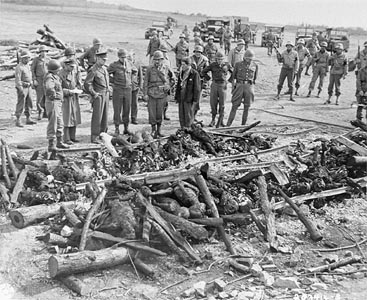
The protection of civilians from deliberate mass murder was already in The Hague and Geneva Conventions of international humanitarian law. However, genocide is different from mass murder. Genocide is the most extreme consequences of racial discrimination and ethnic hatred. Genocide has as its aim the destruction, wholly or in part, of national, ethnic, racial or religious group as such. The term was proposed by the legal scholar Raphael Lemkin, drawing on the Greek genos (people or tribe) and the Latin cide (to kill)[i].

Mass deaths are not genocide. The largest number of deaths since the end of the Second World War was the failure of Chinese agricultural policies between 1958 and 1962 with over 20 million deaths, but the aim was not to destroy the Chinese as a people. Likewise, the destructive famine in Ukraine 1932-1933 with its seven million dead had a political motivation to reduce opposition but not to destroy the Ukrainians as a people. The United States-led war in Vietnam killed some two million Vietnamese, but the aim was not to destroy the Vietnamese as a people.

Genocide in the sense of a desire to eliminate a people has nearly always a metaphysical aspect as well as deep-seated racism. This was clear in the Nazi desire to eliminate Jews, first by forced emigration from Europe and, when emigration was not possible, by physical destruction.

With the horrendous Jewish Holocaust committed by Nazi Germany in mind, on December 9, 1948 the UN General Assembly made genocide the subject matter of the very first human rights instrument created by the World organization, one day before even the Universal Declaration of Human Rights was adopted by the Assembly in Paris.

With the horrendous Jewish Holocaust committed by Nazi Germany during World War II in mind, on December 9, 1948 the UN General Assembly made genocide the subject matter of the very first human rights instrument created by the World organization, one day before even the Universal Declaration of Human Rights was adopted by the Assembly in Paris.

We see a desire to destroy totally certain tribes in the Darfur conflict in Sudan that did not exist in the much longer and more deadly North-South Sudan Civil War (1956-1972, 1982-2005). Darfur tribes are usually defined by “blood lines” — marriage and thus procreation is limited to a certain population, either within the tribe or with certain other groups with which marriage relations have been created over a period of time. Thus children born of rape — considered ‘Janjaweed babies ‘— after the government-sponsored Janjaweed militias— are left to die or are abandoned. The raped women are often banished or ostracized. By attacking both the aged, holders of traditional knowledge, and the young of child-bearing age, the aim of the destruction of the continuity of a tribal group is clear.

We find the same pattern in some of the fighting in the eastern provinces of the Democratic Republic of Congo where not only are women raped but their sexual organs are destroyed so that they will not be able to reproduce.

Thanks to the efforts of Raphael Lemkin, the international community does have a legal instrument to deal with genocide and punish perpetrators whenever necessary. The only trouble is that in this day and age, "genocide" has still not become an anachronism in global affairs.

Thanks to the efforts of Raphael Lemkin, the international community does have a legal instrument to deal with genocide and punish the perpetrators thereof. It is a shame, though, that in this day and age, “genocide” has still not become an anachronism in global affairs.

Article VIII of the Genocide Conventions provides that “Any Contracting Party may call upon the Competent Organs of the United Nations to take such action under the Charter of the UN as they consider appropriate for the prevention and suppression of acts of genocide or any of the other acts enumerated in article III”. Unfortunately no State has ever done so.

Thus we need to look more closely at the ways in which deep-set racism and constant and repeated accusations against a religious, ethnic or social category can be a prelude to genocide.


Prof. René Wadlow is President and Chief Representative to the United Nations Office at Geneva of the Association of World Citizens.


[i] Raphael Lemkin, Axis Rule in Occupied Europe (Washington: Carnegie Endowment for World Peace, 1944)

For good overviews see:

Walliman and Dobkowski (Eds), Genocide and the Modern Age (New York: Greenwood Press, 1987)

F. Chalk, K. Jonassohn, The History and Sociology of Genocide (New Haven: Yale University Press, 1990)

G.J. Andreopoulos (Ed), Genocide Conceptual and Historical Dimensions Philadelphia (University of Pennsylvania Press, 1994)

Samantha Power, A Problem from Hell: America and the Age of Genocide (New York: Basic Books, 2002)

John Tirman, The Death of Others (New York: Oxford University Press, 2011)

Violences contre les femmes : Des murs qui emprisonnent

In Human Rights, International Justice, Solidarity, United Nations, Women's Rights, World Law on November 25, 2013 at 10:57 PM

VIOLENCES CONTRE LES FEMMES : DES MURS QUI EMPRISONNENT

Par René Wadlow


Lorsque, dans son discours de lauréat du Prix Nobel de la Paix (1974), Sean McBride (1904-1988) a cité, aux côtés du développement et de l’acceptation des armes nucléaires sans discernement, l’utilisation d’armes chimiques et d’assassinats politiques comme les signes d’un « écroulement presque total de la moralité publique et privée dans pratiquement tous les secteurs des relations entre les êtres humains », il a mis l’accent sur le thème qui lui était le plus cher : la nécessité d’actions non-gouvernementales visant à assurer la survie.

Même si McBride avait servi en qualité de Ministre irlandais des Affaires Etrangères entre 1948 et 1951 et joué en cela un rôle important dans la création du Conseil de l’Europe, c’est bien en tant que dirigeant d’une organisation non-gouvernementale (ONG) qu’il a apposé sa marque dans l’histoire – en tant que premier président du Comité Exécutif d’Amnesty International (1961-1974), Secrétaire Général de la Commission international des Juristes (1963-1970) et Président du Bureau international de la Paix. C’est dans le cadre de ses efforts pour mettre en lumière l’usage répandu de la torture que nous avions commencé à travailler ensemble à Genève. Il dénonçait des techniques de torture « qui faisaient passer la poucette et le rack du Moyen Age pour des jouets d’enfants ».

Sean McBride, un authentique héros de la défense des Droits de l'Homme.

Sean McBride, un authentique héros de la défense des Droits de l’Homme.

Il critiquait particulièrement la torture et la violence à l’encontre des femmes. Il avait été élevé en grande partie par sa mère, l’actrice et militante nationaliste irlandaise Maud Gonne. Son père, John McBride, avait été pendu par les Britanniques pour sa participation à l’insurrection de Pâques en 1916, quand Sean avait douze ans. La violence contre les femmes était donc doublement injuste – parce qu’il s’agissait de violence et parce que les femmes devaient être respectées.

Quand Sean McBride, au travers d’Amnesty International, a soulevé pour la première fois la question de la torture à la Commission des Droits de l’Homme de l’ONU, les représentants des divers gouvernements ont répondu que la torture pouvait arriver occasionnellement – il y a toujours bien des policiers ou des gardiens de prison à la main lourde – mais que la torture était rare et jamais employée en tout cas au titre de politique gouvernementale officielle. Cependant, une fois que la question a été soulevée et reprise par les représentants d’autres ONG, il est devenu clair que la torture était généralisée, à travers les différentes cultures et les différents systèmes politiques eux-mêmes. En fin de compte, la Commission des Droits de l’Homme des Nations Unies a nommé un Rapporteur spécial pour la Torture et mis en place un moyen systématique d’examiner les plaintes de torture.

Pareillement, c’est pour beaucoup cette façon de faire qui a été utilisée pour faire naître une prise une conscience au sujet des violences contre les femmes. Quand la question a été soulevée pour la première fois par les représentants d’ONG, les gouvernements ont répondu là encore que la violence contre les femmes existait en effet, mais qu’elle était rare ou n’était en tout et pour tout qu’une « violence conjugale », ce qui faisait que les gouvernements ne pouvaient intervenir si la police n’agissait pas la première.

Toutefois, des preuves émanant du monde entier furent présentées par les ONG qui établissaient que la violence contre les femmes atteignait un niveau alarmant. La violence contre les femmes est une agression contre leur intégrité physique, et aussi contre leur dignité. Comme l’ont souligné les représentants des ONG, nous devons mettre l’accent sur l’universalité de la violence contre les femmes, sur la multiplicité des formes qu’elle prend et sur les façons dont la violence, ainsi que la discrimination, que subissent les femmes, et de manière plus large le système de domination basé sur l’asservissement et l’inégalité, fonctionnent en lien direct les uns avec les autres.

‘La violence contre les femmes’, de Gaetano Salerno, 80x60cm, 2013.

‘La violence contre les femmes’, de Gaetano Salerno, 80x60cm, 2013.

En réponse à cette abondance de preuves, l’Assemblée générale de l’ONU a proclamé le 25 novembre Journée internationale pour l’Elimination de la Violence contre les Femmes. La valeur d’une telle « Journée » spéciale est qu’elle offre un moment pour analyser une question donnée puis de remobilisation pour prendre des mesures tout à la fois à court terme et sur une durée plus longue.

Tout à la fois au niveau international de l’ONU et au niveau national, des programmes ont été créés en vue d’assurer l’égalité pour les femmes et la promotion des femmes dans tous les domaines. La violence physique envers les femmes a fait l’objet d’une attention de plus en plus importante, des centres pour les femmes battues ont été créés et l’on s’est aussi penché sur la question de trafic de femmes. Il a été souvent redit qu’il était nécessaire d’assurer l’éducation, la formation, la santé, la promotion de l’emploi, et l’insertion des femmes afin que celles-ci puissent participer de manière pleine et effective au processus du développement dans la société.

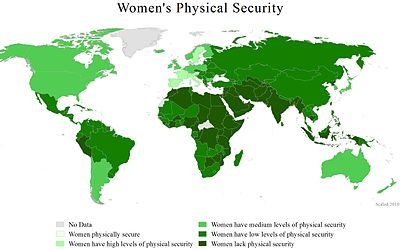
Les violences envers les femmes, encore et toujours un fléau mondial.  (c) Wikipédia

Les violences envers les femmes, encore et toujours un fléau mondial. (c) Wikipédia

Mais l’inégalité perdure, et les murs qui emprisonnent les femmes sont toujours debout. En ce 25 novembre, cette journée pour l’élimination de la violence contre les femmes, il nous faut regarder de près les différentes formes de violences qui font que de telles murailles, à travers le temps, demeurent en place.

Le Professeur René Wadlow est Président et Représentant en Chef  auprès de l’Office des Nations Unies à Genève de l’Association of World Citizens.

Violence Against Women: Walls That Imprison

In Human Rights, International Justice, Solidarity, United Nations, Women's Rights, World Law on November 24, 2013 at 6:32 PM

VIOLENCE AGAINST WOMEN: WALLS THAT IMPRISON

By René Wadlow

When in his Nobel Peace Prize address (1974), Sean MacBride (1904-1988) cited torture along with the development and acceptance of indiscriminate nuclear weapons, the use of chemical weapons, and political assassination as signs of a “near total collapse of public and private morality in practically every sector of human relationship”, he stressed his central theme: the necessity of nongovernmental actions to ensure survival.

Although MacBride had served as the Irish Foreign Minister from 1948 to 1951 and played an important role in the creation of the Council of Europe, it was as a non-governmental organization leader that he made his full mark: as an early chair of the Amnesty International Executive Committee (1961-1974), as Secretary General of the International Commission of Jurists (1963-1970) and as chair of the International Peace Bureau.  It was in his efforts to highlight the wide use of torture that we started to work together in Geneva.  He denounced torture techniques “that make the medieval thumb screw and rack look like children’s toys”.

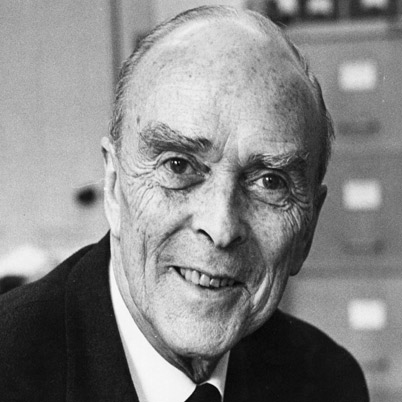
Sean McBride, a true hero of the defense of human rights.

Sean McBride, a true hero of the defense of human rights.

He was particularly critical of torture and violence against women.  He had been largely raised by his mother, the actress and Irish nationalist Maud Gonne. His father, John MacBride, was hanged by the British for his participation in the 1916 Easter uprising when Sean was 12.  Violence against women was doubly unjust: because it was violence and because women were to be respected.

When Sean MacBride through Amnesty International first raised the issue of torture in the United Nations (UN) Commission on Human Rights, the government representatives replied that torture might happen occasionally — there are always some brutal policemen or prison guards — but torture is rare and never a government policy. However, once the issue was raised and taken up by other NGO representatives, it became clear that torture is widespread, in different cultures and in different political systems.  Finally, the UN Commission on Human Rights named a Special Rapporteur on Torture and developed a systematic way of looking at torture complaints.

Likewise, it has largely been the same pattern for raising awareness of violence against women. When the issue was first raised by representatives of nongovernmental organizations (NGOs), governments replied that violence against women exists but is rare or that it is “domestic violence” and governments cannot act unless there are actions taken by the police.

However, worldwide evidence was presented by NGOs that violence against women exists to an alarming degree. Violence against women is an attack upon their bodily integrity and their dignity.  As NGO representatives stressed, we need to place an emphasis on the universality of violence against women, the multiplicity of its forms and the ways in which violence, discrimination against women, and the broader system of domination based on subordination and inequality are inter-related.

"Violence against women", by Gaetano Salerno, 80x60cm, 2013.

‘Violence against women’, by Gaetano Salerno, 80x60cm, 2013.

In a response to the evidence, the UN General Assembly has set 25 November as the UN-proclaimed International Day for the Elimination of Violence against Women. The value of a special “Day” is that it serves as a time of analysis of an issue and then of rededication to take both short-term and longer-range measures.

Both at the international UN level and at the national level, there have been programs devoted to the equality of women and to the promotion of women in all fields.  There has been growing attention to physical violence against women, the creation of centers for battered women and attention given to the trafficking of women.  It has often been repeated that it is necessary to ensure the education, training, good health, employment promotion, and integration of women so that they can participate fully and effectively in the development process.

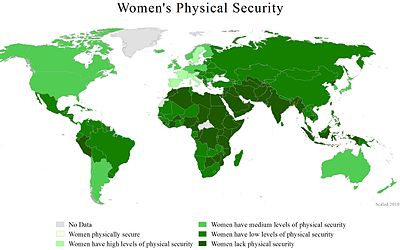
Violence against women, a global scourge. (c) Wikipedia

Violence against women, an enduring global scourge. (c) Wikipedia

Yet inequality continues, and walls still exist that imprison women. On November 25, this day for the elimination of violence against women, we need to look at the different forms of violence which keep such wall in place.

Prof. René Wadlow is President and Chief Representative to the United Nations Office at Geneva of the Association of World Citizens.
The UN and the Disappearing State of the Central African Republic

In Africa, Anticolonialism, Conflict Resolution, Current Events, Democracy, Human Rights, International Justice, The Search for Peace, United Nations, War Crimes, World Law on November 22, 2013 at 10:36 AM

THE UN AND THE DISAPPEARING STATE OF THE CENTRAL AFRICAN REPUBLIC

By René Wadlow

In a November 19, 2013 statement to the United Nations (UN) Security Council, the Secretary General, Mr. Ban Ki-moon, warned that communal violence in the Central African Republic (CAR) was spiraling out of control and backed the possibility of an armed UN peacekeeping force to complement the civilian UN staff, the Integrated Peacebuilding Office in the Central African Republic (BINUCA).

The UN faces a double task in the CAR. There is the immediate problem of violence among tribal-based militias in the absence of a national army or central government security forces. The militias basically pit the north of the country against the south. In addition, there are other militias from the Democratic Republic of the Congo which use the CAR as a “safe haven” and live off the land by looting villages. There are also segments of the Lord’s Resistance Army, largely from the Acholi tribes of northern Uganda who also use the CAR as a safe area looting as they move about.

In the absence of a standing UN peacekeeping force, UN peacekeepers would have to be redeployed from the eastern areas of the Democratic Republic of Congo, an area also torn apart by fighting among different militias and an incompetent Congolese national army. Although the UN forces have been in the Congo for a number of years, it is only in the last couple of months that they have had a mandate to be active in a military way and have started to make an impact on the security situation. By deploying UN troops away from the Congo, there is a danger that the security progress made will fade away.

The longer range task of the UN, the peacebuilding effort, is to create a national administration which provides services beyond the capital city, Bangui. This is the aim of the BINUCA, but its work is largely impossible in the light of the ongoing violence. The challenge is “State-building” which was not done during the colonial period by France.

The area covered by the current State had no pre-colonial common history, but was incorporated into French Equatorial Africa when it could have been as easily part of the Belgium Congo or added to Uganda as part of British East Africa.

Oubangui-Chari as it was then known was the poor cousin of French Equatorial Africa (AEF) whose administrative center was Brazzaville, Congo, with Gabon as the natural resource base. The Cameroon, although legally a League of Nations Mandate, was basically part of AEF. Oubangui-Chari was used as an “exile post” for African civil servants considered “trouble makers”. French colonial administrators also considered Oubangui-Chari as a posting in exile, a place to get away from as soon as possible. Schools were few, and secondary school students were sent away to Brazzaville.

There was only one political figure of standing who emerged from Oubangui-Chari, Barthelemy Boganda (1910-1959). He was the first Roman Catholic priest ordained in 1938. After the Second World War, he was elected to serve in the French Parliament as a member of the Catholic-influenced MRP Party, although he was stripped of his priesthood for going into politics and also for marrying his legislative assistant.

Boganda advocated keeping the AEF together as a federation of independent States knowing that Oubangui-Chari was the poorest of the AEF States and most in need of help from its neighbours. Unfortunately, he was killed in a plane crash on the eve of independence, and with him disappeared all enlightened leadership.

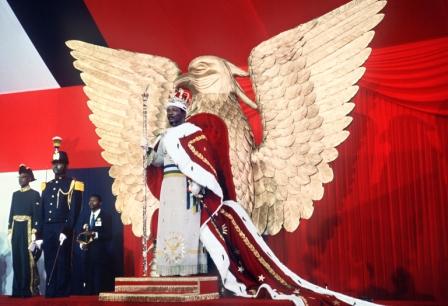
However, his stature in the political life of Oubangui-Chari was such that political power passed on to two cousins, David Dacko, first President of the independent Central African Republic and then Jean-Bedel Bokassa in 1965 who changed the name of the country to Central African Empire and ruled (or misruled) as Bokassa 1er. His dreams of being a new Napoleon was ended in 1979 by a French military intervention after Bokassa had too visibly killed young school children who were protesting.

Jean-Bedel Bokassa aka Bokassa the First, the man who would be emperor – even if it meant reigning over scorched earth.

Jean-Bedel Bokassa aka Bokassa the First, the man who would be emperor – even if it meant reigning over scorched earth.

Since Bokassa, all pretext of a unified administration has disappeared. General Kolingba, Ange-Felix Patassé, followed by Francois Bozizé were considered “Head of State”, but the State had no visible administration. Bozizé was overthrown in March 2013 by Michel Djotodia and his Seleka (alliance in the Sango language) militia. The Alliance has now been dissolved by Djotodia but replaced by nothing. A fact-finding mission sent by the UN Human Rights Council concluded that “both the forces of the former government of President Bozizé and the non-State armed group Seleka committed serious violations of international humanitarian law and international human rights law during the conflict”.

Creating order from disorder is a difficult task, especially as the pre-colonial tribal structures no longer function. There were very few inter-tribal mechanisms to settle disputes in any case. The State-building process merits close attention. Somalia remains a good example of the difficulties. The UN faces real challenges in the Central African Republic and requires help from national governments and NGOs.

Politically, Africa has always been a continent of many dramas. Hopefully, if the international community finally decides to take quick, decisive action at last, the Central African Republic will not be just another name on the list.

Politically, Africa has always been a continent of many dramas. Hopefully, if the international community finally decides to take quick, decisive action, the Central African Republic will not be just another name on the list.

René Wadlow is the President and Chief Representative to the United Nations Office at Geneva of the Association of World Citizens.
Is the UN Trying to Legalize Prostitution Worldwide?

In Current Events, Human Rights, International Justice, United Nations, Women's Rights, World Law on October 15, 2013 at 7:13 PM

IS THE UN TRYING TO LEGALIZE PROSTITUTION WORLDWIDE?

By Bernard Henry

In February 2012 Claude Guéant, the then Minister of Interior of France, caused a stir in the country by stating that “Not all civilizations are equal”, adding that one of the yardsticks against which a society could be viewed as “civilized” was “the subservience of women”[i].

For months, Guéant had spoken out almost obsessively against Islam, even branding all of France’s Muslim population “a problem” once. That latest statement was thus just another attack on a community heavily targeted by Guéant’s party, the Union for a Popular Movement (UMP), to attract voters from the anti-Muslim extreme right National Front. Eventually, President Nicolas Sarkozy and the UMP were defeated at the polls in May 2012 by Socialist Party candidate François Hollande. As for the National Front, it scored a historic 17% and was able to deprive Sarkozy of its much-needed support for the second round.

Guéant’s statement was nonsensical in many ways, not least because the subservience of women is anything but a matter of allegedly unequal civilizations. As the Charter of the United Nations has provided from the very start, and as was recalled by the Beijing Conference in 1995, women’s rights are by essence a global issue, never to be rescinded because of cultural or other differences between societies.

Then, just what is to be deducted from the proposal by two United Nations (UN) agencies to simply legalize, throughout the world, prostitution and everything that goes with it?

This is not a joke. In a September 20 appeal to the UN leadership[ii], the New York-based women’s rights organization Equality Now expressed concern about the recommendations contained in the Global Commission on HIV and the Law’s report HIV and the Law: Risks, Rights and Health (2012), published by the United Nations Development Program (UNDP), and the report Sex Work and the Law in Asia and the Pacific (2012), backed by the UNDP, the United Nations Population Fund (UNFPA) and the Joint United Nations Program on HIV/AIDS (UNAIDS).

In these two reports, Equality Now wrote, the UN agencies tell Member States that “in order to support efforts to reduce HIV/AIDS and to promote the human rights of people in prostitution, all aspects of the commercial sex industry should be decriminalized, including pimping, brothel-keeping and the purchase of sex”. The organization denounces these recommendations as being “in direct opposition to international human rights standards,” adding that these “also largely ignore the experiences and views of survivors of prostitution and sex trafficking.”

Direct opposition to human rights standards is right. When it comes to women’s rights, the international legal instrument of reference is the UN’s own Convention on the Elimination of all Forms of Discrimination against Women (CEDAW). And CEDAW’s Article 6 provides, “States Parties shall take all appropriate measures, including legislation, to suppress all forms of traffic in women and exploitation of prostitution of women.” Not quite what the two reports suggest, indeed.

Besides the letter of the law, evidence on the ground, too, does not seem to support the UN agencies’ claims. As Equality Now further recalls, “[I]n 2000 Nongovernmental Organizations and sex trafficking survivors worked to ensure that the UN Protocol to Prevent, Suppress and Punish Trafficking in Persons, Especially Women and Children (the “UN Trafficking Protocol”) defined trafficking to reflect the wide variety of sex trafficking survivors’ experiences”.

The UN Trafficking Protocol’s definition, Equality Now stresses, was the result of years of discussion and negotiation by countries and reflects a carefully drawn political consensus that should not be challenged by UN agencies. Yet the two reports disturbingly recommend revising and narrowing the definition. Should this recommendation be adopted, many victims would lose all chances of being recognized as victims of sex trafficking and their traffickers would now enjoy legal impunity for their crimes.

Sex trafficking and prostitution – two scourges that would soon be gone if there were no buyers in the first place. So why is the United Nations calling for the removal of domestic laws that make them illegal?

Sex trafficking and prostitution – two scourges that would soon be gone if there were no buyers in the first place. So why is the United Nations calling for the removal of domestic laws against them?

Ironically, in a report issued in September, UNDP, UNFPA, UN Women and UN Volunteers actually established a direct link between rape perpetration and the purchase of commercial sex, noting that both stem from gender inequality. So why are UNDP and UNFPA now advocating the decriminalization of prostitution – and accordingly the inherent decriminalization of rape?

When it comes to protecting the rights of people in prostitution, including the right to health – especially to protection from HIV – safety and freedom from violence and exploitation, throwing in the towel and letting both pimps and customers walk away with their dirty business is obviously not the way.

On September 30 the AWC issued an appeal to the UN, in line with Equality Now’s own recommendations, urging the World organization to clarify its position on the decriminalization of prostitution in all its aspects and ensure that the future development of policies and programs affecting people in the commercial sex industry includes the views of survivors and groups working on the issue.

In the Preamble to the UN Charter, “[T]he peoples of the United Nations have in the Charter reaffirmed their faith in fundamental human rights, in the dignity and worth of the human person and in the equal rights of men and women”. There can be no equality between human beings when a man can officially buy another man as a slave, all right. Now what kind of equality can there be between a man and a woman when the latter can officially be rented for sex? We would very much like an answer.

Bernard Henry is the External Relations Officer of the Representative Office to the United Nations in Geneva of the Association of World Citizens.



[i] Al Jazeera, « Sarkozy ally says all civilisations not equal », February 5, 2012.

Syria: Chemical Weapons and Restraints in War

In Current Events, International Justice, Middle East & North Africa, United Nations, War Crimes, World Law on August 31, 2013 at 3:21 PM

SYRIA: CHEMICAL WEAPONS AND RESTRAINTS IN WAR

By René Wadlow

There was a recent political drawing in the International Herald Tribune which showed high piles of skulls with signs on them which said “Killed by Assad’s Machine Guns”, “Killed by Assad’s Tanks” and two men with the two letters “UN” on their coats saying “If they really were killed by chemical weapons we’ll have to stop Assad.”

The accusations of the recent use of chemical weapons (CWs) in the Syrian conflict has led to a United Nations (UN) investigation as well as discussions at the UN and in national capitals as to the appropriate response to what has been called “a clear violation of international norms.” Yet there has been little discussion of why chemical weapons are prohibited and not tanks, and machine guns which in practice have killed many more people in Syria. To be more accurate, the drawing should have also shown piles of skulls with signs saying “Killed by armed opposition machine guns, snipers etc”.

A short review of the prohibitions on the use of chemical weapons, the UN response, and the use of chemical weapons in conflicts in the Middle East may be useful as background to a discussion of appropriate responses.

I had been active in 1975 with some other Geneva-based representatives of Nongovernmental Organizations (NGOs) in highlighting the fiftieth anniversary of the 1925 Geneva Protocol for the Prohibition of the Use in War of Asphyxiating, Poisonous or other Gases, and of Bacteriological Methods of Warfare which is the core treaty on the prohibition on the use of chemical weapons. We were encouraging states to ratify the Protocol, in particular the French-speaking African states which were not covered by the original signature of the Protocol by France even though France was the Depository Power for the treaty. The Protocol is, in fact, an international treaty. It is called a protocol because it was to have been a protocol — an attachment — to a disarmament treaty never completed within the League of Nations. We were also proposing that there be some sort of investigation – dispute settlement mechanism integrated into the Protocol along the lines then being discussed in Geneva concerning what was to become the Convention on the Prohibition of Military or any Other Hostile Use of Environmental Modification Techniques (Enmod Convention) which came into force in 1978 and has an innovative mechanism for a Committee of Experts to investigate complaints.

However, in 1968, governments had begun discussing a more comprehensive ban on chemical weapons in what was then the main UN arms control body — the Eighteen-Nation Disarmament Conference. In the UN, when negotiations are not fruitful, the practice is to add more states to the body and to change the name. Thus the Eighteen-Nation Conference became the Conference of the Committee on Disarmament (1969-1979), the Committee on Disarmament (1979-1984) and the Conference on Disarmament from 1984 until today. After nearly 30 years of negotiations a far-reaching Convention on the Prohibition of the Development, Production, Stockpiling and Use of Chemical Weapons and on their Destruction (Chemical Weapons Convention) came into force in 1997, and an Organization for the Prohibition on Chemical Weapons with a sizeable Secretariat was created in The Hague. Syria is not a party to the Convention, but it is to the 1925 Geneva Protocol.

Thus, in 1975, few governments were interested in strengthening the 1925 Geneva Protocol, hoping for a speedy conclusion of the broader CW treaty. However when in the late 1970s there were serious accusations of the use of chemical agents in the on-going conflict against the Hmong in Laos — the Yellow Rain accusations — I presented a paper distributed to the members of the Commission on Disarmament (the only ways NGOs could participate directly in the disarmament discussions) “The Strengthening of the 1925 Geneva Protocol Against Poison Gas as an Interim Step Toward a Broader Chemical Weapons Ban” (April 22, 1980). The text led to a number of private discussions with the diplomats but to no specific action.

My text did, however, build a “profile” for my concern with investigating chemical weapon use and thus for my early efforts for a UN investigation of chemical weapon use in the 1980-1988 Iraq-Iran War.

CWs had been used by the Egyptian forces in their support of the republican forces in the Yemen Civil War (1962-1967). Although Egypt had signed the 1925 Geneva Protocol in 1928, its forces used them widely in Yemen. Investigations were carried out by the International Committee of the Red Cross (ICRC) who said that it was “extremely disturbed and concerned by these methods of warfare which are absolutely forbidden by codified international and customary law.” However, the ICRC is extremely cautious in commenting publicly on abuses in conflict situations fearing that publicity would hinder its main task of care of the wounded and visits to war prisoners. Government responses to the report of Egyptian CW use were weak. The US response was muted, presumably because of its own use at the time of chemical agents in the form of herbicides and harassing agents in Vietnam. On the Geneva front, it was not until the early 1970s that NGO representatives became visibly active in UN disarmament negotiations. So there was little NGO activity over the conflict in Yemen — not a high priority area in any case.

However, the Egyptian experience was not lost on everyone. Soon after the 1967 end of fighting in Yemen, Syria requested Egyptian technical assistance in developing its own chemical weapons capabilities. Iraq was also interested in the Egyptian experience; it began its own CW program in the late 1960s turning to the US for help. In 1967, Saddam Hussein and some 15 Iraqi officials participated in a fact-finding trip to the USA to familiarize themselves with chemical warfare and defensive techniques including observation of CW tests at US proving grounds.

On March 16, 1988, the Iraqi regime, then led by Saddam Hussein, used chemical weapons in a genocidal attack on the town of Halabja, in Iraqi Kurdistan. The attack on Iraq’s own Kurdish population killed 5,000 civilians and injured at least 10,000 more. Generally dubbed “Bloody Friday”, the Halabja attack also remains in the memory of the Kurdish people of Iraq and beyond as the "Kurdish Hiroshima”. (Photo by Sayeed Janbozorgi)

On March 16, 1988, the Iraqi regime, then led by Saddam Hussein, used chemical weapons in a genocidal attack on the town of Halabja, in Iraqi Kurdistan. The attack on Iraq’s own Kurdish population killed 5,000 civilians and injured at least 10,000 more. Generally dubbed “Bloody Friday”, the Halabja attack also remains in the memory of the Kurdish people of Iraq and beyond as the “Kurdish Hiroshima”. (Photo by Sayeed Janbozorgi)

I had thought from the start that an Iraq-Iran war was not a good thing and that if frontier delimitation issues were the real reason for the war as Iraq claimed, then there were better ways of dealing with the conflicting claims. I had started seeing if mediation were possible. Saddam Hussein’s half-brother was the Iraqi Ambassador to the UN in Geneva, and I think that my proposals were sent on. The formal UN-led mediation efforts had to wait until late 1985 to be carried out in Geneva and leading to the UN-brokered ceasefire of August 1988.

The first official Iranian complaint on CW use to the UN was in November 1983. The complaint ran into the same structural difficulties I had set out in my text: the 1925 Geneva Protocol has no investigative measures and no dispute settlement provisions. Thus there was a long discussion among governments about what steps to take. Finally, there was a UN Security Council resolution authorizing an investigation. The UN investigations were largely based on examination of victims in medical facilities but which took place some days after the occurrence. The highly-regarded Stockholm International Peace Research Institute (SIPRI) carried out independently interviews with victims as part of its extensive work on chemical weapons arms control possibilities.

The UN investigations led to the conclusion that the Iraq military had used CWs in violation of the 1925 Geneva Protocol, but no further action was taken. The military effectiveness of chemical weapons in the Iraq-Iran War is a matter of debate among military specialists. According to figures released by the Iranian authorities, CWs accounted for only three per cent of their one million war casualties. However, CW impact on military morale and creating fears in the civilian population is difficult to measure. In March 1988, when Iraq publicly threatened to use CWs against Iranian cities, many persons momentarily left Teheran. In the same month, the Iraq army used chemical weapons against unprotected civilians in the Iraqi-Kurdish city of Halabja.

There is also a Red Cross convention that was invoked at the time of the mass killing at Halabja and is relevant to the Syrian case as well. In the light of the experiences of the war in Vietnam which was not an “international war” in the sense that the original Red Cross conventions cover, there was a conference in Geneva so that protection could be provided in cases of “civil” or internal conflicts. The conference led to the Geneva Additional Protocols of 1977 which states in article 51.2 “The civilian population as such, as well as individual civilians, shall not be the object of attack. Acts or threats of violence, the primary purpose of which is to spread terror among the civilian population are prohibited” Further article 51.6 stipulates that “Attacks against the civilian population or civilians by way of reprisals are prohibited.”

It is now an established fact that chemical weapons have been used this month in the Syrian conflict; but just who used them? It is the Assad regime, or did armed groups with the Free Syrian Army do it? Hopefully, the report of the UN investigation mission that was sent in to investigate will yield the much-awaited answer to this question. (C) UPI

It is now an established fact that chemical weapons have been used this month in the Syrian conflict; but just who used them? It is the Assad regime, or did armed groups with the Free Syrian Army do it? Hopefully, the report of the UN mission that was sent in to investigate will yield the much-awaited answer to this question. (C) UPI

There is as yet no agreed upon international sanctions concerning the violation of humanitarian (Red Cross) law. Humanitarian law can be cited in national court trials as was the use of CWs against the Kurds in some of the Iraq trials but not the use against the Iranians. Moreover, the post-Saddam trials resemble too much “victors’ justice” to be used as a basis of world law. The International Criminal Court can also use humanitarian law as a basis for judgments, but its justice grinds slowly.

The use of poison gas strikes a deep, partly subconscious, reaction not provoked in the same way as being shot by a machine gun. The classic Greeks and Romans had a prohibition against the use of poison in war, especially poisoning water wells because everyone needs to drink. Likewise poison gas is abhorred because everyone needs to breath to live.

The UN investigations and the appropriate responses are yet to be made. More shelling of military installations in Syria is unlikely to bring about the negotiations in good faith needed in the Syrian conflict. Thus there is a short-term need to stop beating the drums of war while at the same time stressing the condemnation of the use of chemical weapons. There is a need for longer-term efforts to start serious negotiations with as many factions of the opposition as possible and the Syrian government to create government structures more fully representative of the multi-cultural Syrian society.

René Wadlow is President and Chief Representative to the United Nations Office at Geneva of the Association of World Citizens.