By Vasileios Basios, Ph.D.
Jean Boulton, The Dao of Complexity: Making Sense and Making Waves in Turbulent Times.
Berlin: De Gruyter Brill, 2024, 400 pp.
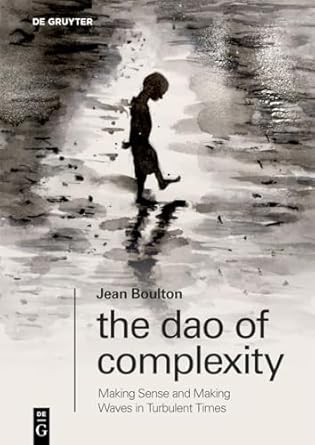
This remarkable book is distinguished by its illuminating exploration of the contemporary complex world, which is characterised by unpredictability, interconnectedness, and constantly changing flows.
Boulton’s book is intellectually invigorating and profoundly nourishing for the heart and spirit. This can be attributed to the author’s infectious enthusiasm and unique ability to translate sophisticated concepts into practical wisdom.
From the very first pages, the reader is immediately struck by a sense of illumination and inspiration. ‘The Dao of Complexity’ represents a distinctive synthesis of a treatise on systems theory and a philosophical musing on ancient wisdom. Furthermore, Boulton’s writing can be considered a form of activism. It is evident that the author employs a persuasive discourse, unique for its meticulous crafting and intimate style, to instigate a shift in perspective among the readership. This discourse serves as a catalyst, prompting novel interpretations of the intricacies and multifaceted nature of the world.
The book’s structure is so appealing, it invites you to just dip in and out, and to enjoy the thought-provoking reflections each time. Her text design is amazing. It is inspired by Daoist texts and, like these, it encourages serendipitous discovery and deep contemplation. This allows the reader to discover meaning and insights.
Here Complexity Daoism meet in a “remarkable resonance”, as she puts it, and in a vibrant resonant synthesis.
The author confidently masters two powerful traditions: the scientific study of complexity and the ancient philosophy of Daoism. Boulton masterfully unveils the deep connections between these worldviews, demonstrating that both emphasise process, emergence, and the interconnectedness of all things.
In these troubled times, with so many challenges to face – turbulence, pandemics, climate change, political unrest and wars – it’s easy to feel overwhelmed. But Boulton’s message is one of hope. She suggests that traditional, mechanistic ways of thinking are not the way to find solutions. Instead, she gently invites us to see the world as a dynamic, ever-evolving process, where outcomes are not always predictable and where our actions ripple outward in unexpected and hopeful ways.
The first part of the book, “Making Sense”, establishes this novel –but ancient– worldview. Drawing on the frontiers of quantum physics, neuroscience and political theory, Boulton confidently demonstrates that both our brains and minds as well as the world around us operate as complex, adaptive, innovating systems, constantly shaped by experience, interaction and feedback. She employs the Daoist concept of “the way that is made by walking” to demonstrate that the future is not a predetermined destination, but rather an attractor shaped by our choices and intentions.
Her perspective is liberating and challenging: it frees us from the illusion of total control and encourages humility and openness. She invites us to stay alert and attuned to subtle shifts for effective leadership and meaningful change.
The second part, “Making Waves”, is where the book really shines as a guide for action. In this, Boulton thoughtfully explores what it means to lead, innovate and create change in a world where outcomes are uncertain and linear planning often fails. She has so many stories and examples to share, covering everything from leadership and education to governance and personal growth. She shows us how to embrace complexity to create responses that are stronger, more caring and better able to adapt.
The book’s most powerful message is clear: we must learn to “make waves” without expecting to control the tide. Our actions matter, but their effects will always be shaped by the broader system in which they occur. This insight is vital for anyone engaged in social change, digital transformation or organisational leadership. Rather than clinging to rigid plans or over-relying on rules, Boulton shows us how to trust, foster creativity, and build cultures of loving, learning and adaptation.
The Dao of Complexity is the indispensable guide to the “big and pressing questions” of our time, including climate change, inequality and polarisation. It combines intellectual rigour and practical relevance with thoughtful guidance on how individuals and societies can respond with hope and determination. Her writing is characterised by a deep compassion and profound respect for the intricacies of human experience. She challenges readers to move beyond simplistic, quantitative measures of success and to value qualities like empathy, trust, and the capacity to hold paradox.
However, what made this book a really joyful and refreshing read is the fact that it is so accessible. I absolutely love how she makes even the trickiest concepts feel so welcoming and relatable. She has this remarkable ability to take these complex ideas and explain them in a way that’s so easy and deeply satisfying for everyone to understand, no matter what their background is.
In a world where control, measurement and certainty can sometimes feel like the only things we know and care about, Jean Boulton’s ‘The Dao of Complexity’ is like a warm breeze on a hot summer’s day. It’s a caring reminder to let go of the daily grind and embrace the beauty and wonder of life. I absolutely love this book. It’s one of those that will really get your creative juices flowing, fill your heart with joy and give you the courage to go out there and “make waves” in your own unique way.
I wholeheartedly recommend it! Read it again and again, for each time you will earn new insights and inspiration for our shared journey ahead.
Vasileios Basios is a Senior Researcher at the University of Brussels.
 Association of World Citizens