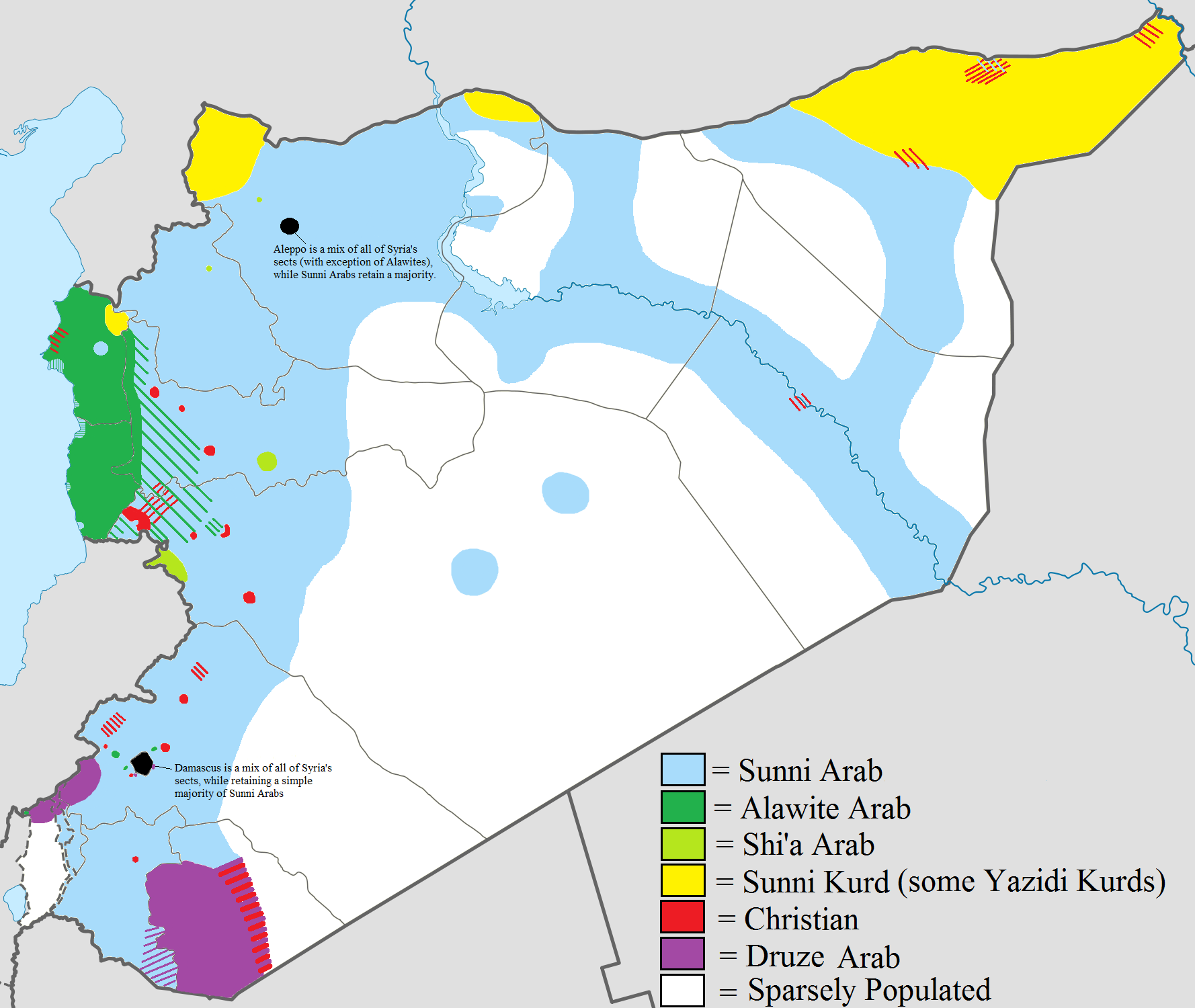
With the end of the long dictatorship of Bachar al-Assad and the naming of Ahmed al-Sharaa, leader of the militia Hayat Tahrir al-Sham (HTS), as President, there is a need for the Syrians to consider the structures of the state. Like its neighbor Lebanon, Syria is home to a number of religious and ethnic groups, sometimes mixed, especially in the major cities. In other places, one group is dominant and usually controls both the economic and political life of the area. Thus, there have been suggestions that Syria should be re-structured as a federal or confederal state.
On March 17, 2016, the “federal democratic system of Rojava” (a Kurdish term for northern Syria) was proclaimed officially. Some 150 representatives of Kurdish, Arab, and Assyrian (largely Christian) groups met in the city of Rmeilan in northeast Syria and voted in favor of the union of three ‘cantons’ largely populated by Kurds − the cantons of Afrin, Kobani, and Jezireh.
The government as well as a major opposition group stated their refusal of a federalist system which they saw as a first step to the breakup of Syria.
While the Kurdish issues in Turkey have attracted international attention, and the largely autonomous Kurdish region of Iraq is a major player in Iraqi politics, the Kurds in Syria have been less discussed.
The Kurds of Syria had not been as visible a factor as other ethnic or sectarian groups. As Michael Gunter, a specialist on the Kurdish world, writes,
On July 19, 2012, the previously almost unheard Syrian Kurds suddenly emerged as a potential game changer in the Syrian civil war and what its aftermath might hold for the future in the Middle East when in an attempt to consolidate their increasingly desperate position, government troops were abruptly pulled out of the major Kurdish areas. The Kurds in Syria had suddenly become autonomous, a situation that also gravely affected neighboring Turkey and the virtually independent Kurdistan Regional Government in Iraq. Indeed, the precipitous rise of the Kurds in Syria bid to become a tipping point that might help change the artificial borders of the Middle East established after the First World War following the notorious Sykes-Picot Agreement. (1)
In a hope of keeping the Kurds out of the growing armed conflict, shortly after the March 15, 2011 start of the Syrian armed conflict, in April 2011, Bashar al-Assad had granted Syrian citizenship to some 220,000 Kurds that had been long waiting to be considered as citizens or who had been stripped of their citizenship in a 1962 census.
However, armed conflict spread, and the Islamic State started to control territory near Kurdish majority areas. Some observers saw the Kurds as “objective allies” of Bashar as they had many of the same enemies.
Working with the regime had largely saved the Kurdish areas from government bombardment and allowed Kurdish leadership to build alternative forms of government. Gunter discusses in some detail the influence among some Kurdish leaders in Turkey and Syria of the writings of Murray Bookchin (1921-2006) and his views of ecologically-sound autonomous governance – “democratic autonomy”.
In the first years of the French mandate of Syria after the First World War, the French had created a form of ‘federal’ administration.
It is very unlikely that the Kurdish propositions will be on the agenda for new governmental structures in Syria now in 2025. The current Syrian leadership is heavily influenced by the government of Turkey, strongly opposed to anything Kurdish. The future development of the Syrian state is an issue to watch closely.
Prof. René Wadlow is President of the Association of World Citizens.
Notes
(1) Michael M. Gunter, Out of Nowhere: The Kurds of Syria in Peace and War (London: Hurst and Co, 2014, p.1)
 Association of World Citizens