By Vladimir Ionesov
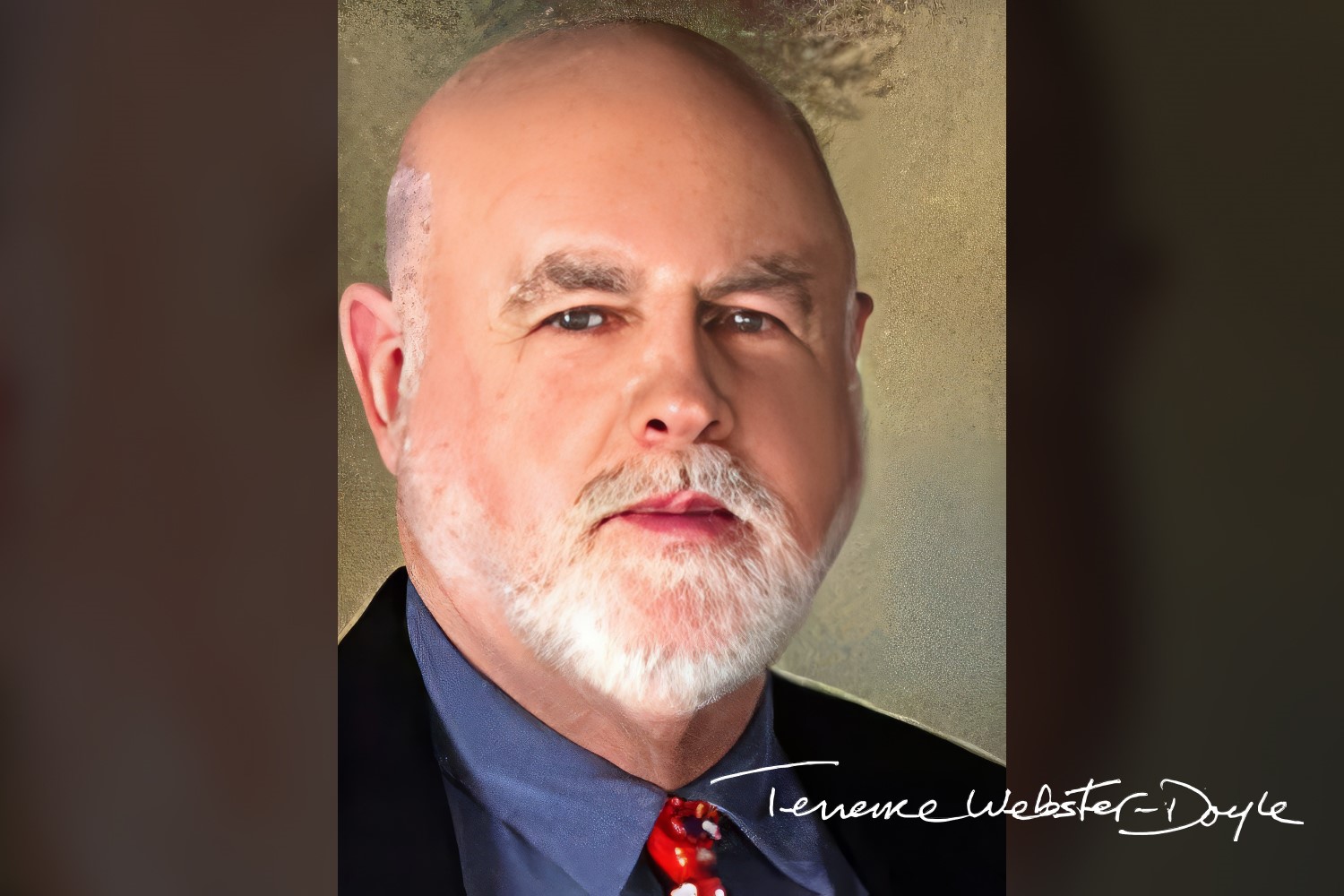
One of the most renowned authors and educators in the field of peace education, Dr. Terrence Webster-Doyle, passed away at noon on Friday, June 16, 2023, in Paonia, Colorado, USA. He was 83.
Dr. Terrence Webster-Doyle (1940-2023) was the founder and director of the Atrium Peace Institute and the Brave New Child Peace Museum Exhibits. He had a sixth-degree black belt in martial arts and was a co-founder of the Martial Arts for Peace Safety Awareness Response System Program (MAP STARS). Holding a Ph.D. in Health and Human Services, a Master’s Degree in Humanistic Psychology, he taught at Sonoma State University and Santa Rosa Community College in California.
He was the author of more than 150 scientific and methodological works, including 15 monographs, 20 textbooks and 23 curricula; the developer of a series of conflict resolution courses for adolescents; a ten-time recipient of the Benjamin Franklin Lifetime Achievement Award for excellence in independent publishing. He was awarded the Robert Burns Medal by the Albert Schweitzer Society of Austria for outstanding service in promoting peace. Recipient of the Benjamin Franklin Gold Medal for his book “Fighting the Invisible Enemy. Understanding the Effects of Conditionality”.
Dr. Terrence Webster-Doyle’s books have been widely recognized by the professional community as an important resource in conflict prevention and resolution. He is the author of the first seminal book on bullying “Why Is Everybody Always Picking on Me? A Guide to Handling Bullies”. Dr. Webster-Doyle is credited to have given a human face back to the culture of peace.
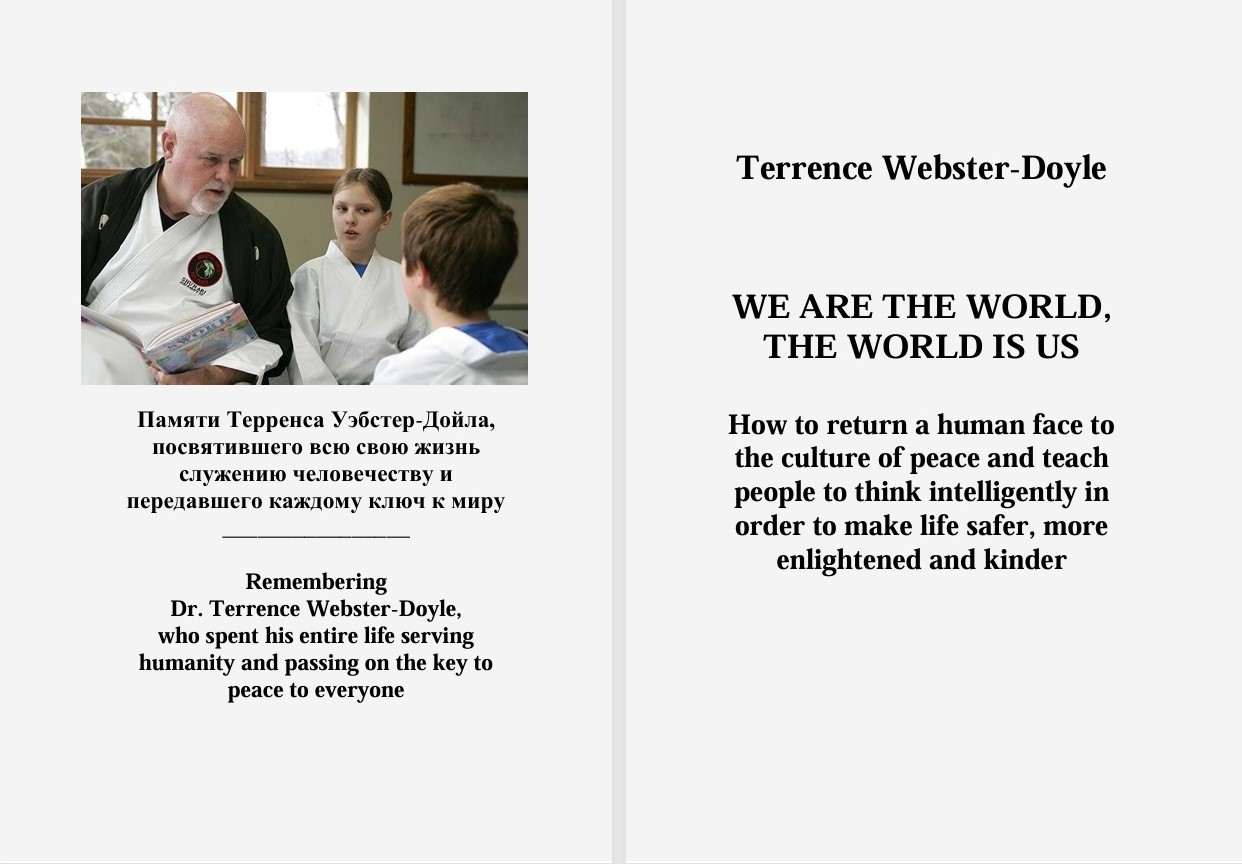
In one of his latest books, A Mini Museum on Understanding the Roots of Prejudice and Discord. Learn More about How to Make Life Safer and Kinder (Samara, 2022), T. Webster-Doyle invites young people to take a fascinating page-by-page museum tour through the illustrated ideas, images, and stories in the book, and learn more about the anthropological, psychological, historical, and social roots of reprehensible thinking and hostility between people, cultures, and nations. The author thrives to show that freeing oneself from prejudice and understanding the root causes of fear and violence in human life is the way to make life better, more peaceful and kinder.
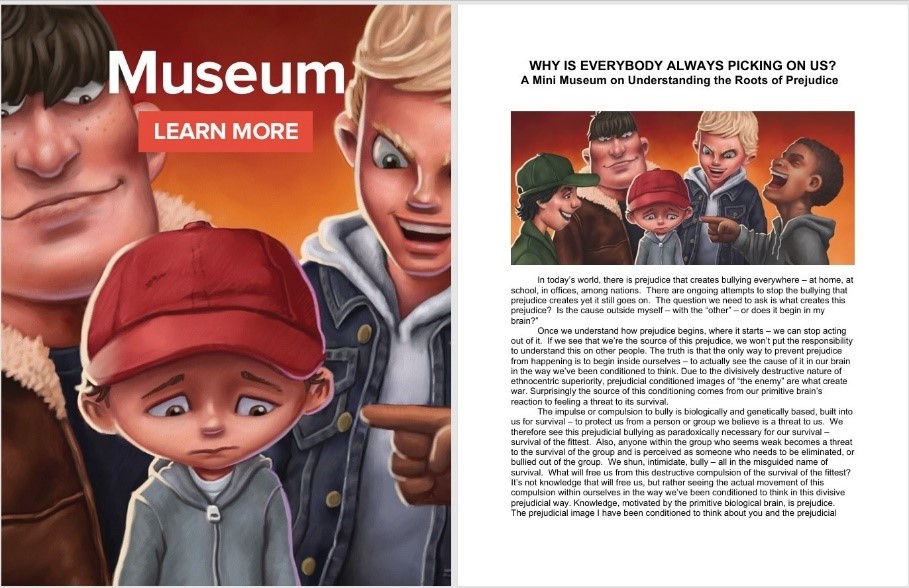
A two-page spread of the book Museum: Learn More. Why is Everybody Always Picking on Us? A Mini Museum on Understanding the Roots of Prejudice (English Edition, Atrium Society Publications, USA, 2019. – 75 p.)
In his writings, Webster-Doyle sought to show that all the best in a person is tied to peace. To achieve peace, we must understand what hinders it, and what hinders it is our very predisposition to ethno- and sociocentrism. The origins of conflicts lie in our prehistory, in the biological predisposition of our brain to protect itself from external threats – imaginary and real. Sometimes a person does not notice how he/she himself/herself becomes a victim of his/her own prejudices. No image. No enemy. No war. It is important to be able to observe and recognize situations that challenge us based on cultural resistance and behavioral stereotypes, and not succumb to outbursts of intolerance, hostility, and aggression.
Once in a conversation with me, T. Webster-Doyle shared the thought that “peace is a given, but only as a premise, a potential, under attack every time by prejudice and preconceptions. Peace requires a true awakening of the mind, here and now, but peace does not require multiple and endless theoretical constructions. Therefore, it is important to understand what creates it, and how one can achieve a real, rather than an imaginary peace”.
Т. Webster-Doyle thought a lot about why people cannot create a lasting peace and find harmony with each other. He began to ask questions: how to bring cultures closer together, to deal with mistrust and enmity, to learn how to build peace on the basis of reasonable, virtuous and humanistic principles. In my search for answers to these questions, I began to use the training materials he developed on peacebuilding pedagogy.
Terrence Webster-Doyle never ceased to remind people that “understanding is the key to peace”. But how can we find the key to understanding itself? Maybe it is the works of T. Webster-Doyle that could become such a key, opening the doors to dialogue, peace and harmony among peoples, cultures and nations.
Vladimir Ionesov, Doctor of Cultural Studies, Candidate of Historical Sciences, Professor with the Department of Cultural Studies, Museology and Art History at Samara State Institute of Culture. Developer of the concept of cultural transformation and models of civilization viability in transition. Full member of the European Academy of Sciences and Arts. Deputy Chairperson, Research Advisory Council, “Personality. Culture. Peace” Scientific and Enlightening Center of Samarkand International University of Technology (SIUT).
 Association of World Citizens