By Lawrence Wittner
Samuel Zipp, The Idealist: Wendell Willkie’s Wartime Quest to Build One World.
Cambridge, MA: Belknap Press of Harvard University Press, 2020
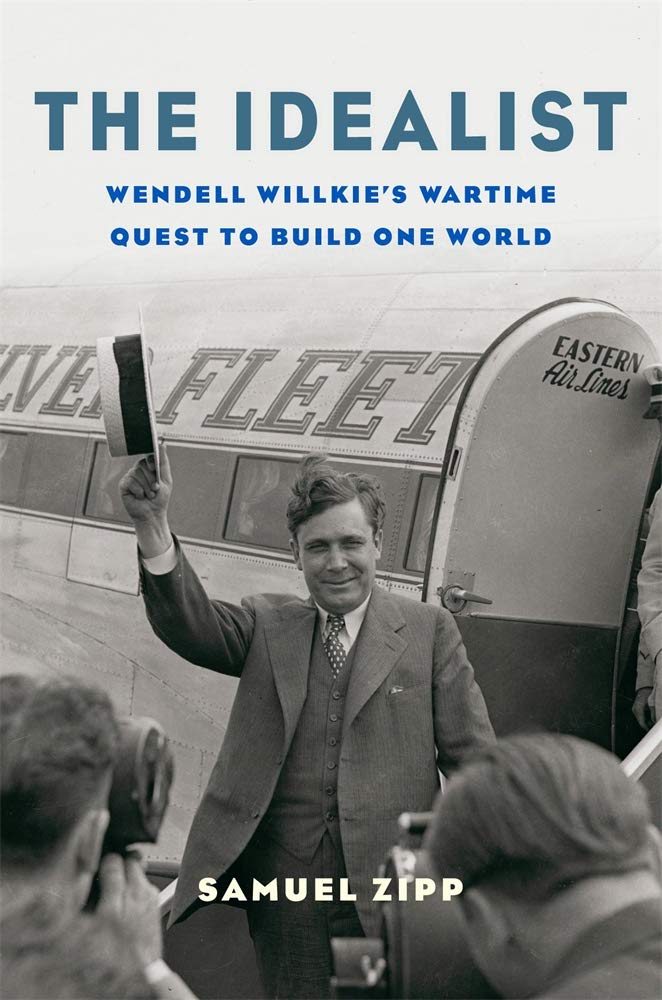
Wendell Willkie – successful lawyer and businessman, as well as a defeated candidate for U.S. President on the Republican Party ticket in 1940 – is a largely forgotten figure today. But, as Samuel Zipp reminds us, Willkie was extremely influential during World War II, when he launched a popular campaign for “global interdependence” or, as it became known, “One World.”
In this beautifully written and well researched book, Zipp, Professor of American Studies at Brown University, points out that, unlike the conservatives and isolationists in his party, Willkie was a liberal who had backed Woodrow Wilson’s call for a League of Nations, advocated racial equality, and usually supported President Franklin D. Roosevelt’s policy of collective security.
Indeed, with World War II well underway, he and Roosevelt hatched a plan to have Willkie embark on a worldwide goodwill tour, by aircraft, from August to October 1942. This well-publicized venture was designed to demonstrate America’s political unity in wartime, foster support for the Allied powers, and provide a source of information on governmental and public opinion abroad.
Willkie – an informal, garrulous, likeable individual with a common touch – not only had great success along these lines, but was powerfully influenced by what he saw. Appalled by imperialism and racism and impressed by the demand for freedom of colonized or subordinate people in Africa, the Middle East and Asia, Willkie returned, as Zipp notes, convinced of the need to get Americans “to see the wider world through the lens of fraternity and cooperation.” He hoped to convince them that their independence “would require a new form of interdependence with the world,” one in harmony with “global desires for an end to empire and a guarantee of self-determination.”
Back in the United States, Willkie embarked on a round of interviews, speeches, and articles along these lines, capped off by the publication of an immensely popular book, One World. With sales topping 1.6 million copies by July, some observers called it the best-selling book in U.S. history. Furthermore, that June over 100 newspapers in the United States and abroad, with a combined circulation of over seven million readers, ran an abridged version in their pages. Using his celebrity status to assail both “narrow nationalism” and “imperialism,” Willkie produced what Zipp calls “a fleeting moment,” when he “showed the country an alternative possible future.”
But the moment passed. Nationalists and imperialists began to criticize this vision, the Republican Party repudiated his leadership, and, in October 1944, Willkie – only 52 years of age – died of a heart attack. Although, after the atomic bombing of Japan, world federalist and nuclear disarmament groups adopted “One World or None” as their slogan, the idea of egalitarian global interdependence gradually lost favor, despite its occasional revival by environmentalists and others.
Even so, Zipp concludes, Willkie’s “diagnosis of the value of global interdependence has never been more prescient,” while “his warnings about the perils of racially charged ‘narrow nationalism’ have never been more indispensable.”
Lawrence Wittner (http://lawrenceswittner.com) is Professor of History Emeritus at SUNY/Albany.
 Association of World Citizens