AIME CESAIRE (1913 – 2008): A BLACK ORPHEUS
By René Wadlow
My negritude is not a stone,
nor deafness flung out against the clamor
of the day
my negritude is not a white speck of dead water
on the dead eye of the earth
my negritude is neither tower nor cathedral.
Return to My Native Land
On April 6, 2011, Aimé Césaire was honored by the President of the French Republic, Nicolas Sarkozy, at the Pantheon, a monument in Paris where persons who have contributed to French political culture are honored. Aimé Césaire, the Martinique poet and political figure, was a cultural bridge builder between the West Indies, Europe and Africa. A poet, teacher, and political figure, he had been mayor of the capital city, Fort-de-France for 56 years from 1945 to 2001, and a member of the French Parliament without a break from 1945 to 1993 — the French political system allowing a person to be a member of the national parliament and an elected local official at the same time. First elected to Parliament as a member of the Communist Party, he had left the Party in 1956 when he felt that the Communist Party did not put anti-colonialism at the center of its efforts.
The Communist Party’s position was that colonialism would end by itself once the workers had come to power. Césaire went on to form a local political party which existed only in Martinique and was largely his political machine for creating municipal jobs. Césaire faced a massive rural to urban migration on the 400,000 person West Indian department of France. One answer to unemployment was to create municipal posts largely paid for from the central government budget — a ready pool of steady political supporters. Césaire also did much to develop cultural activities from his mayor’s office— encouraging theater, music and handicrafts.
Aimé Césaire’s wider fame was due to his poetry and his plays — all with political implications, but heavily influenced by images from the subconscious. Thus it was that André Breton (1896-1966) writer and ideologue of the Surrealists saw in Césaire a kindred soul and became a champion of Césaire’s writing. Breton had been interested in African art and culture, by its sense of motion, color and myth. Breton often projected his own ideas onto African culture seeing it as spontaneous and mystical when much African art is, in fact, conventional and material. Nevertheless, Breton, who spent some of the Second World War years in Martinique, was able to interest many French writers and painters in African culture. It was Breton who encouraged Jean Paul Sartre to do an early anthology of African and West Indian poetry – Black Orpheus – and to write an important introduction stressing the revolutionary character of the poems.
Aimé Césaire’s parents placed high value on education — his father was a civil servant who encouraged his children to read and to take school seriously. Thus Césaire ranked first in his secondary school class and received a scholarship in 1931 to go to France to study at l’Ecole Normale Supérieure — a university-level institution which trains university professors and elite secondary school teachers. He was in the same class with Léopold Sédar Senghor of Senegal and Leon Damas. They, along with Birago Diop also from Senegal, started a publication in Paris L’étudiant noir (The Black Student) as an expression of African culture. One of Césaire’s styles in poetry was to string together every cliché that the French used when speaking about Africa and turning these largely negative views into complements. Thus he and Senghor took the most commonly used term for Blacks, Nègre, which was not an insult but which incorporated all the clichés about Africans and West Indians and put a positive light upon the term. Thus negritude became the term for a large group of French-speaking Africans and French-speaking West Indians – including Haiti – writers. They stressed the positive aspects of African society but also the pain and agony in the experience of Black people, especially slavery and colonialism.
In 1938, just as he finished his university studies, Césaire took a few weeks’ vacation on the coast of Yugoslavia. There he wrote in a burst of energy his Cahier d’un retour au pays natal (Notebook of the Return to My Native Land), his best known series of poems. In 1939, he returned to Martinique having married another teacher from Martinique who was also trained in Paris. Both started teaching at the major secondary school of Martinique and started being politically active. However, by 1940, Martinique was under the control of the Vichy government of France and political activity was firmly discouraged. Thus Césaire concentrated on his writing. He met André Breton who spent the war years in the USA. Breton encouraged an interest in the history and culture of Haiti. While Haiti is physically close to Martinique, Haitian history and culture is often overlooked — if not looked down upon — in Martinique. Césaire wrote on the Haitian independence leader Toussaint Louverture as a hero, and later a play in 1963 La Tragédie du roi Christophe largely influenced by the early years of the dictatorship of Francois Duvalier.
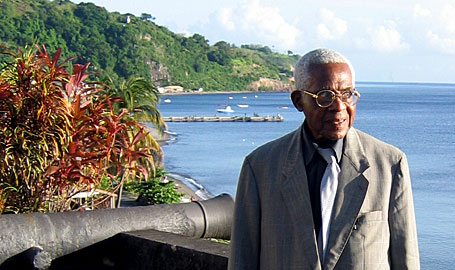
Aimé Césaire (1913-2008)
With the end of the Second World War, the French Communist Party had one third of the seats in the Parliament of the newly created Fourth Republic. The French Communists were looking for potential candidates from Martinique where the Party was not particularly well structured. They turned to young, educated persons who had a local base. Césaire, with his Paris education and as a popular teacher at the major secondary school fitted that bill. He was elected the same year both to Parliament and to the town hall. When in Paris, he took an active part in cultural life, especially with African students and young intellectuals. In 1947, along with the Senegalese Alioune Diop and Senghor, he founded the journal Présence africaine which later became also a publisher of books and the leading voice of the negritude movement.
As the French Communist Party had a rule of tight party discipline, Césaire played no independent role in the French Parliament until he left the Party in 1956. However, his 1950 Discours sur le Colonialisme, at the same time violent and satiric became the most widely read anti-colonial tract of the times, calling attention to the deep cultural roots of colonial attitudes. After 1956, most of his efforts in Parliament were devoted to socio-economic development for Martinique. His strong anti-colonial efforts were made outside Parliament, especially in the cultural sphere. Nevertheless, as a member of Parliament he could open doors that poets do not usually enter.
Césaire, who read English well, was interested in the writings of Langston Hughes whose poems were close in spirit and style. He translated into French some of the poems of the Negro poet Sterling A. Brown.
In the 1960s, Césaire turned increasingly to writing plays, especially on the history of Haiti, as the earliest independent State of the West Indies. These were verse plays as the actors’ dialogues were nearly poems. As the French African colonies became independent in the 1960s, he stressed that the end of colonialism was not enough but that colonial culture had to be replaced by a new culture, a culture of the universal, a culture of renewal. “It is a universal, rich with all that is particular, rich with all the particulars that are, the deepening of each particular, the coexistence of them all.”
René Wadlow is Senior Vice President and Chief Representative to the United Nations Office in Geneva of the Association of World Citizens.
 Association of World Citizens