The Official Blog of the

Archive for the ‘Current Events’ Category

Le Kef, Tunisie: Il suffit d’une ville pour soutenir une révolution

In Current Events, Democracy, Human Development, Middle East & North Africa, Solidarity on March 4, 2011 at 1:19 PM

LE KEF, TUNISIE: IL SUFFIT D’UNE VILLE POUR SOUTENIR UNE REVOLUTION

Par Cherifa Maaoui

Je suis une Citoyenne du Monde, membre de l’AWC depuis 2007, mais je suis aussi, au départ, une Tunisienne.

Pendant la révolution, une partie de ma famille était en visite chez moi, dans la banlieue de Paris, pour les Fêtes de Fin d’Année, et le matin même de la chute de Zine el Abidine ben Ali, ils étaient là, avant de prendre quelques heures plus tard le vol du retour …  C’est du moins ce qu’ils pensaient, que nous pensions tous. Après la réouverture de l’espace aérien tunisien, quand ils sont revenus là-bas, ce n’était plus le même pays, du moins sur le plan politique. Car chez nous, dans la ville de nos racines, malgré la révolution, rien n’avait vraiment changé.

Je suis née dans une ville du nord-ouest de la Tunisie, El-Kef, ou plutôt, pour les Français, « Le Kef ». L’Algérie n’est pas loin, à quarante kilomètres seulement, plus proche que Tunis qui se trouve à 175 kilomètres de chez nous. C’est une ville de montagne, perchée à 780 mètres d’altitude, une ville qui conserve les traces de la colonisation romaine entre les anciens remparts qui l’enserrent. Là-bas, les trois religions abrahamiques ont bâti chacune un ou plusieurs lieux de culte, entre le mausolée Sidi ben Makhlouf et la mosquée El Qadriya pour l’Islam, la synagogue de Ghriba pour le judaïsme et l’ancienne basilique romaine pour le christianisme. Nous avons des écoles supérieures et la ville est aussi, excusez du peu, un chef-lieu de gouvernorat, ce qu’on appellerait en France une préfecture. Bref, il y a tout chez nous pour faire penser que nous avons de la chance par rapport au reste de la Tunisie.

Et pourtant, c’est loin d’être le cas. Le Kef est une ville où règne la pauvreté, une de ces villes où, sous Ben Ali, les uns et les autres ont été forcés de partir vers les villes plus grandes ou les zones côtières pour trouver un travail, souvent avec peu de succès. Tous les gens qui ont eu entre leurs mains le destin de la Tunisie nous ont oubliés, tant le protectorat français qu’Habib Bourguiba puis Ben Ali, comme si notre sort n’intéressait personne.

A l’hôpital du Kef, il existe une salle de jeux où les enfants peuvent s’amuser, mais ce n’est que depuis trois ans tout au plus, parce que, grâce à l’aide de mes amis ici en France, j’ai pu y faire installer une climatisation. Avant, la salle était trop froide l’hiver, cet hiver montagnard rigoureux que, depuis l’étranger, l’on n’imagine pas possible en Tunisie, et trop chaude l’été. Mais derrière ce problème résolu, il en reste bien d’autres en souffrance. Nous avons beau avoir des écoles supérieures, cela ne nous empêche pas d’avoir aussi chez nous des quantités de jeunes gens diplômés qui, parfois jusqu’à l’âge de quarante ans, restent sans travail malgré leurs hautes qualifications, ce qui est particulièrement vrai des diplômés du supérieur en langue et littérature arabe.
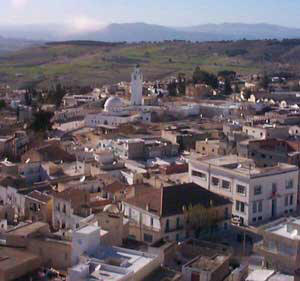
Le Kef, ville oubliée de l'histoire.

Déjà sans aller jusqu’à ce niveau, dans le lycée local, il n’y a pas de salle informatique, le seul cybercafé de la ville étant privé et facturant des sommes exorbitantes aux usagers. Il en faudrait peu pour trouver sur place de quoi équiper chaque écolier d’un cartable et le lycée d’une salle informatique digne de ce nom, la seconde opération pouvant être réalisée pour moins de 300€. Mais je ne peux pas le financer toute seule, d’où ma frustration et ce sentiment d’impuissance qui sont les miens.

En comparaison de l’avenir d’un pays tout entier – le premier pays arabe à avoir évincé son dictateur dans une révolution populaire – le sort d’une seule ville, une ville perdue dans la montagne, peut paraître insignifiant. Mais c’est justement là, dans ce genre d’endroits oubliés de l’histoire, que se jouent les destins des révolutions. C’est lorsque des villes comme Le Kef se sentent soutenues, incluses dans le changement et non exclues de celui-ci, que ce changement qui affecte donc tout un pays est vraiment possible. Sinon, cela donne des violences comme celles qui ont frappé Le Kef début février dernier, des morts, des immeubles brûlés, et la peur, celle qui, s’ajoutant au désespoir, vous tue.

L’ancienne Première Dame américaine Hillary Clinton, aujourd’hui Secrétaire d’Etat, a écrit en 1996 un livre qui s’intitulait Il faut tout un village pour élever un enfant. Moi, je suis convaincue qu’il suffit d’une ville pour soutenir une révolution, et cette ville, je suis bien persuadée que c’est Le Kef.

Cherifa Maaoui (maaoui.cherifa@yahoo.fr) est Officier de Liaison pour le Maghreb du Bureau de Représentation auprès de l’Office des Nations Unies à Genève de l’Association of World Citizens.

Libya: The People’s Revolution on the March

In Current Events, Human Rights, Middle East & North Africa on February 28, 2011 at 7:45 PM

LIBYA: THE PEOPLE’S REVOLUTION ON THE MARCH

By René Wadlow


Along with Tunisia and Egypt, the People’s Revolution is on the march in Libya. In the words of Henry A. Wallace, then Vice-President of the USA in 1942 “The people’s revolution is on the march.  When the freedom-loving people march — when the farmers have an opportunity to buy land at reasonable prices and to sell the produce of their land through their own organizations, when workers have the opportunity to form unions and bargain through them collectively, and when the children of all the people have an opportunity to attend schools which teach them truths of the real world in which they live — when these opportunities are open to everyone, then the world moves straight ahead…The people are on the march toward ever fuller freedom, toward manifesting here on earth the dignity that is in every human soul.

While the People’s Revolution in Tunisia and Egypt was largely non-violent, the revolution if Libya may turn more violent as the last of the palace guard circle around Colonel Qaddafi, his family and a small number of people with tribal ties to him.

Somewhat too late in the day, the U.N. Security Council demanded an embargo on arms sales to Libya.  However, the country has more arms than it can use.  The Security Council also requested the International Criminal Court to investigate if there have been war crimes and crimes against humanity committed in Libya as well as freezing the foreign bank holdings of the Qaddafi family.

The U.N. Human Rights Council, like the Commission on Human Rights, had been silent on human rights violations in Libya for years. In fact, the then Libyan Ambassador, Najat al-Hajjaji, a former wife of one of the Qaddafi sons had chaired the Commission on Human Rights in 2003. There is now discussion of expelling Libya from the Human Rights Council, however the Libyan representatives in both New York and Geneva have resigned in order to join the opposition. At this stage, Colonel Qaddafi is not interested in diplomatic symbols.

The representatives of the European Union are worried, especially of a possible migration of Africans through Libya towards Europe.  Colonel Qaddafi had signed an agreement that he would try to control migration through Libya toward Europe, and he had been given speed boats from Europe to help him in his task.  The Europeans are also worried about energy supplies from Libya, although Libya represents a very small – some 2 per cent – of energy to Europe, easily replaced from other sources.  However, revolution in Libya and unrest in other parts of the Arab world has moved oil prices upward, and they are not likely to go down soon. NATO planners are meeting, reflecting the same worries as those of the EU officials.

The EU and US officials remind one of the aristocrats watching the French Revolution from safety in London or Belgium.  They had not seen that the people were getting tired of the contempt in which they were held, nor that there was a rise of an educated middle class that could take care of itself without the nobles and the clergy.  Likewise many in the Arab world can do without the kings and tribal chiefs, without the higher military officers who played a role of nobles and without the preaching of the Islamic clergy.

Today’s People’s Revolution, like that of France in 1789, is the victory of  an educated middle class bringing  along with it in its current a mass of the unemployed, small merchants, regular soldiers often from the rural farming milieu which has little prospered from modernization.

The question now is how will the young and educated middle class in the Arab world be able to structure a new society based on relative equality and justice.  In each country, there are remains of the old society with some power, some skills, and a continuing sense of their own importance.  We have seen in Tunisia how some of the old structure wanted to continue in power though this was met with continuing street protests.

Creation of new structures in a society is never easy.  Both Tunisia and Egypt face an influx of workers fleeing Libya.  Just as the French Revolution did not have only friends abroad, the People’s Revolution of the Arab world has more sceptical observers saying “what next?” than friends.

The governments, such as those of Algeria, Morocco and Jordan where only the first shocks have been felt are promising “reforms” or “bread and circuses” but probably too little and too late.

The People’s Revolution is just that, the rise of a new people, not yet structured into a real social class.  It has some leaders but rarely on a national level, and interest groups are only partly structured.  This is not chaos except in the sense described by the classical Greek thinker Hesiod who saw chaos, creativity, and transformation working together.  For Hesiod, chaos was not confusion but a richly creative space which flowed from the dual cosmic forces of heaven and earth or as in Chinese philosophy, from Yin and Yang. From this chaos comes new and more mature organization, one with more complexity and greater adequacy for dealing with the challenges of life.

Thus we need to find ways to support the People’s Revolution, to keep an eye open for counter-revolutionary activities and to watch closely as the next structures are put into place.


René Wadlow is Senior Vice President and Chief Representative to the United Nations Office in Geneva of the Association of World Citizens.

Blood in the Sand: A World Citizen Protest to Repression in Libya

In Current Events, Human Rights, Middle East & North Africa on February 23, 2011 at 7:42 PM

BLOOD IN THE SAND: A WORLD CITIZEN PROTEST TO REPRESSION IN LIBYA

By René Wadlow


Surely, I said

Now will the poets sing

But they have raised no cry

I wonder why

Scottsboro, Too, Is Worth Its Song


Countree Cullen


We, citizens of the world, determined to safeguard future generations from war, poverty, injustice, and environmental degradation, have always stood for a simple yet powerful idea: that humanity on this planet, must think of itself as one society and must unite in developing the basic policies that advance peace with justice.

The Right to Life — a reverence for life — is the core value upon which our efforts for human rights, for the resolution of conflicts, and for ecologically-sound development is based.

Thus, we are encouraged by the waves of efforts for democracy and social justice that are sweeping over North Africa and the Middle East. We salute the courage of those who have brought change and an opportunity for justice in Tunisia and Egypt. The people’s revolution for dignity and social justice is on the march.  The march will not be broken, although the old structures of repression try to hold back the future with force.

We are sad when we note a loss of life in different countries throughout North Africa and the Middle East, nearly always the life of a protester at the hands of the military, the police or militia forces.

We are particularly concerned with the repression and loss of life due to the forces of Colonel Muammar Gaddafi in Libya. Although foreign journalists have been refused entry and Internet and phone lines have been disrupted, we have received reports made in good faith of widespread repression and killings by special commandos and government-sponsored snipers.  These actions seem to constitute a widespread and systematic practice.

Therefore, we first call upon the Government of the Libyan Arab Jamahiriya to uphold universally-recognized human rights and to prevent the disproportionate use of force by its agents.

Secondly, we call upon the Member States of the U.N. Human Rights Council, which has the duty to address situations of the systematic violation of human rights, to organize an Emergency Special Session to mandate a fact-finding team of independent experts to collect information on possible violations of international human rights law.

Thirdly, we call upon the representatives of Non-Governmental Organizations and other representatives of civil society to raise their voices so that all will hear their determination to protect the Right to Life and Human Dignity.

When in 1931 in the USA, the Scottsboro Boys — a group of nine Blacks — were tried for rape in Alabama under conditions which  prevented a fair trial, the poet Countree Cullen was listening for the voices of protest, for the calls for justice, but he heard no such cries and wondered why.

Let it not be said of us that when the blood of protesters in Libya flowed int the sand, no cries were heard.


René Wadlow is Senior Vice President and Chief Representative to the United Nations Office in Geneva of the Association of World Citizens.