By Lawrence Wittner
Allen Pietrobon, Norman Cousins: Peacemaker in the Atomic Age.
Baltimore: Johns Hopkins University Press, 2022
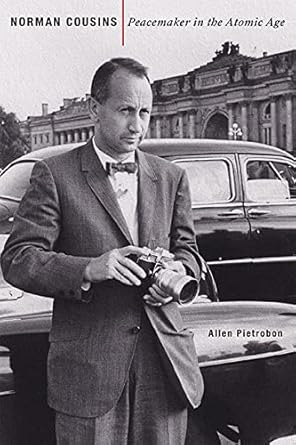
Although Norman Cousins was a major figure in U.S. and world affairs during his lifetime (1915-1990), this is the first book-length biography of that extraordinary individual.
The book, written by Allen Pietrobon, an Assistant Professor of Global Affairs at Trinity Washington University, argues that, unlike many peace activists during the Cold War, Cousins had “an enormous impact on domestic politics and international relations.” The key to this impact, Pietrobon observes, was Cousins’s role, for 35 years, as editor of the Saturday Review, which he built into the third most popular public affairs magazine in the United States, with a circulation of 650,000. This role enabled him to have a significant impact upon public opinion and, also, to build up a network of connections with prominent individuals, including Adlai Stevenson, Nikita Khrushchev, Pope John XXIII, Albert Schweitzer, Norman Thomas, Jawaharlal Nehru, John F. Kennedy, Martin Luther King, Jr., and many more.
According to Pietrobon, the atomic bombing of Japan set the course for Cousins’s peace advocacy. That bombing, Cousins wrote in Modern Man Is Obsolete, “marked the violent death of one stage in man’s history and the beginning of another.” It meant that war, which had persisted throughout human history, finally had to be ended, for, given the advent of nuclear weapons, the alternative was global suicide. And war could only be ended, Cousins maintained, by establishing a world government.
Naturally, then, Cousins, gravitated toward aiding victims of the atomic bombing, promoting world federalism (for example, leading United World Federalists and, later, the World Federalist Association), founding and co-chairing the National Committee for a Sane Nuclear Policy (SANE), brokering the Partial Test Ban Treaty of 1963, and improving East-West relations. In addition, he sought to end the wars in Vietnam and Biafra and, from 1948 to 1964, gave an estimated 2,100 speeches for peace. He also worked to assist victims of Nazi “medical experiments,” prepared speeches for U.S. presidential candidates and presidents, and from 1940 to 1964 alone, published just under 600 editorials and wrote or edited ten books.
In compiling this excellent account of Cousins’ busy and productive life, Pietrobon has drawn upon Cousins’s lengthy correspondence (located at UCLA), his extensive published writings, interviews with his daughters, and relevant manuscript materials at U.S. presidential libraries, the German Federal Archives, and Princeton University.
Although Pietrobon has done an outstanding job of pulling together many facets of Cousins’s extraordinary career and grounding them in the relevant sources, some areas would have benefited from further exploration. For example, Cousins was probably the most important figure in the history of SANE and of the U.S. branch of the world federalist movement. And yet his role in many of SANE’s internal operations―including its ordeal over the role of Communists in its ranks―is not examined. Nor, for that matter, is his presidency of the World Federalist Association from 1976 to 1990.
Overall, though, readers will learn much from this fine study of one of the most prominent figures in the 20th century peace movement.
Lawrence Wittner (http://lawrenceswittner.com) is Professor of History Emeritus at SUNY/Albany.
 Association of World Citizens