By René Wadlow
E.G. Vallianatos, Fear in the Countryside: The Control of Agricultural Resources in the Poor Countries by Nonpeasant Elites.
Cambridge. MA: Ballenger Publishing Co. 1976, 180pp.
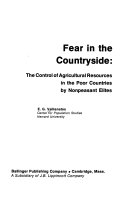
E.G. Vallianatos, a former member of the United Nations (UN) Secretariat, shows the connection between the lack of power and the lack of productivity. He highlights that most economic and political power in developing countries is concentrated in urban areas. Agrarian structures and access to essential resources often do not favor the majority of rural people, especially the poorest groups. Policies on development priorities and allocation of resources and services often help the politically powerful urban sector. An increasing amount of rural productive land is falling under the control of urban elites.
One answer to why the rural poor stay poor is that they rarely are well organized so as to be able to participate meaningfully in decision-making. Especially the least powerful among the rural poor – the tenant farmers, the landless laborers, members of tribal societies – are the least well organized, the most easily divided and blocked.
Social change is inevitably a challenge to the status quo. No development project, no matter how small or how technical, is without an impact on the distribution of power. A new well dug in a village is not simply an added social service. The new well calls into question the power of those who controlled the access to water prior to digging the new well.
If measures are not taken to facilitate the peaceful participation of the rural poor, it is likely that the rural poor will turn to armed violence, thus creating fear in the countryside. Non-violent techniques have been used to organize the powerless in rural areas. One of the first efforts of Mahatma Gandhi on his return to India from South Africa was to investigate and then mediate in the struggle of the indigo pickers. Cesar Chavez in the USA was a leading advocate of non-violence in his efforts to organize agricultural workers. The Sarvodoya Movement in Sri Lanka has applied the Buddhist values of compassion to construct a social and economic infrastructure based on a strong community spirit. There is a need to study the wide range of situations and the opportunities for constructive action.
Prof. René Wadlow is President of the Association of World Citizens.
 Association of World Citizens