The Official Blog of the

Archive for 2012|Yearly archive page

Does the Non-Aligned Movement Still Matter?

In Africa, Anticolonialism, Asia, Cultural Bridges, Current Events, Middle East & North Africa, United Nations, World Law on August 27, 2012 at 11:36 AM

DOES THE NON-ALIGNED MOVEMENT STILL MATTER?

by René Wadlow

With Iran taking over the three-year term of the presidency of the Non-Aligned Movement (N.A.M.) at the end of August 2012, the question arises: Does the Non-Aligned Movement still matters in world politics and how will Iran use the presidency?

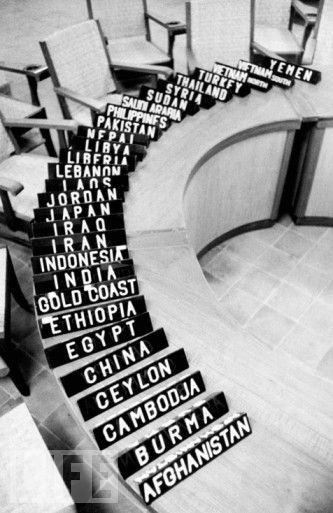
At the time of its founding at the Bandung Conference in April 1955, the major world powers were aligned in Soviet- and United States-led blocs. The war in Korea had recently ended in an armistice with the same frontiers as at the start but could have been the forerunner of a world war. The French war in Indochina had ended with independence of the three Indochina states, but a new independence conflict had just started in Algeria. Basically Bandung marked the end of formal colonialism. As Sir John Kotelawala, Premier of Ceylon (now Sri Lanka), said at the end of the conference “Bandung will be a name to reverberate in history and earn the gratitude and blessings of ages to come.”

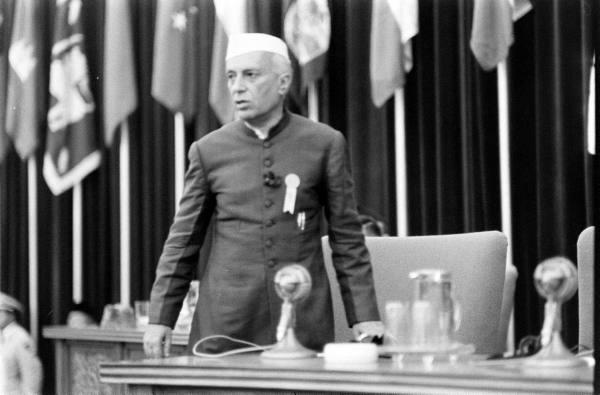
Prime Minister Jawaharlal Nehru of India delivering the closing speech at the Bandung Conference that created the Non-Aligned Movement.

For fear that the new Non-Aligned movement might supplement or weaken the United Nations (UN), no implementary organization was set up. Later, the pattern of three-year rotating presidency was developed, but without a permanent secretariat. The country holding the presidency offers its own diplomats and civil servants to carry on Non-Aligned tasks. The outgoing presidency — Egypt — was so taken up with its own political changes that it virtually played no role on behalf of the N.A.M. Will Iran be able to do more than use the prestige of the Movement to defend its own interests?

In time, the Non-Aligned Movement grew up to become a major player in international relations, providing the Third World with a voice of its own on the world stage.

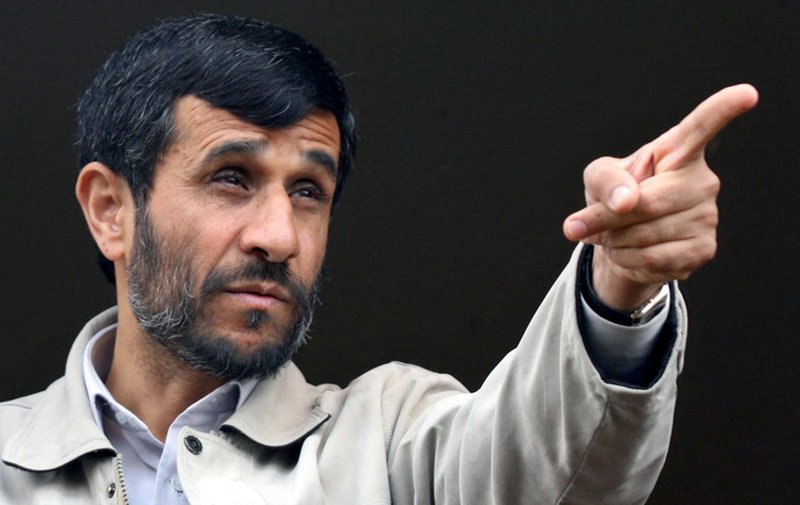
President Mahmoud Ahmadinejad will become the N.A.M. representative for its 118 members. His first presentation will be to the UN General Assembly in September. His talk should be analyzed closely to see if his presentation goes beyond the usual Iranian positions to be more inclusive of the interests of the N.A.M. members. A large conference at the end of August in Tehran will be the formal start of Iran’s presidency. Some Iranian leaders have called for the creation of a permanent secretariat. Thus it will be important to note what structural reforms are made within the N.A.M.

While in 1955, the idea of a “third camp” was a possibility — a wedge of sanity and restraint between the two atomic giants —, now there are real conflicts of interest among the N.A.M. members — the conflict in Syria being a prime example, along with differing territorial claims within the South China Sea among China and its neighbors.

The direct threats issued against the State of Israel by Iran’s President, Mahmoud Ahmadinejad, albeit in response to Israeli Prime Minister Benjamin Netanyahu’s own warmongering rhetoric against Iran, raises serious questions as to what Ahmadinejad can be expected to make of his presidency of the Non-Aligned Movement.

Iran itself is at the center of an international storm, and it is not clear if its diplomats and political leaders will have the energy to deal with the host of current conflicts among N.A.M. states as well as making proposition concerning the important economic, financial and ecological issues that the world faces. Moreover, the N.A.M. states are members of regional, intergovernmental organizations and therefore look less to N.A.M. leadership to structure economic and cultural cooperation.

Yet the N.A.M. does provide a structure for states and a large percentage of the people of the world. N.A.M. leadership has had an erratic relation with non-governmental organizations (NGOs) — sometimes encouraging their participation in meetings and programs and at other times ignoring them completely. Without a permanent secretariat, the N.A.M. has not developed the sort of consultative status that the UN has with NGOs. The Indian government at one stage had encouraged NGO-related activities within the N.A.M. Given the challenges facing the Iranian presidency of the N.A.M. it would be useful for NGOs to propose a more structured and formal relation with the N.A.M. especially if a permanent secretariat is created.

René Wadlow is President and Chief Representative to the United Nations, Geneva, of the Association of World Citizens.

June 8: The Law of the Seize

In Environmental protection, International Justice, United Nations, World Law on June 8, 2012 at 9:44 PM

JUNE 8: THE LAW OF THE SEIZE

By René Wadlow


June 8 of each year has been proclaimed by the UN General Assembly as the Day of the Law of the Sea. However, as my friend John Logue who had participated with me as non-governmental organization representative in the long negotiations — one year in New York, the next in Geneva — said “It should be called the Law of the Seize.”

What had started out in November 1967 with a General Assembly presentation by Ambassador Arivid Pardo of Malta as a call to establish a new political and legal regime for the ocean space ended in August 1980 with a draft convention, a mixed bag of successes and disappointments but which has now been ratified by 162 States.

For world citizens, the quality of the Law of the Sea Convention was of special significance. The greater part of the oceans has been considered res communis, a global common beyond national ownership.  Furthermore, the physical nature of the oceans suggests world rather than national solutions to the increasing need for management of marine resources and the marine environment.

World Citizen Thor Heyerdahl was one of those who called attention to the dangers of ocean pollution coming to Geneva to speak for world citizens during the Law of the Sea negotiations.  The oceans and the seas remind us that the planet and not the State should be our focus.  A holistic view of life arises from our interdependence as a species and our dependence on the life system of nature.  World citizens have stressed that a balanced, sustainable eco-system will only emerge if our political, economic and ethical policies coincide in building a more stable, a more peaceful, in short, a more human planet.

Thus, if there is to be a qualitative jump in the awareness of the earth as our common home, the rules for the management of the oceans was a real possibility. However, the UN Law of the Sea Conference was first and foremost a political conference with over 160 States participating.  From the outset of the Conference, it was agreed that the Convention had to be drafted by consensus in order to create a political and legal system for the oceans accepted to all — to manage what Arivid Pardo had called “the common heritage of mankind.”

During the negotiations, there were groupings that cut across the Cold War divisions of the times, especially within a group called “the landlocked and geographically disadvantaged countries.” There were also informal groups of persons who acted in a private capacity, a mixture of NGO representatives, legal scholars, and diplomats who prepared suggestions on many of the issues of the Conference such as the economic zones, the continental shelf, scientific research, marine pollution and dispute settlement.  These propositions were taken seriously by the government negotiators, in part because few diplomats had the technical knowledge needed for making decisions on technical subjects as well as the creation of a new international organization, the Seabed Authority.

However, in practice, government negotiators are more used to working for the “national interest” and in defending the idea of “territory” both on land and on the sea.  Boundary-making is a primordial activity.  Various theories have been advanced to explain why, many of them derived from our animal ancestors. However ocean boundary problems are more difficult than building a wall on land. Thus as Douglas Johnston and Mark Valencia write “The forces of nationalism were too strong to be swayed by Pardo’s appeals to international cooperation and technocratic rationality.  Instead the coastal states, developed and developing alike, saw in the newly available ocean areas an unexpected windfall, offering the prospect of a previously unimagined extension of their natural resource base. The economic goal of national autonomy had prevailed over the interest in global cooperation, setting in motion the processes of establishing vast national enclosures of offshore areas, especially those enclosures consonant with the new exclusive economic zone (EEZ) regime.  International cooperation had yielded to national autonomy.” (1)

“Ye free man, thou shall always cherish the sea!”
– Charles Baudelaire, French poet (1821-1867)

Conflicts over national sea boundaries are particularly strong in the Pacific Ocean among China, Vietnam, the Philippines, Japan, Taiwan and Cambodia with India and Indonesia watching closely.  The disputed arise largely because of the claims of territorial waters around small islands claimed as national territory. Most of these islands are not inhabited, but are claimed as the starting point of “territorial waters”.

Originally, the disputes concerned exclusive fishing rights within national territorial zones.  Now the issues have become stronger as it is believed that there are oil and natural gas reserves in these areas.

As Krista Wiegand writes concerning China’s dispute with Japan but which is also largely true of China’s policy with the other Asian countries “China’s current strategy to negotiate with Japan over joint development of natural gas and oil resources outside the disputed zone seems to be the most rational strategy it can take in the disputes.  Rather than dropping its territorial claim, China continues to maintain its claim for sovereignty, while at the same time benefiting from joint development of natural gas resources.  By maintaining the territorial claim, China also sustains its ability to confront Japan through diplomatic and militarized conflict when other disputed issues arise.” (2)

Territorial sea disputes can be heated up or cooled off at will or when other political issues require attention.  We are currently in a “heating up” stage. Thus for 8 June in honour of the Law of the Sea we can consider how best to resolve territorial disputes by having a wider view of the common heritage of mankind.

Notes

1)         Douglas M. Johnston and Mark J. Valencia, Pacific Ocean Boundary Problems (Dordrecht: Martinus Njihoff Publishers, 1991, 214pp.)

2)      Krista E. Wiegand, Enduring Territorial Disputes (Athens, GA: University of Georgia Press, 2011, 340pp.).


René Wadlow is President and Chief Representative to the United Nations Office at Geneva of the Association of World Citizens.

Supporting Young Syrians who Say “Stop the Killing!”

In Conflict Resolution, Current Events, Human Rights, Middle East & North Africa, Solidarity, The Search for Peace, United Nations, World Law on May 26, 2012 at 3:07 PM

SUPPORTING YOUNG SYRIANS WHO SAY “STOP THE KILLING!”

By René Wadlow

 Image

In early May 2012, there were particularly deadly explosions in Damascus, the capital of Syria, an escalation of a conflict which began over a year ago with nonviolent protests but which spilled over into violence, refugee displacements, and ever deeper division among the people of Syria.

For the moment, the efforts of the League of Arab States and the United Nations have not been able to establish good-faith negotiations or even a permanent ceasefire. Therefore a group of young nonviolent Syrians have created a movement “Stop the Killing,” not related to a political party or a confessional religious group, but which wishes to unite those of good will to stop the violence and to develop a society in which all can contribute.

Therefore, we who are outside Syria, send our support and willingness to cooperate.

I believe in you, and I believe in your destiny.

I believe that you have inherited from your forefathers an ancient dream, a song, a prophecy which you can proudly lay as a gift of gratitude to  those working for a just resolution of the current conflicts.

I believe that it is in you to be good citizens.

And what is it to be a good citizen?

It is to acknowledge the other person’s rights before asserting your own, but always to be conscious of your own.

It is to be free in word and deed but it is to know that your freedom is subject to the other person’s freedom.

It is to know that killing will never bring a society of justice and harmony. A just and nonviolent society is the fruit of wisdom and love. Therefore let love, human and frail, command the coming day.


Rene Wadlow, a member of the Fellowship of Reconciliation and of its Task Force on the Middle East, is President and Chief Representative to the United Nations Office at Geneva of the Association of World Citizens.

World Citizens Call for Renewed Efforts for a Mali Federation

In Africa, Conflict Resolution, Current Events, The Search for Peace, United Nations, World Law on April 29, 2012 at 10:10 PM

STATEMENT BY THE REPRESENTATIVE OFFICE

TO THE UNITED NATIONS OFFICE AT GENEVA

OF THE ASSOCIATION OF WORLD CITIZENS

WORLD CITIZENS CALL FOR RENEWED EFFORTS

FOR A MALI FEDERATION


In an April 29, 2012 message to H. E. Mr. Ramtane Lamamra, Commissioner for Peace and Security of the African Union, Prof. René Wadlow, President of the Association of World Citizens, called upon the African Union to facilitate the creation of a federation of north and south Mali rather than having the country split into two independent states with unresolved frontier issues.

President Wadlow highlighted the recent meeting of representatives of the 15-member Economic Organization of West African States (ECOWAS) on April 26-27 in Abidjan which set a 12-month deadline for a transition period in Mali after the March 22coup of military officers led by Captain Amadou Sanogo. In response to strong, negative reactions by the international community, on April 7 there was a return to a civilian transitional government. However, the northern half of the country is now controlled by two rival Tuareg groups, the Mouvement national de libération de l’Azawad (MNLA) and the Ansar Dine. The MNLA has declared the northern half to be the independent state of Azawad.

“12 months should be long enough to work out a new constitution which maintains the unity of the country while at the same time providing the needed autonomy to the north and a preservation of the Tuareg way of life.” World Citizens believe in cooperation and in finding solutions based on respect for the positions and values of all the parties in the conflict.

“The Association of World Citizens believes that the Commission for Peace and Security of the African Union is well placed to help in drafting such a new federal constitution, especially as the Commissioner is a former Ambassador of Algeria to the United Nations. In the past, Algeria has played a mediation role between the Tuareg who also inhabit south Algeria and the governments of Mali and Niger where there are larger Tuareg communities.”

The declaration of the independence of north Mali by the MNLA is the first time such a formal proclamation has been made, although the independence of Azawad has always been among the Tuareg demands. Thus, it may be difficult for the Tuareg leadership, now in a position of force, to return simply to promises of greater autonomy within a unified Mali. A federation with clear divisions of authority could be a measure acceptable to both the MNLA and the government in Bamako.

“A crisis is a time for creative efforts. The Association of World Citizens is prepared to be of help with expertise in federal-confederal forms of government in this process.

“A transition period of 12 months may seem like a long time, but given the deep divisions of attitudes among leaders of north and south Mali, the sooner such efforts get underway the better. Support for the goal of a Mali federation on the part of the African Union’s Commission for Peace and Security could be an important part of creating a positive atmosphere in which such constitution drafting could be carried out.”

–   30   –

A New Mali Federation?

In Africa, Anticolonialism, Conflict Resolution, Current Events, The Search for Peace, United Nations, World Law on April 21, 2012 at 9:55 PM

A NEW MALI FEDERATION?

By René Wadlow


Since the fall of northern Mali to the forces of the Tuareg at the end of March 2012, the situation has grown in complexity. The group of young officers, more or less led by Captain Amadou Sanogo, had taken control of the government buildings of the Central Government in Bamako on March 23, but they had little idea of what else to do.

There was an immediate counter-reaction on the part of Western States such as France and the USA who provide most of the financial and technical assistance to Mali. Both France and the USA cut their aid to Mali—a country currently facing a severe drought and food shortages.  Likewise, the 15 states of the Economic Organization of West African States (ECOWAS) called for a speedy return to the civilian government. Captain Sanogo saw the “handwriting on the wall” and agreed to turn over the government to the President of the National Assembly who is the constitutional replacement when the President is absent.

In the meantime, the country is divided into two roughly equal areas—a north with the Tuareg holding the two major cities of Timbuktu and Gao, and the more populated south whose population provides most of the civil service, the army and the agricultural wealth of the country.

The Tuareg along with various armed groups probably from Mauritania, south Algeria and fighters who had been recruited for Libya are divided on what strategy to follow. There are two broad options. The largest group, Mouvement national de libération de l’Azawad (MNLA) wants an independent state of northern Mali (and probably part of the Tuareg-inhabited Niger) to be called Azawad. The second faction, called Ansar Dine, is smaller but is more heavily armed and contains the bulk of armed foreigners. Their stated aim is to take control of all of Mali and to install Islamic law.

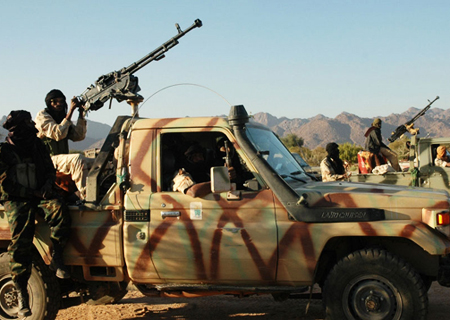
Tuareg rebels near the Sahara desert

Both options have difficulties. Northern Mali as an independent state of Azawad has no natural resources, a small population and few educated people to administer a state or to develop any economy beyond that of camel nomadism. In addition, most African states are opposed to carving up existing states or changing frontiers—a Pandora’s box as many states could be redrawn on ethnic lines and frontiers changed. Thus “territorial integrity” is an article of faith.

Ansar Dine’s option of an Islamist Mali is also difficult to realize. The Bambara and the Malinké are the largest groups in the country and hold economic, military, and political power. Ideologically, they are opposed to the Islamic vision of Ansar Dine, being more Sufi-influenced with a large measure of traditional African beliefs and practices mixed in.(1) Thus the possibility of Ansar Dine gaining support in the south of Mali is slight.  However, they may be able with force of arms to impose their views on Timbuktu and Gao but not on the northern countryside.  The Tuareg are not Islamist by tradition.  Yet in the two cities, the Ansar Dine may be able to force women to cover their hair, prevent the sale of wine and cut the hands of robbers—these three practices being the extent of their knowledge of Islamic law.

Faced with the difficulties of having a northern Malian state—Azawad—accepted by the power-holders of Mali and the neighboring states, there have been some discussions among Tuareg leaders and a former Malian government leader in Nouahchott, Mauritania. There have been no official statements coming from these talks, in part because both north and south Mali are in administrative disorder.  No one knows how much authority the persons involved have.  For the moment, it is probably at best “Track II” diplomacy, trying to see what are the aspirations, the limits of the acceptable, and the degree of the willingness to compromise. In the past France and Algeria have mediated disputes between the Tuareg and the central government of Mali. There have been past agreements on autonomy for the Tuareg.  However, these agreements have rarely held and more centralized government was slowly restored. I believe that this is due more to the incapacity of the Tuareg to provide trained people to run a decentralized administration than ill will or a desire of control on the part of the central government.

Yet, in the past, a “declaration of independence” for northern Mali was never proclaimed. Now that a powerful segment has declared the independence of Azawad, can they go “backward” and accept greater autonomy within a unified Mali?

Echoes from the current Nouachott talks have spoken of a “Federation of Mali”. The name has already been used. The Mali Federation with Senegal was achieved briefly on the eve of independence and lasted for 506 days from April 1, 1959 until August 19, 1960 when it fell apart during the conflict between the President of Senegal, L. S. Senghor and his Prime Minister Mamadou Dia, largely over the division of authority between the two posts.

Because of the way these events occurred, Mali was deprived of its principle outlet to the sea —Dakar, for three years.  Attempts to revive federalism between Mali, Guinea, and Ghana, two other states which had also chosen an anti-colonial “socialist” policy, proved futile.(2) Mali, which had been known as Soudan during the French colonial period, took the name Mali on the suggestion of President Senghor of Senegal from the 14th century empire which covered much of what is today Senegal, Mali and part of Niger.(3)

Can a new Mali Federation of the two sections of the current Mali work better than the earlier Federation of Mali?  With good will and imagination, federalist structures should be able to be worked out. Yet there are times when good will and imagination are in short supply.


Rene Wadlow is the President and Chief Representative to the United Nations, Geneva of the Association of World Citizens.

Notes:

1) See the classic study: Germaine Dieterlen, Essai sur le religion Bambara (Paris,:Presses Universitaires de France,1951)

2) See: Ruth Schachter Morgenthau, Political Parties in French-speaking West Africa (Oxford: Clarendon Press, 1964)

William J. Foltz, From French West Africa to the Mali Federation (New Haven: Yale University Press, 1965)

3) Raymond Mauny, Tableau géographique de l’Ouest africain au Moyen Age (Dakar: IFAN, 1961)

World Citizens Call for Protection of Timbuktu, UNESCO Cultural Heritage Site and Center of Trans-Saharan Cultural History

In Africa, Conflict Resolution, Current Events, Human Development, The Search for Peace, World Law on April 8, 2012 at 8:47 PM

WORLD CITIZENS CALL FOR PROTECTION OF TIMBUKTU,

UNESCO CULTURAL HERITAGE SITE

AND CENTER OF TRANS-SAHARAN CULTURAL HISTORY


By René Wadlow


In an April 8, 2012 Appeal to Irina Bokova, Director-General of the United Nations Educational, Scientific and Cultural Organization (UNESCO), René Wadlow, President of the Association of World Citizens (AWC), welcomed UNESCO’s speedy effort to prevent damage to Timbuktu and called for negotiations between the Mouvement national de libération de l’Azawad (MNLA) and the Ansar Dine, a rival Tuareg group currently holding separate parts of the historic city.  The MNLA, led by its Secretary-General Bilal Ag Cherif, is the larger group and focuses on the creation of an independent state, Azawad, comprising northern Mali and possibly part of the Tuareg-inhabited area of northern Niger.

Ansar Dine, a smaller faction, is led by Ag Ghaley. It claims to want to create an Islamic state within all of Mali. Within or alongside Ansar Dine are Islamists from Algeria and Mauritania and probably other countries.  Some had been fighting in Libya and are heavily armed.  The aim of moving south toward non-Tuareg areas is, no doubt, unrealistic as Ansar Dine has no support in the more densely-populated south, inhabited by Bambara and Malenke ethnic groups. However, there could be an armed struggle for power between the MNLA and Ansar Dine in which the fragile, backed mud building of Timbuktu could be destroyed or badly damaged.
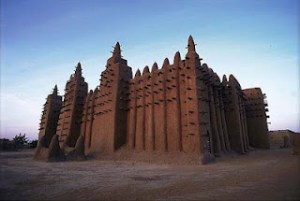
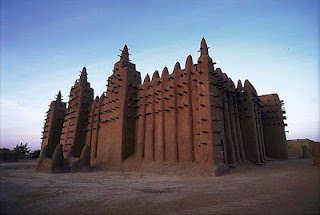
Timbuktu, a jewel of African culture and history, stands proud and tall in the desert sands of Mali.

While Timbuktu was once a metaphor for the middle of nowhere, it was an important city for the trans-Sahara trade from about 800 until 1591 when Moroccan troops destroyed the then Songhai Empire of Mali and Portugal and others developed a sea-going trade that largely replaced the trans-Sahara trade. (1). During the time that trade flourished, scholars and religious preachers were attracted to Timbuktu and Gao, the other trans-Sahara “port” and learning was highly developed.

The protection of Timbuktu’s cultural wealth may depend a good deal on the role of non-governmental organizations to facilitate negotiations between the MNLA the Ansar Dine and possible other armed groups. For the moment, the political situation in Mali is confused, and the protection of cultural sites in Timbuktu must not rank very high on the list of priorities.

From March 22 until April 6, 2012, a military group of young officers had taken control of government buildings in Bamako claiming that the government of President Amadou Touré was incompetent in the struggle against the Tuareg.  The coup was more or less led by Captain Amadou Sanogo, who had been trained by the United States (U. S.) Marine Corps, but Sanogo was probably acting on his own and not on behalf of the U. S. Marines.  The negative reaction to the coup was speedy.  Led by France, the former colonial power, the United Nations Security Council decided on April 4 to issue a President’s Statement (less strong than a resolution but on which all states must be in agreement) calling for a restoration of the civilian government.  It is not likely that the civilian-led government of President Touré will be restored.  Touré was himself a former general who had come to power in a coup, then governed in a fairly democratic way but without making many socio-economic advances.  The country now faces a food crisis due in part to drought and in part to the lack of improvements in the agricultural production and distribution system.

While the UN Security Council was meeting, the 15-member Economic Organization of West African States (ECOWAS) also met, calling for a return to a civilian government and closing the frontiers.  During the ECOWAS meeting, it was decided to activate the Anti-Terrorism Centre which is located at Tamanarasset in south Algeria and to place some 2000 soldiers on alert. Captain Amadou Sanogo saw the “handwriting on the wall” and agreed to turn over the government to the President of the National Assembly who is the constitutional replacement when the President is absent.
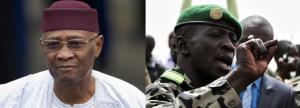
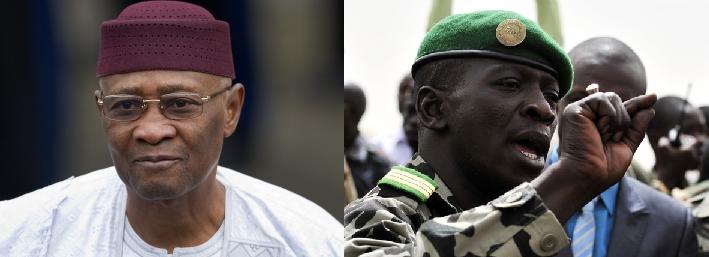
President Amadou Touré of Mali (left) and his rival, Captain Amadou Sanogo of the Mali military (right).

The states in the UN Security Council and in ECOWAS refused to recognize the creation of the Tuareg state of Azawad, so it is unlikely that they will provide any mediators to negotiate between MNLA and Ansar Dime or to facilitate the protection of historic sites. There is on the part of many governments a dislike of carving up existing countries in order to create new states. It took fighting from 1982 to 2005 for there to be an agreement to create the new state of South Sudan and for other African states to agree to the division.

The military in Bamako do not seem organized or willing to die to retake northern Mali, especially since most of the Mali military are from the Bambara ethnic group with little attachment to northern Mali in any case.

Much of the initiative for the protection of educational and cultural institutions has come from the NGO world and world-mined artists. Early efforts were undertaken by Nicholas Roerich (1874-1947) a Russian and world citizen.  Nicholas Roerich had lived through the First World War and the Russian Revolution and saw how armed conflict can destroy works of art and cultural institutions.  For Roerich, such institutions were irreplaceable and their destruction was a loss for all humanity.  Thus, he worked for the protection of works of art and institutions of culture in times of armed conflict. He envisaged a universally-accepted symbol that could be placed on educational institutions in the way that a red cross had become a widely-recognized symbol to protect medical institutions and medical workers.  Roerich proposed a “Banner of Peace” — three red circles representing the past, present, and future — that could be placed upon institutions and sites of culture and education to protect them in times of conflict.

Roerich mobilized artists and intellectuals in the 1920s for the establishment of this Banner of Peace.  Henry A. Wallace, the US Secretary of Agriculture and later Vice-President was an admirer of Roerich and helped to have an official treaty introducing the Banner of Peace — the Roerich Peace Pact — signed at the White House on April 15, 1935 by 21 States in a Pan-American Union ceremony. At the signing, Henry Wallace on behalf of the USA said “At no time has such an ideal been more needed. It is high time for the idealists who make the reality of tomorrow, to rally around such a symbol of beauty, science, education which runs across all national boundaries to strengthen all that we hold dear in our particular governments and customs. Its acceptance signifies the approach of a time when those who truly love their own nation will appreciate in addition the unique contribution of other nations and also do reverence to that common spiritual enterprise which draws together in one fellowship all artists, scientists, educators and truly religious of whatever faith.”
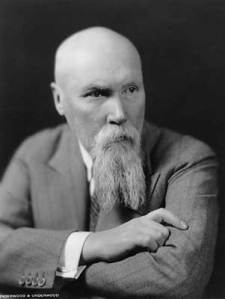
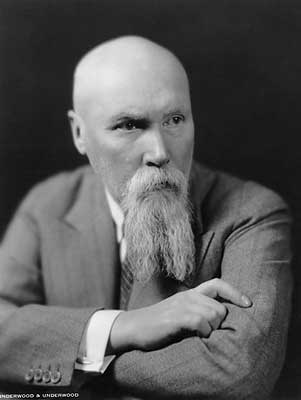
Nicolas Roerich (1874-1947), the man who opened the drive to make protection of works of art a full-fledged part of the law of armed conflict.

After the Second World War, UNESCO has continued the effort, and there have been additional conventions on the protection of cultural and educational bodies in times of conflict.  The most important is the 1954 Hague Convention for the Protection of Cultural Property in the Event of Armed Conflict. The spirit of the Hague Convention is clear and the protection of cultural and educational institutions should be a priority in conflicts among States or in civil wars even if no State recognizes Azawad.

Therefore we, as World Citizens, all have a duty to articulate more clearly the crucial link among human rights standards, humanitarian law, and world law to protect educational and cultural institutions in times of conflict.  As Nicholas Roerich said in a presentation of his Pact “The world is striving toward peace in many ways, and everyone realizes in his heart that this constructive work is a true prophesy of the New Era.  We deplore the loss of libraries of Louvain and Oviedo and the irreplaceable beauty of the Cathedral of Rheims.  We remember the beautiful treasures of private collections which were lost during world calamities.  But we do not want to inscribe on these deeds any words of hatred. Let us simply say: Destroyed by human ignorance — rebuilt by human hope.

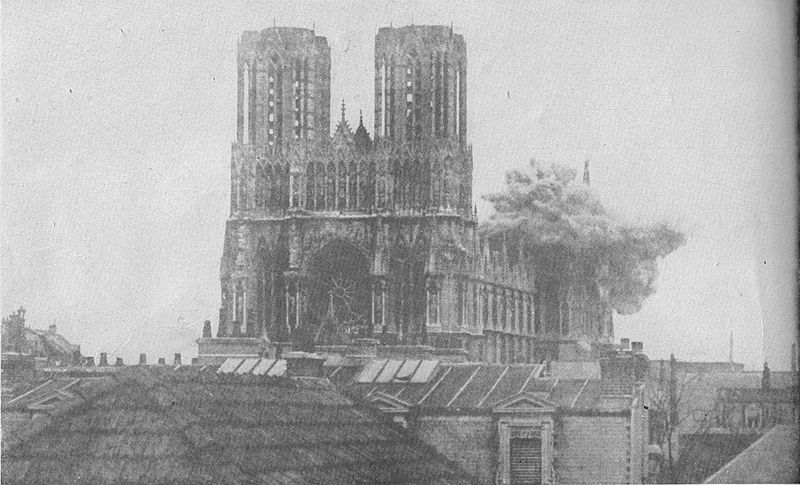
In 1914, a shell explosion at the Cathedral of Rheims in the early times of World War I.
Almost a century later, can the world possibly let Timbuktu become a "casualty of war" too?


René Wadlow is President and Chief Representative to the United Nations Office at Geneva of the Association of World Citizens.


(1)   See  Raymond Mauny Tableau géographique de l’Ouest africain au Moyen Age (Dakar, IFAN, 1961, 587 pp.)

In English : Horace Miner, The primitive city of Timbuctoo (Princeton: Princeton University Press, 1953, 297pp.)
March 8 – International Day of Women: Women as Peacemakers

In Conflict Resolution, Human Rights, The Search for Peace, United Nations, Women's Rights, World Law on March 7, 2012 at 10:37 PM

MARCH 8 – INTERNATIONAL DAY OF WOMEN:

WOMEN AS PEACEMAKERS

By René Wadlow


It is only when women start to organize in large numbers that we become a political force, and begin to move towards the possibility of a truly democratic society in which every human being can be brave, responsible, thinking and diligent in the struggle to live at once freely and unselfishly.


March 8 is the International Day of Women first proposed by Clara Zetkin (1857-1933) at the Second International Conference of Socialist Women in Copenhagen in 1911.  Zetkin, who had lived some years in Paris and active in women’s movements there was building on the 1889 International Congress for Feminine Works and Institutions held in Paris under the leadership of Ana de Walska. De Walska was part of the circle of young Russian and Polish intellectuals in Paris around Gerard Encausse, a spiritual writer who wrote under the pen name of Papus. For this turn-of-the-century spiritual milieu influenced by Indian and Chinese thought, ‘feminine’ and ‘masculine’ were related to the Chinese terms of Yin and Yang. Men and women alike have these psychological characteristics. ‘Feminine’ characteristics or values include intuitive, nurturing, caring, sensitive, relational traits, while ‘masculine’ are rational, dominant, assertive, analytical and hierarchical.

Clara Zetkin (1857-1933), a woman who changed the world.

As individual persons, men and women alike can achieve a state of wholeness, of balance between the Yin and Yang.  However, in practice ‘masculine’ refers to men and ‘feminine’ to women.  Thus, some feminists identify the male psyche as the prime cause of the subordination of women around the world.  Men are seen as having nearly a genetic coding that leads them to ‘seize’ power, to institutionalize that power through patriarchal societal structures and to buttress the power with masculine values and culture.

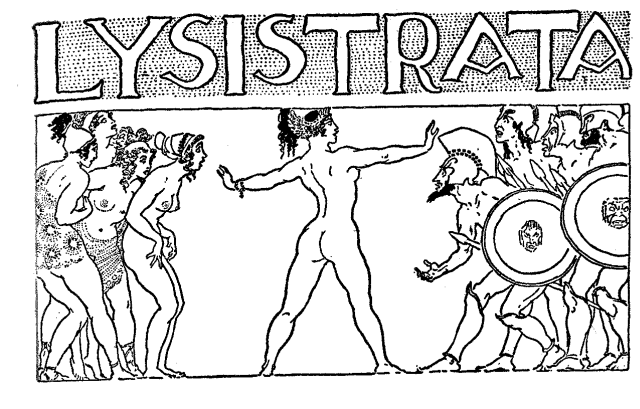
One of the best-known symbols of a woman as peacemaker is Lysistrata, immortalized by Aristophanes, who mobilized women on both sides of the Athenian-Spartan War for a sexual strike in order to force men to end hostilities and avert mutual annihilation.  In this, Lysistrata and her co-strikers were forerunners of the American humanistic psychologist Abraham Maslow who proposed a hierarchy of needs: water, food, shelter, and sexual relations being the foundation. (See Abraham Maslow The Farther Reaches of Human Nature) Maslow is important for conflict resolution work because he stresses dealing directly with identifiable needs in ways that are clearly understood by all parties and with which they are willing to deal at the same time.

Addressing each person’s underlying needs means you move toward solutions that acknowledge and value those needs rather than denying them.  To probe below the surface requires redirecting the energy towards asking ‘what are your real needs here? What interests need to be serviced in this situation?’ The answers to such questions significantly alter the agenda and provide a real point of entry into the negotiation process.

It is always difficult to find a point of entry into a conflict, that is, a subject on which people are willing to discuss because they sense the importance of the subject and all sides feel that ‘the time is ripe’ to deal with the issue.  The art of conflict resolution is highly dependent on the ability to get to the right depth of understanding and intervention into the conflict.  All conflicts have many layers.  If one starts off too deeply, one can get bogged down in philosophical discussions about the meaning of life. However, one can also get thrown off track by focusing on too superficial an issue on which there is relatively quick agreement.  When such relatively quick agreement is followed by blockage on more essential questions, there can be a feeling of betrayal.

Lysistrata's message to the "men at war" from Athens and Sparta was clear as could be: No peace, no sex!

Since Lysistrata, women, individually and in groups, have played a critical role in the struggle for justice and peace in all societies. However, when real negotiations begin, women are often relegated to the sidelines.  However a gender perspective on peace, disarmament, and conflict resolution entails a conscious and open process of examining how women and men participate in and are affected by conflict differently.  It requires ensuring that the perspectives, experiences and needs of both women and men are addressed and met in peace-building activities.  Today, conflicts reach everywhere.  How do these conflicts affect people in the society — women and men, girls and boys, the elderly and the young, the rich and poor, the urban and the rural?

I would stress three elements which seem to me to be the ‘gender’ contribution to conflict transformation efforts:

1) The first is in the domain of analysis, the contribution of the knowledge of gender relations as indicators of power. Uncovering gender differences in a given society will lead to an understanding of power relations in general in that society, and to the illumination of contradictions and injustices inherent in those relations.

2) The second contribution is to make us more fully aware of the role of women in specific conflict situations.  Women should not only be seen as victims of war: they are often significantly involved in taking initiatives to promote peace.  Some writers have stressed that there is an essential link between women, motherhood and non-violence, arguing that those engaged in mothering work have distinct motives for rejecting war which run in tandem with their ability to resolve conflicts non-violently. Others reject this position of a gender bias toward peace and stress rather that the same continuum of non-violence to violence is found among women as among men.  In practice, it is never all women or all men who are involved in peace-making efforts.  Sometimes, it is only a few, especially at the start of peace-making efforts.  The basic question is how best to use the talents, energies, and networks of both women and men for efforts at conflict resolution.

3) The third contribution of a gender approach with its emphasis on the social construction of roles is to draw our attention to a detailed analysis of the   socialization process in a given society.  Transforming gender relations requires an understanding of the socialization process of boys and girls, of the constraints and motivations which create gender relations. Thus, there is a need to look at patterns of socialization, potential incitements to violence in childhood training patterns, and socially-approved ways of dealing with violence.

Former Chilean President Michelle Bachelet, now the Executive Director of UN Women, addressing a meeting of the UN Security Council marking the 10th anniversary of landmark resolution 1325 on women, peace and security (October 26, 2010).

Awareness that there can be ‘blind spots’ in men’s visions is slowly dawning in high government circles.  The U.N. Security Council, at the strong urging of non-governmental organizations (NGOs), on October 31, 2000 issued Resolution 1325 which calls for full and equal participation of women in conflict prevention, peace processes, and peace-building, thus creating opportunities for women to become fully involved in governance and leadership.  This historic Security Council resolution 1325 provides a mandate to incorporate gender perspectives in all areas of peace support.  Its adoption is part of a process within the UN system through its World Conferences on Women in Mexico City (1975), in Copenhagen (1980), in Nairobi (1985), in Beijing (1995), and at a special session of the U.N. General Assembly to study progress five years after Beijing (2000).

There is growing recognition that it is important to have women in politics, in decision-making processes and in leadership positions. The strategies women have adapted to get to the negotiating table are testimony to their ingenuity, patience and determination. Solidarity and organization are crucial elements.   March 8: International Day of Women is a reminder of the steps taken and the distance yet to be covered.


René Wadlow is President and Chief Representative to the United Nations Office at Geneva of the Association of World Citizens.

Kunlabora Spirito kaj Ĝiaj Multaj Elmontriĝoj

In AWC Esperanto Division, Environmental protection, Human Development, Solidarity, The Search for Peace, United Nations, World Law on January 25, 2012 at 10:20 PM

KUNLABORA SPIRITO KAJ ĜIAJ MULTAJ ELMONTRIĜOJ

de René Wadlow

esperantigite de Bernard Henry


La Ĝenerala Asembleo de Unuiĝintaj Nacioj (UN), en ĝia Rezolucio A/RES/64/136, konsekris 2012 kiel Internacia Jaro por Kooperativoj, celante antaŭenmeti la larĝan rolon kiun kooperativoj ludas en ekologiema disvolvo kaj malapliigo de malriĉeco. Kiel diris UN-Ĝeneralsekretario Ban Ki-moon, “Kooperativoj estas rememorigilo al la internacia komunumo, ke eblas ja celi al kaj ekonomia kaj sociala respondeco”. La kooperativa movado ludas larĝan rolon en ambaŭ la produkado kaj la disdono de komercaĵoj kaj servoj tra la mondo. Kvankam malpli videblaj ol private posedataj, transnaciaj korporacioj (kiuj havas larĝajn reklambuĝetojn kaj tiel igas siajn komercaĵojn neĉirkaŭpaseblaj), kooperativoj estas grava parto de la monda ekonomio kaj meritas la atenton kiun la UN-jaro kapablas alporti (1).

Tamen, malantaŭ kooperativoj de produkado kaj disdono, loĝas unuavice “Kunlabora Spirito” kiu elmontriĝas laŭ multegaj manieroj, kiuj estas ĉiuj bazitaj sur kunlaboro sed ne ĉiuj nomiĝas “kooperativo”. Kunlabora Spirito substrekas renoviĝon, kunlaboron, mutualan helpon, kaj komunecon kiel “tagordo” je la surloka, nacia, kaj monda niveloj. Kunlaboro estas nepra neceso por la venontaj paŝoj en homa evoluo.

Kunlabora Spirito aperas en multaj formoj. Homoj tra la mondo pli kaj pli ekkonscias, ke ĉiuj el ni estas interligitaj kun aliaj personoj, per la aero kiujn ni spiras kaj akvosistemoj, la grundo kaj ĉiuj vivoformoj. Ju pli ni povas plipovigi unu la alian por ekflori sen noci al aliaj, des pli ni kreas mondan kunlaboran socion. Tial ĉiu ago de la individuo – aŭ neago – povas havi forserĉajn konsekvencojn ambaŭ por ĉiuj homoj en la mondo kaj por la naturmedio je kiu ni ĉiuj dependas.

Kunlabora Spirito evidentiĝas en la kreskaj zorgoj de Verda – ekologiema – Ekonomio. Eŭropo subtenas komercan kaj kunlaboran disvolvon de karbonmalpliigaj teknologioj kun miksaĵo de registara investado, impostosenpezoj, pruntedonoj kaj leĝoj. Ekzistas agnoskata neceso ŝirmi la naturmedion, investi en puran energion kaj krei daŭripovajn laborpostenojn, sed multo restas por fari en la tuta mondo.

Tra la mondo, ni ĉiuj estas enirantaj periodon de ŝanĝiĝo por kiu estas neniaj antaŭplanoj. Tial nepras ke ni scipovu kunan laboron. La formoj de kunlabora agado fontas el historiaj cirkonstancoj, surloka kulturo, kaj ekologiaj kondiĉoj. Tamen ekzistas komuna zorgo pri kunlabora uzo de naturvivrimedoj, komercaĵoj kaj servoj. Kunlabora agado loĝas en la koro de la ekonomia kaj politika alturno al mondnivela disvolvo de vivrimedoj kaj pli bona vivokvalito.

Ekzistas multaj formoj tradiciaj de kunlaboro, de mutuala helpo en periodoj de manko. 2012 devas utili kiel ŝanco alrigardi la multajn manierojn laŭ kiuj Kunlabora Spirito elmontriĝas en la mondo. Tial 2012 devas esti nia ĉefa interesocentro koncerne al la plifortigo de la konvinkoforto de Kunlabora Spirito.


(1)  Bv vidi la UN-retejon pri la Jaro: http://social.un.org/coopyear


Prof. René Wadlow estas Prezidanto kaj Ĉefreprezentanto ĉe UN en Ĝenevo de la Asocio de la Mondcivitanoj.

Bernard Henry estas la Oficisto pri Eksteraj Rilatoj de la Oficejo ĉe UN en Ĝenevo kaj la Ĝenerala Direktoro de la Esperanto-sekcio de la Asocio de la Mondcivitanoj.

The Cooperative Spirit and its Many Manifestations

In Human Development, Solidarity, The Search for Peace, United Nations, World Law on January 25, 2012 at 10:07 PM

THE COOPERATIVE SPIRIT AND ITS MANY MANIFESTATIONS

By René Wadlow


The United Nations (UN) General Assembly in Resolution A/RES/64/136 has designated 2012 as the International Year of Cooperatives in order to highlight the large role that cooperatives can play in ecologically-sound development and poverty reduction.  As Secretary-General Ban Ki-moon said “Cooperatives are a reminder to the international community that it is possible to pursue both economic viability and social responsibility.”  The cooperative movement plays a large role in both the production and the distribution of goods and services worldwide.  Although less visible than privately-owned trans-national corporations (which have large advertising budgets so their products become household names) cooperatives are an important part of the world economy and merit the attention that the UN Year may provide (1)

However, behind production and distribution cooperatives, there is first a “Cooperative Spirit”, and it manifests itself in a multitude of ways, all of which are based on cooperation but not all are called “cooperatives”. The Cooperative Spirit stresses renewal, cooperation, mutual help, and community as the ‘order of the day’ at the local, national, and world levels.  Cooperation is an absolute necessity for the next steps in human evolution.

The Cooperative Spirit takes many forms. People throughout the world are increasingly realizing that each of us is interconnected with every other person through the air we breathe and the systems of water, soils and life in all its forms.  The more we can empower one another to flourish without harming others, the more we create a cooperative world society. Therefore every action taken by an individual — or not taken — can have far-reaching consequences both for all the people of the world and upon the environment on which we all depend.

This Cooperative Spirit manifests itself in the growing concerns with a Green — ecologically-sound — Economy.  Europe has encouraged commercial and cooperative development of carbon-reducing technologies with a mix of government investment, tax facilities, loans and laws.  There is a recognized need to protect the environment, to invest in clean energy and to create lasting jobs, but much more needs to be done worldwide.

Throughout the world, we are all entering a period of change for which there is no blueprint.  Therefore it is essential that we learn to work together cooperatively.  Cooperative action takes its forms due to historical circumstances, local culture, and ecological conditions.  However, there is a common concern with the cooperative use of resources, goods and services.  Cooperative action is at the heart of an economic and political shift toward a worldwide development of livelihoods and greater quality of life.

There are many traditional forms of cooperation, of mutual help in times of need. 2012 should serve as an opportunity to look at the many ways in which the Cooperative Spirit manifests itself in the world. Thus 2012 can be our focus to strengthen the impact of the Cooperative Spirit.

(1)   See the UN website for the Year: http://social.un.org/coopyear


René Wadlow is President and Chief Representative to the United Nations, Geneva, of the Association of World Citizens.

World Citizens Call for Urgent Action to End Human Trafficking — a Modern-Day Slave Trade

In Human Rights, Women's Rights, World Law on January 11, 2012 at 9:05 PM

WORLD CITIZENS CALL FOR URGENT ACTION TO END HUMAN TRAFFICKING — A MODERN-DAY SLAVE TRADE

 By René Wadlow

January 11 was in some countries a “National Day of Awareness on Human Trafficking”. While ‘awareness’ is always a first step, it is action that is needed as was underlined by the Association of World Citizens in a message to the Chairman of the United Nations (UN) Human Rights Council. The recent increase in the scope, intensity and sophistication of trafficking of human beings around the world threatens the safety of citizens everywhere and hinders countries in their social, economic, and cultural development.

The smuggling of migrants and the trafficking of human beings for prostitution and slave labor have become two of the fastest growing worldwide problems of recent years.  From Himalayan villages to Eastern European cities — especially women and girls — are attracted by the prospects of a well-paid job as a domestic servant, waitress or factory worker. Traffickers recruit victims through fake advertisements, mail-order bride catalogues, casual acquaintances, and even family members.

However, trafficking in human beings is not confined to the “sex industry”.  Children are trafficked to work in sweatshops and men to work in the “three Ds jobs” — dirty, difficult, and dangerous.  The lack of economic, political and social structures providing women with equal job opportunities has also contributed to the feminization of poverty, which in turn has given rise to the feminization of migration, as women leave their homes to look for viable economic solutions. In addition, political instability, militarism, civil unrest, internal armed conflicts and natural catastrophes increase women’s vulnerability and can contribute to the development of trafficking.

Trafficking impacts the lives of millions of people — those trafficked and their family members — especially from poorer countries or the poor sections of countries.  Trafficking of persons has become a multi-billion dollar business and ranks right after the trade in drugs and guns. Trafficking is often an activity of organized crime.  In some cases, it is the same organization which deals in drugs, guns and people.  In other cases, there is a “division of labor”, but the groups are usually in contact.

Thus drugs, guns, illegal immigration — these form a nightmare vision of the dark side of globalization with untold human costs. Human trafficking affects women, men and children in their deepest being. It strikes at what is most precious in them: their dignity and their value as individuals.  Trafficked persons experience painful and traumatizing situations which can be with them for the rest of their lives. From recruitment to exploitation, they lose their identity and desperately struggle against a situation that reduces them to objects.

The Association of World Citizens stresses that the fight against human trafficking must be waged in a global and multidimensional way by the UN, regional intergovernmental organizations, by national governments and by non-governmental organizations so that countries of origin, transit and destination develop cooperative strategies and practical action against trade in human beings.  One of the foundations of cooperation is mutual trust. When mutual trust is established, cooperation becomes a natural way to act.

As trafficking in people is more often tolerated by the law enforcement agencies than drugs or guns, there has been a shift of criminal organizations toward trafficking in people.  116 governments have signed a UN-promoted 2000 Protocol to Prevent, Suppress and Punish Trafficking, Especially Women and Children which entered into force in December 2003. However, trafficking in persons is often not a priority for national governments.  Some countries which are important links in the trade of persons such as India, Pakistan, and Japan have not yet signed.

For many governments, trafficking is considered a question of illegal migration, and there is relatively little (in some cases no) consideration of the problems of the individual being trafficked.  Human concern for those caught in the web is a prime contribution of non-governmental organizations.  Concern for physical and mental health is crucial.  There is also an obvious need to deal with the issues which have created these pools of people from which traffickers can draw.  The large number of refugees from Iraq — over two million in Jordan and Syria — await better political and economic conditions in Iraq so they can return home.

Thus, one of the aspects of trafficking in which non-governmental organizations can play a crucial role is the psychological healing of the victims. Unfortunately, the victim’s psychological health is often ignored by governments.  Victims often suffer a strong psychological shock that disrupts their psychological integrity.  The result is a lack of self-esteem after having experienced such traumatizing events.

Within the Association of World Citizens we must not underestimate the difficulties and dangers which exist in the struggle against trafficking in persons nor the hard efforts which are needed for the psychological healing of victims.  However, as World Citizens, we have the opportunity of dealing with a crucial world issue.


René Wadlow is President and Chief Representative to the United Nations Office at Geneva of the Association of World Citizens.